

1866–1894: Hawai`i and Christianity
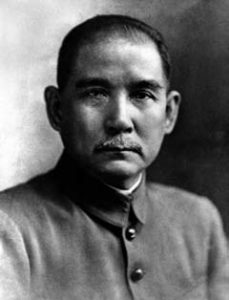
In the world in which Sun Yatsen was born, China had already fought and lost two Opium Wars (1839–42, 1856–60) with Great Britain, leading to “unequal treaties” that gave Westerners privileges in designated treaty ports along China’s Pacific coast. During the same period, a southern Chinese insurgent had led the Christian-influenced, virtually nationwide Taiping Rebellion against the Manchu-led Qing dynasty, an effort that the government finally quashed in 1864. Clearly, the West and its ideas were already leaving their mark on China. Sun Yatsen was born in the village of Cuiheng in the Pearl River Delta, a region with a lengthy history of connections with foreign countries. Indeed, his own elder brother, Sun Mei, immigrated to the Hawai`ian islands in 1871, gradually building up his wealth to the point where he could open a store and, eventually, manage a rice plantation on the island of Mau`i. The young Sun eagerly read Sun Mei’s letters describing Hawai`i—then independent but in- creasingly shaped by Americans—as a prosperous land with a liberal government. Following Sun Mei’s triumphal visit to Cuiheng in 1879, Sun followed him back to Hawai`i and spent the core of his teen years there. Educationally, this became Sun’s second start. His first start had been at Cuiheng’s elementary school with its emphasis on memorization of the Confucian classics. Now, he boarded at Iolani School, which was run by British Anglicans and featured a strong component of prayer services and Bible study. Sun steadily absorbed the school’s message that identified Christianity with progress. Following his graduation from Iolani in 1882, he proceeded to Oahu College, a school with a reputation as the watering hole for the islands’ most ambitious youth. (Interestingly, American President Barack Obama attended this school, renamed Punahou, in the 1970s.) Oahu College was controlled by American Congregationalists who deepened Sun’s interest in Christianity while spurring his curiosity about political science and medicine. Sun Mei, disapproving of Christianity, sent his brother back to Cuiheng the following year. While it is difficult to separate the British and American influences in Sun’s teenage education, it is clear that he emerged with an attraction to Christianity, a respect for republican government, and an appreciation for entrepreneurial self-strengthening. In short, he was smitten with the Anglo-American West as Hawai`i’s upper crust had packaged it. Not long after Sun returned to Cuiheng, his new value system emerged. He and a childhood friend damaged several religious icons in the village, leading the village to expel them temporarily. Sun responded by moving to nearby Hong Kong, then a British colony, and continuing his education there. Before long, he formally converted to Christianity at the hands of Dr. Charles Hager, a young American Congregationalist missionary who subsequently had Sun accompany him on an evangelizing tour. Historian Paul A. Cohen has pointed out that Christianity in nineteenth-century China functioned somewhat like a secret society—viewed by the government as heterodox, it became a semi-underground support network for its members.1 This is certainly how Sun saw it. While his commitment to Christian doctrine and ritual would vary in later years, he consistently turned to Chinese Christians—like himself, marginal figures in Chinese society—whenever he needed immediate assistance. Following a traditional Chinese arranged marriage and further activity in the Pearl River Delta and Hawai`i, in 1887 Sun entered the College of Medicine for Chinese, a Hong Kong institution established by the London Missionary Society. The next several years were dominated by British Protestant contacts. After graduating from this college with distinction in 1892, he sought to establish himself as a doctor successively in Hong Kong, Macao, and Guangzhou (Canton). While in Guangzhou, he decided to appeal to one of the most powerful figures in the Qing government, Viceroy Li Hongzhang. He wrote a lengthy letter seeking Li’s support for his reformist plans for China and traveled north with a friend in hopes of obtaining a personal interview with Li. On their way toward Li’s office in Tianjin, Sun and his friend stopped in Shanghai, where Sun attended church services and became acquainted with Charlie Soong, a Chinese Christian comprador who had spent his teenage years in the American South. As Sun would later marry one of Charlie’s daughters, and his successor Chiang Kai-shek would marry another, the importance of this link is difficult to overstate. As to Sun’s travels northward, his attempt to meet Li was rebuffed, leading him to embrace a revolutionary path as his solution to China’s deteriorating circumstances.By 1904, his followers controlled community newspapers both in Honolulu and San Francisco. In that same year, Sun published an English-language pamphlet in New York City titled "The True Solution of the Chinese Problem."
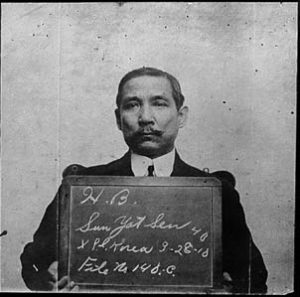
At this juncture, America’s influence on Sun was multiform, consisting of such elements as the example of Hawai`i, the teachings of Christianity, and the accumulation of friends with American connections. This influence would continue and even deepen during the next phase of Sun’s life.1895–1911: Organizing in American Chinatowns
1912–1925: America as Model and Obstacle
As developments in China proceeded rapidly, Sun traveled to Washington, DC, London, and Paris, in hope of obtaining support for the new Chinese government that was taking shape. Instead, he received merely promises of neutrality—and not even so much as a meeting with America’s secretary of state. Nevertheless, he returned to China at the end of the year, taking the position of provisional president of the Republic of China on January 1, 1912. Soon after assuming office, Sun struck a deal with Yuan Shikai, the strongman who had amassed the most military power during the fighting that followed the Wuchang Uprising. According to the deal, Yuan would become president after the emperor abdicated, Yuan declared his support for a republic, Sun resigned, and a newly formed parliament elected him. After these events took place, Yuan indeed became president, and he appointed Sun to be his director of railways. Sun, enthusiastic as ever, drew up plans for a comprehensive rail system for China that took the American system that he was so familiar with as a primary model. Although these plans were not implemented at the time, they testify to Sun’s near-obsession with mobility in all its forms.
Yuan proceeded to become a dictator, and Sun opposed him. When Yuan tried to have himself crowned as emperor of a new dynasty, others opposed him as well and forced him to abandon his plan. For a time, however, it was dangerous to live in China as an open critic of Yuan, leading Sun, along with comprador Charlie Soong and his family, to escape to Japan. Soong’s daughters had received their college education at Wesleyan College in Macon, Georgia, rendering them the first Chinese women to attend college in the US. One daughter, Soong Qingling, was particularly excited by the republican revolution when she received news of it at Wesleyan and was eager to meet Sun in Japan after she graduated. Qingling soon became Sun’s secretary and then his fiancée. They married in 1915 (over Charlie’s vehement objections), and Qingling henceforth became a major advisor for Sun politically. Qingling drew fascinated attention from Chinese at the time because she was often the only woman present at her husband’s political meetings. Sun’s public reliance on Qingling thus displayed his acceptance of controversial ideas of gender parity that some Americans strongly held. Yuan Shikai died in 1916, discredited by his power grab. The next leader— to the extent that China had a leader at all during the chaotic period it now entered—was Duan Qirui, an erstwhile follower of Yuan’s. When the US entered World War I in 1917 on the Allied side, Duan joined it. Sun Yatsen loudly objected. For him, the main Chinese interest in the war was in restraining the power of Great Britain, which had backed Yuan Shikai. This—along with Sun’s apparent receptivity to German offers of assistance—put Sun at loggerheads with the US. When Sun established his own independent state in the far south of China, the US, along with other nations, refused to recognize it, and the American government refused to acknowledge Sun’s political ambitions from this point forward. Despite this, Sun increased his appeals to the US in subsequent years. When Sun’s first state ended in failure in 1918, he moved to Shanghai and turned to writing. In 1920, he established a second state, again based in Guangzhou, that lasted until 1922. This state, too, became mired in the warlord politics of its region and had little effect on China as a whole. In 1923, however, he established a third state in the same area—and this time he had substantial Russian assistance backing him up. Russians previously had their Communist revolution in 1917 and sought to ally the tiny Chinese Communist Party with Sun’s Nationalist Party. Essentially, each side aimed to use the other. From the standpoint of the United States government, however, Sun was too close to— and indeed was a part of—a potentially global Red menace. His sharpened anticolonialist rhetoric, too, gave powerful Americans a negative impression. While Sun may have wanted assistance from various directions, including the US, his embrace of the Soviets limited his options in that regard. In 1924, Sun gave a series of lectures at the Huangpu (Whampoa) Military Academy on his famous Three People’s Principles that summarized his sense of where China stood and what it needed to do. Sun explained these principles—nationalism, democracy, and people’s livelihood—in some depth. In earlier statements, he had already compared the principles to Abraham Lincoln’s famous reference to government of the people, by the people, and for the people.3 Now, he drew on American ideas in some of the specifics he presented with regard to democracy and people’s livelihood, respectively. Sun expressed concern that Western-style democracy sometimes encouraged an attitude of reflexive “opposition to government.”4 Despite this, he saw the need to maintain checks on government officials, and to this end, he recommended elections, initiatives, referenda, and recalls—all mechanisms that he claimed were used in some states in the northwestern US. Sun also held that dividing government into branches helped the government maintain checks on itself. He appreciated the American division of government into legislative, executive, and judicial branches and recommended that China adopt this as well. He amended the system, however, by adding two additional branches from imperial China: examinational (i.e., civil service) and censorial (i.e., impeachment). In short, while Sun did not seek to precisely replicate the American governmental structure in China, he was very willing to incorporate aspects of it into his vision for China’s future. It was in his views on people’s livelihood that Sun displayed most fully the influence of the US. Specifically, he advocated the “single tax” proposal that nineteenth-century American progressive Henry George had set forth. George was especially worried about skyrocketing land prices in the American West, leading him to argue that the government should collect the entire price increase on unimproved land as tax. This, he held, could solve the problem of unreasonable land price increases even as it would remove the need for other taxes. Coastal China had been rocked by rampant land speculation similar to that of the western US, prompting Sun to argue enthusiastically for George’s proposal. Sun did revise the proposal in a more moderate direction; nevertheless, his attraction to George’s ideas was clear through his lengthy and admiring exposition of them.5