The Communist government that controlled Mongolia from 1921 to 1990 contributed to environmental degradation and had a devastating influence on the land, air, and water, as did the development of a mostly unregulated economy after 1990.
Mongolia is the world’s eighteenth-largest country and about three times the size of France. With its relatively limited population, it is the least densely populated country in the world. It has meager arable land and has little productive soil. It has faced, partly due to climate change, an increased frequency in the number of zuds (disastrous winters with almost overwhelming amounts of snow and ice), and its cold climate and short growing season preclude its developing a sedentary agricultural economy.2 Instead, the abundant grasslands in the center of the country are optimal for nomadic pastoralism. The Gobi Desert in the south supports only a small group of herders, while the Altai, Khentii, and Khangai mountains in the north and west limit their living spaces. Approximately 30 percent of the population is composed of herders, but an increasing number are abandoning herding because of pressures to be described later. Mongolia has proven to be fascinating to foreigners, partly due to a romantic view of herders; partly to the purported exploits of Chinggis Khan, the founder of the Mongolian Empire; and also due to its remoteness and its inaccessibility for much of the twentieth century. The small Mongolian population ought to have prevented considerable damage to the environment, but this has not been the case. The land and waters have traditionally been pristine, as most Mongolians have, from earliest times, respected their living spaces. Khans, princes, monks, and the Communist heads of collectives, known as negdels, apportioned animals and grazing grounds to protect the carrying capacities of the steppes. For example, recognizing that goats ate plants down to their roots, which destroyed the grasslands and prevented reseeding, these leaders mandated that sheep outnumber goats in their herds. Nonetheless, despite its miniscule population and vast territory, modern Mongolia has faced environmental problems and challenges in its habitat. Humans are culpable for most of these dilemmas, including increasing desertification. Man-made disasters have generated crises, with harm to water supply, forests, and land. The Communist government that controlled Mongolia from 1921 to 1990 contributed to environmental degradation and had a devastating influence on the land, air, and water, as did the development of a mostly unregulated economy after 1990. The Communist state constructed coal-burning power plants for the capital city of Ulaanbaatar, laid out roads and railways, and initiated open-pit mining, all of which resulted in air pollution and considerable harm to the land. As one observer has written, the various factories and mines established in Darkhan in the Communist period are “not somewhere you would rush to see”3 due to the polluted land and air. Rapid industrialization was the main objective. The Erdenet Mine, a joint Soviet–Mongolian corporation, was built in 1974 to extract copper and molybdenum—and also contributed to pollution. The Soviet and Mongolian Communist governments shared the profits, but private individuals, on occasion illegally, also secured substantial gains. In the post-Communist period, rapid privatization, profiteering, and insufficient government regulations would lead to environmental degradation.Dismantling the Negdels
The collapse of Communism in 1990 overturned the negdels. The negdels, which the Communist government had, with the help of the USSR, initiated in the mid-1950s, eliminated most private ownership of animals. Instead, herders received wages to tend the animals owned by the negdels. In the early 1990s, the USSR, Mongolia’s principal supplier of foreign aid and technical assistance, and most important trade partner, fell apart. The Mongols turned for aid and trade to the International Monetary Fund, the Asian Development Bank, the World Bank, and the US Agency for International Development, which favored privatization and required abolition of the negdels in return for loans and grants. These agencies and the Mongolians who supported them feared a regression to Communism and an all-powerful government, and thus proposed immediate privatization, a market economy, and a state that played a reduced role in the economy—a policy of so-called “shock therapy.” Yet few Mongolians had experience with privatization, and such a rapid transition to a market economy whose institutions and practices were barely known to the population, together with increasing levels of corruption, would impact society and the environment. The negdel leaders were authoritarian, but the collectives had provided trucks to transport animals to market, hay for additional feed, and newspapers and radios that supplied information on climate. They also offered training in herding, constructed and maintained wells, and provided rudimentary health care and education, mostly in boarding schools, for herders’ children. The precipitous abandonment of the negdels in 1990 and 1991 led to serious adverse effects. Within a year or two, the herds were privatized, and a few well-connected government officials and negdel leaders profited from this hurried and chaotic process of shock therapy. Most Mongolians viewed “privatization as an unfair process which distributed state property to relatives, friends, and powerful business groups.”4 A Danish anthropologist offered a similar assessment, “The final privatization process was frequently reported to be chaotic . . . enabling negdel leaders to maintain control over key assets.”5 A small group gained a disproportionate share of the negdels’ animals, trucks, and other equipment. Income inequality accelerated, with a few acquiring thousands of animals, as well as machinery, vehicles, and even laborers to tend the herds, while most scarcely had sufficient animals to eke out a living. Many were forced to abandon herding and move to Ulaanbaatar, the capital city, to find work. The new post-Communist government had a lesser role in the economy and did not have the resources to provide much assistance to herders. The post-Communist government also did not provide the herders with transport of their herds to market, compelling them to move closer to towns to sell their animals and animal products. Because these herdsmen now no longer moved their animals semiannually or even more frequently, they depleted the neighboring grasslands. This situation contributed to desertification. Adding to the difficulties for herders, the chief export market for meat had been the USSR, but the disappearance of the old Soviet state and its decline translated into a two-thirds reduction in its consumption of Mongolian meat. Mongolia’s main market for meat disappeared.Market Economy and Herders
The introduction of a market economy exacerbated the pressure on the environment. Sheepherders, progressively more aware of the initial export market for cashmere, increased the total number of animals, particularly goats, in their herds. This subverted the practice of sheep outnumbering goats, which had been adopted to avert the damage the grazing habits of goats imposed on the grasslands. In 2019, the animal census counted thirty-two million sheep and twenty-nine million goats, an unsustainable number that has and will continue to degrade the pastures. By contrast, in 1989, the negdels had fourteen million sheep, about five million goats, and a total of approximately twenty-five million horses, camels, and bovine. The total number of animals for 2019—seventy million—is astonishing and far beyond the carrying capacity of the land. The existing pasture can accommodate about half that number; seventy million is an overpopulation that will contribute to desertification. The market for cashmere led to an increase in goats, but the demand for cashmere could not sustain the great increase in goats. Herders found themselves with an excess of goats. The National Statistical Office maintains an annual listing of degraded land. It notes that in the fifteen years after the dissolution of the negdels, much land was ruined due to an increase in the size of herds, especially of goats, and the resulting overgrazing. In the years after 2015, the figures have declined somewhat but are still high. In 2019, the figures actually increased to more than 7,000 hectares (17,300 acres) of degraded land. In sum, management of the pasturelands has significantly changed. Privatization, lack of regulations, and government corruption damaged the herding economy. In an introduction to a translation of a herder’s autobiography, the author wrote: “Privatization and the simultaneous decline in state support have heightened the risks faced by herders. Veterinarians have not been as readily available . . . Herders cannot expect the state to help them restock if a bad winter or disease decimates their herds . . . [They also have lost] state support in the forms of digging of wells, provisions of fodder, and trucks for transport, which previously reduced the risks in an exceptionally perilous occupation.”6 The demanding environment of Mongolia required cooperation among herders who faced devastating winters characterized by substantial amounts of snow and ice. These winter zuds (disastrous winters) resulted in the deaths of hundreds of thousands or millions of animals. Herders had generally banded together to protect the remaining herds and had received government aid. Even during normal times, herders often collaborated to round up the animals and to keep them from harm. An anthropologist who spent considerable time in the countryside wrote that “the government has largely ignored rural areas, trusting that herders would pretty much get along all right without state interference . . . In the absence of an overarching political structure . . . responsibility for herding and for contending with climate has shifted almost entirely to individual herding households.”7 Herders who did not have sufficient numbers of animals and who could not rely on government aid abandoned the countryside and moved to Ulaanbaatar or other towns. Some government officials and foreign advisers belatedly recognized the need for cooperation in Mongolia’s countryside. Yet hundreds of thousands of herders had already moved. Recognition by government and international organizations of the importance of cooperatives came too late for these migrants. The government’s lack of attention to the rural areas has also impeded the herder economy in other ways. A paucity of roads in the countryside has prompted travelers to drive vehicles through what one anthropologist has described as the “precious steppe,”8 still another way to degrade the land. The state built some roads, but it has not initiated a campaign to educate drivers concerning the damage in traversing the land with heavy trucks or jeeps. It should be noted that several groups have attempted to protect and restore rangeland. The Green Gold Animal Project, with the support of the Swiss Agency for Development, recognized the dangers of overstocking and worldwide climate change, with higher temperatures and lower precipitation, and has brought back degraded land. It has succeeded, in part, because it has resorted to traditional grazing practices by allowing some land to remain fallow. Yet its laudable efforts are not sufficient to deal with the scope of the problem. Another trend has been community-based rangeland management. Herders, often bound by kinship ties, have increasingly collaborated with local officials to determine claims to land and to avoid conflicts over pasture with others, a promising reversion to greater cooperation in the countryside.9 Damage to the forests in the north and west has been another threat in the countryside. Forests ought to balance the mostly treeless steppes, and the government, recognizing their value, organized Strictly Protected Areas to save the trees, which preserve the water supply, prevent soil erosion, drain natural gas, and maintain the habitat for wildlife. Yet in the aftermath of the collapse of Communism, the state has devoted few resources to these Strictly Protected Areas. The Ministry of Nature and the Environment has received scant funding to combat pests and insects, tree diseases, and in particular wildfires, which have increased in number and intensity, perhaps due to climate change.10 Illegal logging has also contributed to the damage. Herders who did not obtain sufficient animals in the inequitable distribution of the negdels’ assets during the privatization process or whose herds were devastated by zuds (disastrous winters) could not eke out a living. They often turned to the lucrative trade of supplying wood to China and Japan. They cut down trees and smuggled logs to their East Asian neighbors. Others had been turned into paupers because of the inequitable privatization and the loss of most of their animals. They used wood for fuel because they could not afford coal. Even in the Gobi Desert, the poor herders ravaged the unique and rare saksaul plants or trees and used them for firewood. This also harms the limited soil. These practices and conditions had led to a loss of almost 300,000 hectares (741,316 acres) of forested land in 2010, which then decreased to approximately 220,000 (543,631 acres) in 2017 but then dramatically increased to almost 600,000 hectares (1.48 million acres) in 2019.Mongolia’s Rare and Endangered Species
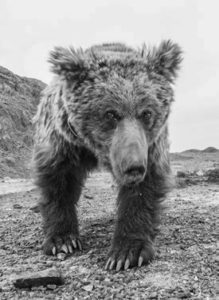
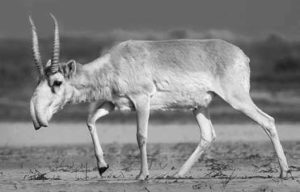
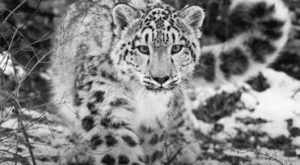
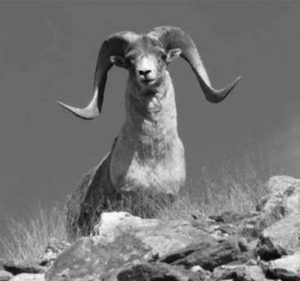
The Strictly Protected Areas were designed to protect rare and endangered species. Yet many of the animals have not been well-preserved.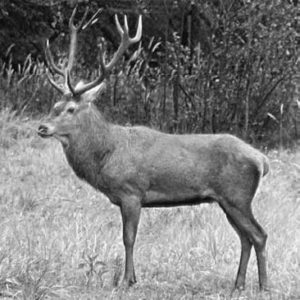
Source: Wikimedia Commons at https://tinyurl.com/5jk9zhv8.
http://www.gobibearproject.org/.
Source: Wikimedia Commons at https://tinyurl.com/jjn55j84.
website at https://tinyurl.com/rkjtkpf6.

Predatory Mining
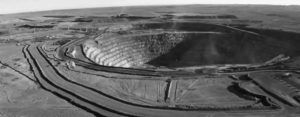
The most serious threat to the environment is mining. Mongolia has substantial reserves of minerals and natural resources, including copper, coal, gold, and even uranium. As early as the 1970s, the USSR and Mongolia cooperated to extract copper and molybdenum from a mine in the town of Erdenet. During the Communist period, Mongolian geologists knew about other deposits, and Eastern European and Mongolian specialists confirmed the presence of such resources, especially in the Gobi Desert. In the post-Communist period, a notorious American–Canadian entrepreneur known as “Toxic Bob” (because his mining operations had generated considerable pollution in the Colorado River) learned about copper, gold, and coal deposits in Oyu Tolgoi in the Gobi Desert. Toxic Bob (or Robert Friedland, his real name) obtained leases for exploration. His Ivanhoe Mining Company rapidly sought investments. In a 2005 speech to investors, he bragged about the stability agreement he was negotiating with the Mongol government. He said the tax would amount to 5 or 6 percent and that he would secure a five-year-tax holiday: “And the nice thing about this, there’s no people around, the land is flat, there’s no tropical jungle, there’s no NGOs, we’re only seventy kilometers [43. 5 miles] from the Chinese border. You’ve got lots of room for waste dumps . . . . ”12Many Mongolians were enraged by Toxic Bob’s blithe assumption that he would despoil the Gobi Desert’s fragile ecosystem.
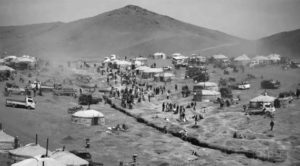
Many Mongolians were enraged by Toxic Bob’s blithe assumption that he would despoil the Gobi Desert’s fragile ecosystem. Demonstrations in Ulaanbaatar compelled him to sell much of his interest in Oyu Tolgoi to Rio Tinto, an Anglo–Australian mining company. But it too has been accused of environmental degradation. The 2009 agreement and subsequent amendments between Rio Tinto and the Mongolian government for mining have fomented controversy and caused corruption. In 2020, S. Bayartsogt, the finance minister who signed the initial agreement, received a ten-year prison sentence for accepting bribes equivalent to US $10 million. S. Bayar, the prime minister who also signed the agreement, was arrested in 2018 and is awaiting trial. Both had secret offshore accounts amounting to millions of dollars, money that probably derived from graft. The agreement they negotiated gave Rio Tinto a 66 percent equity stake and the Mongolian government 34 percent. Mongolia borrowed the money for its partial ownership from Rio Tinto at a relatively high rate of interest. Repayment of the debt will, as of this writing, translate into a lack of dividends until 2051. Mongolia’s GDP increased by 17.3 percent in 2011 and 15.7 percent in 2013, but with the GDP based in large part on mining, it shrank to 1.2 percent in 2016. One reason for the decrease was China’s environmental policy. Concerned about air pollution, China did not import as much coal by 2016. Another reason was that a general economic slowdown led to less Chinese demand for copper that harmed Mongolia’s mining industry, which contributed 83.7 percent of Mongolia’s exports in 2019.13 Disputes with Rio Tinto also contributed to disarray. Rio Tinto’s cost overruns dismayed Mongolian officials because Mongolia was liable for these additional expenses. The initial cost estimate of US $5.1 billion for construction of the mines ballooned to US $7.1 billion and generated conflicts between the two sides. It also remains unclear how many Mongolians profited from these resources.Known as ninjas, the former herders worked under dangerous conditions, and newspapers reported on accidents and even deaths.
documentary, Ninja Miners of Mongolia on YouTube at
https://tinyurl.com/2ueh922w.
Areas on the World Bank website at https://tinyurl.com/4xskmtkb.
Migration to Ulaanbaatar
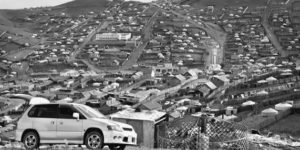
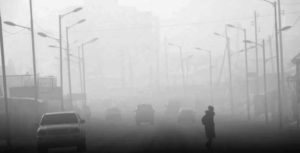
Most of the dispossessed herders moved to Ulaanbaatar, where they contributed to a different type of environmental damage. Zuds (disastrous winters), especially in 2009–2010, and the lack of government support during those times was a primary cause of former herders’ migration to the capital. Such zuds have occurred more frequently than in the early to mid-twentieth century and have placed great strains on Ulaanbaatar. The capital had a 1950 population of 62,000 that increased to 575,000 in 1990. Even that figure far exceeded the original plan for the city. By 2020, the population had tripled from its 1990 level, with about 60 percent of the city’s inhabitants composed of former herdsmen living in gers (tents) without access to running water and trash pickups. Chaotic privatization, government ineffectiveness and corruption, and inexperienced herders had prompted this migration, which generated severe environmental problems.The government cannot supply the sizable population that inhabits the gers [tents], and the ger residents also cannot afford the more fuel-efficient stoves that the state endorses.