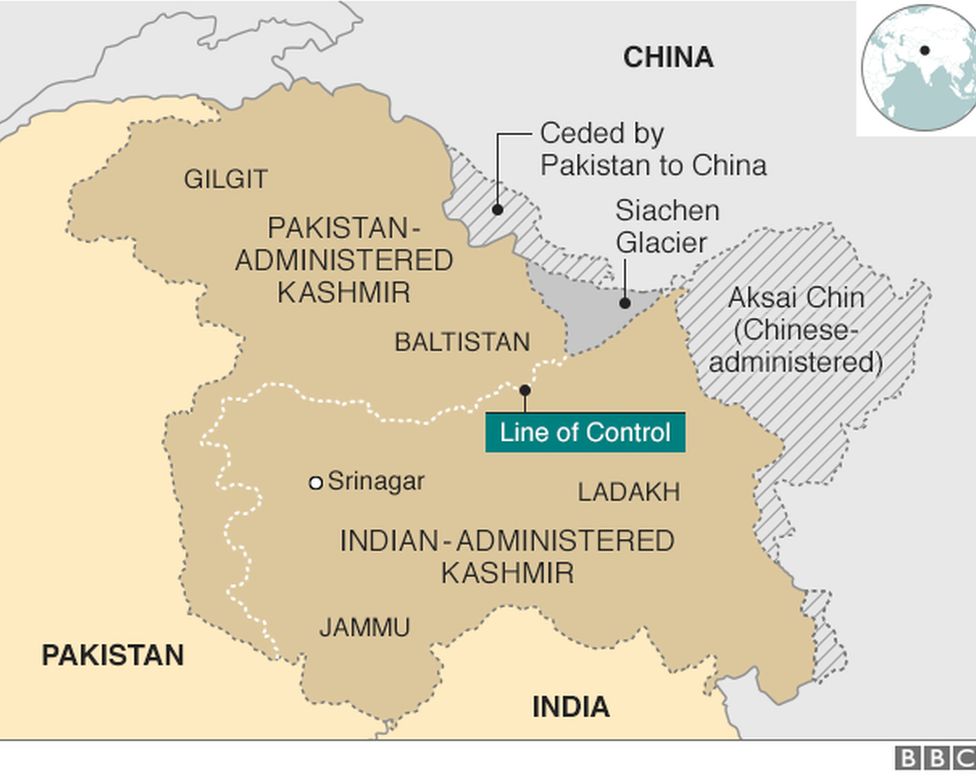
It is important for instructors and students in high school and college and university survey courses such as Comparative Politics, World History, and International Relations to learn about the Jammu–Kashmir problem. The highly respected International Crisis Group, governed by an international board of forty-seven members representing the highest levels of government, business, and philanthropic organizations from thirty-one countries, keeps this perpetually unresolved problem on its watch list. The struggle over the disputed territories goes back to 1947 and has resulted in two wars between India and Pakistan, as well as more limited conflicts. China borders Kashmir and has a history of sometimes-violent border disputes with India, and the US alliance with India further complicates the situation.
In order to better understand and make use of the links in the film essay that follows, readers are strongly encouraged to first learn vital contextual information on the problem through reading and viewing the BBC’s superb pedagogical digital offering Kashmir: Why India and Pakistan Fight Over It? (August 8th, 2019) https://tinyurl.com/6cnc4uxn.
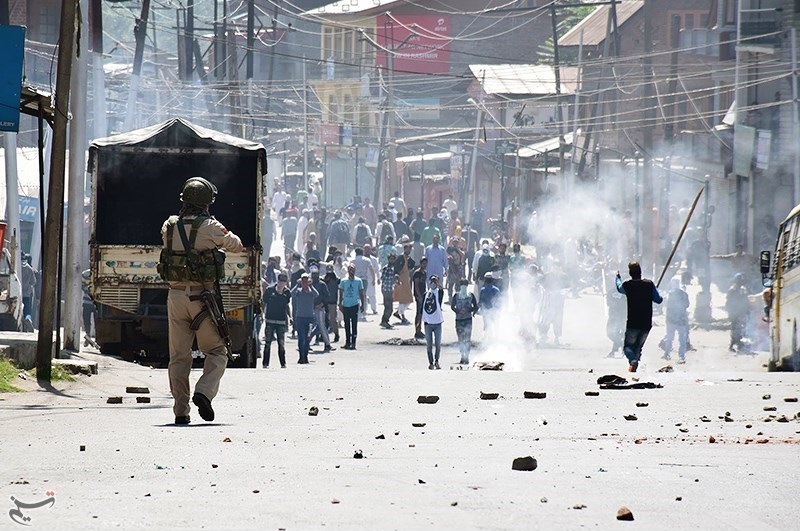
Police in Kashmir confronting violent protesters in December 2018. Source: Wikipedia at https://tinyurl.com/3swjmycp.
The pedagogical introduction includes a timeline, short videos, succinct narrative, primary source excerpts, and related updates.
Since many EAA readers are teachers and students in American high schools and universities, a basic understanding of the US government position on the problem, and potential policy issues caused by the long-standing conflict, may be gleaned from reading two key pages, (“Summary,” and “US Policy and Issues for Congress,” page 23) from a longer Congressional Research Service (CRS) report, “Kashmir: Background, Recent Development and US Policy (August 8th, 2020.) More interested teachers and students might want to read the CRS Report at https://tinyurl.com/znmvcdt7. It is important to know that the Joe Biden Administration has announced a continuation of the policies of prior administrations regarding Kashmir.
Completing these more general introductions provides both necessary context and perspectives on the issue that are different from that of most directors, who take a Kashmiri perspective, in the documentary film essay.
The Kashmir dispute—one of the most intransigent political conflicts in Asia—has its beginnings in the end of British colonial rule over India and the subsequent Partition of the Indian subcontinent in 1947, which left the princely state of Jammu and Kashmir divided into an Indian-administered region and a Pakistani-administered region.1 Some argue that the crisis has its origins in the British sale of Kashmir to Maharaja Gulab Singh in 1846 and the establishment of a feudatory Dogra state under the suzerainty of British India. The legitimacy of the Dogra state was often challenged by its Kashmiri Muslim subjects, which culminated in a revolt against it in the 1930s, supported by the leaders of the Indian freedom struggle. Even though India’s struggle for freedom ended with the rise of India and Pakistan as independent states, the Kashmiri sense of political dispossession was made more acute by the dispute between India and Pakistan over Kashmir that erupted in 1947 and led to the first India–Pakistan War of 1948. A series of missteps by the Indian government from the 1950s to the 1970s aggravated the crisis in Indian-administered Kashmir, which escalated by the late 1980s to a full-scale anti-India insurgency that has left the region devastated. One of the main reasons for the anti-India insurgency was the denial of democratic rights (such as fair elections and civil liberties) to the people of Kashmir. More than 75,000 lives have been lost and thousands have disappeared or been internally displaced. The rise of Islamism in Kashmir in the 1990s, the displacement of Kashmir’s Hindu minority from Kashmir, and massive human rights violations add further layers of complication to the crisis. Even though cinematic representations of Kashmir go as far back as the beginnings of the crisis in 1947–1948, it was only after the Kashmiri insurgency had been pushed into retreat by the late 1990s that Kashmiri and Indian filmmakers turned to the documentary film form to reflect on the conflict. This article introduces the reader to ten documentary films that follow a nuanced and critical approach to the Kashmir conflict. Even though I discuss two documentary films made on Kashmir by an Israeli and an American filmmaker, the focus of this article is on documentary film narratives on Kashmir by Kashmiri and Indian filmmakers.
A war broke out between India and Pakistan within weeks of their freedom in October 1947 over the future of Kashmir. The first documentary on the 1947–1948 war over Kashmir, which was to shape the future of relations between India and Pakistan, arrived as early as 1948. B. D. Garga, an Indian documentary filmmaker and film historian, made Storm over Kashmir (1948), one of the first documentary films on the Kashmir conflict. Garga was in Kashmir at the same time as the legendary French photographer Henri Cartier Bresson and was urged to make this film by the senior activists of the Indian Left, who had rallied to support the Indian military effort in Kashmir against the irregulars of the Pakistan Army.2 This film, which portrays ordinary Kashmiris as the victims of Pakistani aggression, scripted by the Urdu writer Rajinder Singh Bedi, set the tone for Indian cinematic narratives on Kashmir that persist to the present. But the independent documentary films from the early 2000s take a very critical approach to such statist representations of Kashmir and advance a more complex understanding.
These ten documentary films with English subtitles on Indian-administered Kashmir (many of them by Kashmiris) are critical to understanding the Kashmir conflict in the present.
Tell Them "The Tree They Had Planted Has Now Grown"
By Ajay Raina
Produced by Rajiv Mehrotra
2001, Public Service Broadcasting Trust
58 minutes, color
https://tinyurl.com/dyneh38d
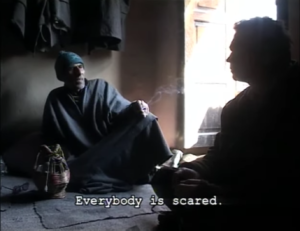
Ajay Raina speaks with a man from the village where his father lived in Kashmir. Source: Screen capture from the film.
Ajay Raina is an alumnus of the Film and Television Institute of India (FTII), and his cinematic diary of a visit to Kashmir after his family had been forced to migrate from Kashmir in the early 1990s exemplifies a subjective, personal style that is rare in independent documentary films on Kashmir. The documentary maps the filmmaker’s return journey to Kashmir after years, meeting old neighbors, family friends, and ordinary Kashmiris. Raina begins by documenting his physical journey from the plains to Srinagar, a city where he once had a family home. He struggles to understand the changes in Kashmir since his family was displaced and interviews the leaders of the Jammu and Kashmir Liberation Front (JKLF) who launched the armed struggle in the late 1980s. There are striking visuals of desolate neighborhoods and a grim winter cast to the visuals of everyday life in Kashmir that accentuate the feelings of loss and longing expressed in the film. Some of the most memorable moments in the film are Raina’s moving interview with the Kashmiri writer Akhtar Mohiuddin, who lost both his son and son-in-law to the violence, and his conversations with old neighbors and childhood friends. Even though the film struggles to insulate itself against dominant media representations on Kashmir, its formal brilliance and subjective storytelling make it one of the most compelling documentary films about Kashmir. It is also one of the first films to offer a sensitive portrayal of the internal displacement of Kashmiri Pandits (Kashmir’s Hindu minority). Raina won many awards for this film and went on to make another politically nuanced documentary on the cost of India–Pakistan hostilities on Kashmir’s fragile borderland communities (Between Border and the Fence, on Edge of a Map, 2013). The film is available on YouTube and can be used to introduce the perspective of the Kashmiri Hindu minority, which has often resisted national liberationist discourses on Kashmir. But it is advisable to screen it with a film like Sanjay Kak’s Jashn-e-Azadi, which offers a dissenting view from the same subject position.
Jashn-e-Azadi (How We Celebrate Freedom)
By Sanjay Kak,
2005, 139 minutes, color
Part 1: https://tinyurl.com/9bc6zn2v and Part 2: https://tinyurl.com/2r394t56
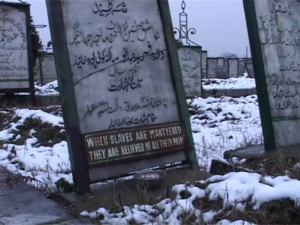
Mazar-e-Shouda (Martyrs’ Graveyard) in Srinagar, Kashmir. Source: Screen capture from part 1 of the film.
This film by the well-known Kashmiri filmmaker Sanjay Kak provides the best overview of the Kashmir conflict and is a great point of entry into the conflict from a standpoint critical of the Indian state and supportive of the Kashmiri movement for self-determination. Kak’s documentary interweaves a historical account of the conflict with powerful observations of the impact of violence on everyday life in Kashmir. For instance, the film begins with the empty symbolism of state rituals in Kashmir (such as the celebration of India’s Republic Day), which it contrasts with the grief and suffering in the lives of ordinary Kashmiris. The film examines the huge costs of the conflict to the economy, livelihoods, and mental health of Kashmiris. It offers a subtle critique of religio-nationalist tourism, development ideology, and counterinsurgency tactics of the Indian state. Even though Kak also belongs to Kashmir’s Hindu minority, his film offers a sharp counterpoint to Ajay Raina’s treatment of the fate of the Kashmiri Pandit minority in Tell Them “The Tree They Had Planted Has Now Grown.” Kak is known for a dialectical, observational style that builds an argument slowly and painstakingly, but like his films on the Narmada Bachao Andolan (NBA) and the Maoist unrest in central India, his political sympathies are rarely ambiguous. There is a tension in the film between the documentary form and political commitment that never reaches a breaking point. Deftly edited by Tarun K. Bhartiya and skillfully shot by renowned cinematographer Ranjan Palit, the film is a powerful introduction to the contemporary crisis in Kashmir. This film strives toward an unbiased and objective discourse on Kashmir that is sympathetic to the political struggles of Kashmir’s Muslim majority and the struggle for self-determination in Kashmir..
Khoon Doy Baarav (Blood Leaves Its Trail)
By IFFAT FATIMA
2015, 90 MINUTES, COLOR
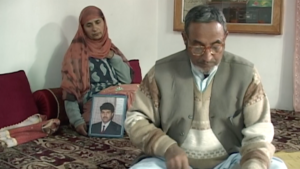
The parents of Fayaz Ahmad, who disappeared on September 9, 1997. Source: Screen capture from The Dear Disappeared on YouTube at https://tinyurl.com/zuf4k.
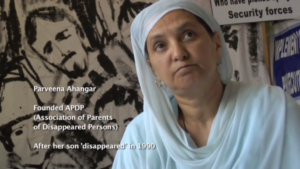
Iffat Fatima’s Khoon Diy Baarav is one of the first Kashmiri documentary films made from a feminist standpoint. The film documents the trials and tribulations of the families of Kashmiri victims of enforced disappearances. The film records journeys of the filmmaker with the women of the Association of the Parents of Disappeared Persons (APDP). The filmmaker travels with the women activists of the APDP and chronicles the life of Parveena Ahanger, whose son Javed Ahmad Ahanger disappeared in custody in 1990. Ahanger started meeting with the families of the Kashmiri disappeared in a local Sufi shrine and later founded the APDP. The film offers subtle character studies of the women of the APDP and their heroic struggle for justice against all odds. Even though the film is sympathetic to the movement for Kashmiri self-determination, it raises powerful questions about the limits of national liberationist discourse. The film emerged from a close collaboration of Fatima with the APDP and is a powerful example of observational cinema and collaborative feminist filmmaking from South Asia. This film is not available online, but two other shorts by the director (Where Have You Hidden My New Crescent Moon [https://youtu.be/RZK_J96O6gQ] and The Dear Disappeared [https://youtu.be/n6YWxopENqQ]) on disappearances in Kashmir are available on YouTube and the APDP website. All inquiries about purchasing a DVD copy of the film or arranging special screenings can be sent to the filmmaker at iffatiffat@gmail.com.
Pather Chujaeri (The Play Is On)
By Pankaj Rishi Kumar
Produced by Rajiv Mehrotra
2001, Public Service Broadcasting Trust
43 minutes, color
https://tinyurl.com/8atb462s
Bhand Pather, actor. Source: Screen capture from the film.
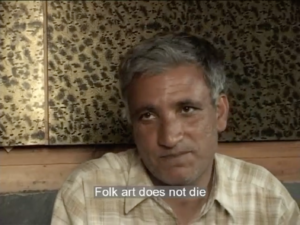
Pankaj Rishi Kumar’s Pather Chujaeri examines the impact of the Kashmir conflict on Kashmir’s artistic traditions through its moving portrait of Bhand Pather (Kashmiri folk theater), under assault from the rise of Islamism in Kashmir in the 1990s on the one hand and the indifference of the Indian state on the other. Bhand Pather has always offered satiric commentary on contemporary affairs and as such is deemed political and dangerous by both the insurgents and the state. Kumar’s documentary is a heartwarming story about how committed artists have kept the local traditions alive against all odds. This film juxtaposes dominant media representations of Kashmir with vignettes from everyday Kashmiri life that challenge mainstream narratives on Kashmir. The film, in particular, documents the efforts and struggles of Ghulam Ali Majboor and Ghulam Bhagat to revive theater in Kashmir. Much like Sanjay Kak’s Jashn-e-Azadi, Kumar also contrasts the celebration of Republic Day in Kashmir (attended largely by senior functionaries of the state) with the everyday lives of Bhand Pather performers. Sanjay Kak’s Jashn-e-Azadi also has a sequence that explores Bhand Pather, but Kumar’s film is a detailed study of this theatrical form. The film, available on YouTube, is an excellent point of entry into a discussion on how traditional forms of art endure through crisis and war.
When the Storm Came
By Shilpi Gupta
2004, 24 minutes, color
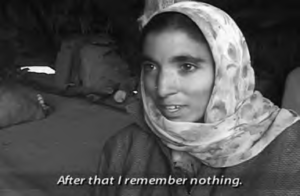
Survivor of the “storm.” Source: Screen capture from the film.
Shilpi Gupta won the Jury Award at the Sundance Film Festival in 2004 for this twenty-four-minute short on the mass rapes in the village of Kunanposhpora in north Kashmir. Gupta traveled from the US to Kashmir to document the mass rape at Kunanposhpora, which took place February 23, 1991, at a time when the Indian media had for years been largely dismissive of the claims made by villagers. Gupta spent two weeks living in the village and shooting her film. This was the only film on Kashmir until 2004 that explored the use of rape in the Kashmir conflict. The film focuses on the persistent trauma of the women of Kunanposhpora and the terrible events of the night of the mass rape. The film is available for institutional purchase and rental from the Centre for Asian American Media (https://caamedia.org/films/when-the-storm-came/). Bilal Jan’s Ocean of Tears (2012) (https://youtu.be/a2dmS-ASVzo) revisits the Kunanposhpora mass rape. Jan’s film was surrounded by controversy and banned from being screened at two university campuses. Both the films rely heavily on contextualizing the mass rape and recording the testimony of the survivors. Gupta’s film is especially useful to instructors who want to draw attention to gender-based human rights violations in Kashmir.
Kashmir: Journey to Freedom
By Udi Aloni
2009, 72 minutes, color
https://tinyurl.com/43b2xv3n
Protest in Kashmir. Source: Screen capture from the film.
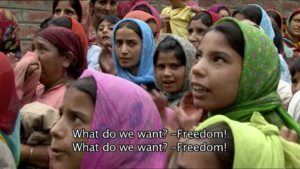
In 2009, Udi Aloni, the Israeli-American filmmaker, made a documentary film on Kashmir titled Kashmir: Journey to Freedom. Aloni is better known for his feature film, Forgiveness (2006), and his documentary on the Palestine–Israel conflict, Local Angel (2004). Aloni’s Kashmir film begins with the shots of a peaceful demonstration by the pro-Independence Jammu and Kashmir Liberation Front (JKLF) in Kashmir. The film’s emphasis is on a new generation of Kashmiris who are exploring nonviolent methods of resistance. One of the earliest sequences of the film begins with the shots of an activist and a US citizen of Kashmiri origin, Usman Raheem Ahmed, riding his motorbike near the Dal Lake, which are edited with archival footage of violent incidents and protests in Kashmir. The film then interviews lawyer Fasiha Qadri and the artist Amin Bhat. It includes a forceful interview with Siddiq Wahid, former vice chancellor of the Islamic University in Kashmir, in which he advocates that violence is not the answer to the problems in Kashmir. The film reads the struggle in Kashmir as one to find a voice for the Kashmiri narrative between the competing narratives of two powerful states, i.e., India and Pakistan. A serious flaw in the film is that it presents a view of Kashmir solely from the standpoint of the JKLF. Many of those interviewed are either members of the JKLF or have a close association with it. One of the sequences in the film overlays excerpts from a prerecorded English speech by the JKLF leader Yasin Malik on his visuals addressing Kashmiri villagers. But despite these flaws, the film is able to stage certain contradictions in Kashmiri political discourse. For instance, the shots of Yasin Malik raising religious slogans follow right after his claim in the interview that JKLF believes in a secular politics. Soon after the abrogation of Article 370 of the Indian constitution, which canceled Kashmir’s limited autonomy in the Indian union, Aloni made this film available on YouTube for free. This film is especially useful for instructors who want to highlight the national liberationist perspective on Kashmir.
Floating Lamp of the Shadow Valley
By Rajesh Jala
2006, 62 minutes, color
https://tinyurl.com/2cr6ehnk
Arif. Source: Screen capture from the film.
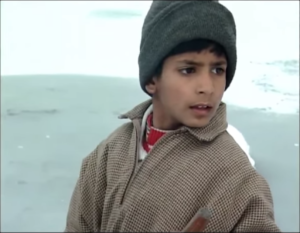
Rajesh Jala’s 2006 documentary tells the story of a nine-year-old Kashmiri boatman, Arif Dar, who has become the sole breadwinner of his family. We see Arif rise early in the mornings in the bitter chill of Kashmiri winters to unfreeze his boat. The floating lamp of the title is the lamp Arif uses when he rows his boat in the dark. We learn in the film that Arif ’s father is an insurgent and has abandoned the boy and his family. One day, young Arif is caught in the crossfire between the rebels and the Indian security forces, but he does not abandon his responsibility to his family. The film combines careful observation with subtle reconstructions as it approaches the Kashmir conflict from the standpoint of Kashmiri children. Jala’s unusual sensitivity in portraying the lives of marginalized children (he himself spent many years in a refugee camp for Kashmiri Hindus in Delhi) allows him to paint a lyrical portrait of Arif ’s difficult life, which helps us understand the terrible impact of the Kashmir conflict on the lives of children. Jala shot the film himself in a beautiful, almost balladic, style, and some of the best sequences in the film revolve around Arif and his young siblings in their lakeside hut. Even though its commentary on the Kashmir conflict does not move beyond a generalized humanism, the instructors can use the film to highlight the human cost of protracted conflict in Kashmir.
Soz: A Ballad of Maladies
By Sarvnik Kaur Tushar Madhav
2016, Public Service Broadcasting Trust
85 minutes, color
https://tinyurl.com/29st5h4r
MC Kash. Source: Screen capture from the film.
Sarvnik Kaur and Tushar Madhav’s documentary turns to the relations between art and politics in Kashmir. It begins with a concert, Battle of Bands, organized by the Indian Central Reserve Police Force (CRPF) in Srinagar. The film documents the lives and work of poets such as Zareef Ahmad Zareef, artists such as Showkat Katju, rock band Parvaaz, folk performer Gulzar Bhat, the hip-hop artist MC Kash, and the cartoonist Mir Suhail. The film opens with the poet Zareef Ahmed Zareef speaking of the need for trust in a conflict zone, and it explores the potential for that trust in art and music. One of the most moving sequences in the film is the interview with the popular Kashmiri hip-hop artist MC Kash, whose first song “I Protest” was banned by the state in 2010. The film explores the connections among modern arts forms, protest, and Kashmir’s Sufi spirituality. But it avoids the more controversial ground of Kashmiri contestations of the legitimacy of Indian rule, which is at stake in the works of artists like MC Kash and Mir Suhail. This film, however, is an excellent introduction to contemporary urban youth culture in Kashmir.
Yi As Akh Padshah Bai (There Was a Queen)
By Hansa Thapliyal and Kavita Pai
2007, 105 minutes, color
https://tinyurl.com/ver2f3fw
Women protesting for information about their disappeared sons, fathers, brothers and husbands. Source: Screen capture from the film.
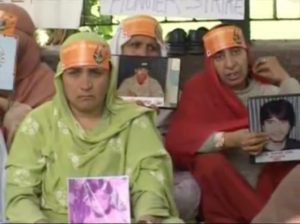
This documentary by Hansa Thapliyal and Kavita Pai delves into the lives of Kashmiri women. The film covers some of the same territory as Iffat Fatima’s Khoon Diy Baarav as it interviews Parveena Ahanger and Hajra Begum of the APDP. Yet it contrasts the somber stories of the APDP women who have lost their loved ones with everyday hopes and fears of young Kashmiri women who are attending a course at a vocational center. The film also has a rare interview with the women activists of the Islamist Dukhtaran-e-Millat (Daughters of the Community). It also chronicles the tragic death of two young Kashmiri women in Sopore in retaliatory fire by Indian soldiers. The film uses poems by Naseem Shifae and interviews with the activists of the APDP and civil society leaders such as Hameeda Nayeem to pose some hard questions about women and peace in Kashmir. Many young Kashmiri women speak freely in this film about such subjects as militarism, terrorism, peace, and gender. The film was made by an all-women crew in 2007 and is available for free online at cultureunplugged.com. It is useful to mention here that Radhika Kaul Batra’s film Women in Conflict (2002) (https://youtu.be/BFQrhsDAyuE) was one of the first films to document the story of the struggles faced by Kashmiri women since the onset of insurgency in 1990.
Inshallah, Kashmir: Living Terror
Written, Directed, and Produced by Ashvin Kumar
2012, 80 minutes, color
https://tinyurl.com/af2d9z5s
Source: Screen capture from the film.
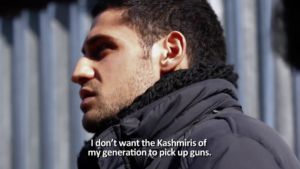
This film by Ashvin Kumar begins with an interview with the young Kashmiri artist Malik Sajad. The film combines the narrator’s breezy commentary with testimonies from Kashmiri artists, civil society activists, former militants, and survivors of violence and torture. Even though stylistically less complicated than films by Raina or Fatima, it is one of the most comprehensive accounts of torture in Kashmir. The film interviews a former civil servant, Wajahat Habibullah, and the grandson of a human rights activist killed by Kashmiri insurgents to create an empathetic portrait of a society grappling with collective trauma. It also has a rare interview with a young Kashmiri insurgent who speaks about his motivations. Ashvin Kumar’s other Kashmir documentary, Inshallah Football (2010), explores the impact of violence on the younger generation through the hopeful story of a young eighteen-year-old Basharat who has been selected to train at a club in Brazil. But Basharat is being denied a passport by the Indian government because his father was an insurgent. Inshallah Football is about sports and dreams in Kashmir. Recently, Ashvin Kumar also finished his first feature on Kashmir titled No Fathers in Kashmir (2019). Ashvin Kumar’s two Kashmir documentaries are available on cultureunplugged.com. Much like Sanjay Kak’s Jashn-e-Azadi, Inshallah Kashmir provides a good general overview of the conflict, emphasizing the devastation wrought by three decades of insurgency and counterinsurgency in Kashmir.
Conclusion
The documentary film screenings are best supplemented through assigned readings that provide a proper historical background to the Kashmir conflict. These could be selections from studies by scholars such as Sumantra Bose or Chitralekha Zutshi, or articles by public intellectuals such as Pankaj Mishra or Eqbal Ahmed.3 The best film for a general overview of the conflict is Sanjay Kak’s Jashn-e-Azadi. As the film received a hostile critical reception from some members of Kashmir’s Hindu minority, it might be advisable to screen it with Ajay Raina’s Tell Them the Tree They Had Planted Has Now Grown, which is more sympathetic to dominant political perceptions within the Kashmiri Hindu minority. Kak’s film can be used to initiate discussions on the history of the conflict, militarization in Kashmir, India’s counterinsurgency efforts, human rights violations in Kashmir, and the enduring dream of azaadi (freedom) in Kashmir. Or else a screening of Jashn-e-Azadi could be combined with a screening of Ashwin Kumar’s Inshallah Kashmir, which also provides a good introduction to the conflict. Alternatively, the instructor can combine a screening of Pather Chujaeri and Soz: A Ballad of Melodies to introduce students to the conflict through its impact on the arts in Kashmir. An instructor can also choose to focus on the gendered nature of the conflict by screening either Khoon Diy Baarav or Yi As Akh Padshah Bai. Additionally, the instructors could consider screening some Bollywood films on the Kashmir crisis (or clips from these films) and encourage the students to contrast the ideological work of mainstream Bollywood films (for instance, the portrayal of Kashmir as an object of desire in films such as the 1964 Kashmir Ki Kali) with the questioning of such dominant modes of representing Kashmir in documentary films such as Jashn-e-Azadi and Khoon Diy Baarav. Some of the Bollywood films on the Kashmir crisis that the instructors can consider screening are Roja (Mani Ratnam, 1992), Mission Kashmir (Vidhu Vinod Chopra, 2000), Yahaan (Shoojit Sircar, 2005), Lamha (Rahul Dholakia, 2010), Haider (Vishal Bhardwaj, 2015), and Shikara (Vidhu Vinod Chopra, 2020). The instructors can ask students to compare the ideological perspectives in these films from India with the ones found in a Pakistani popular film such as Azaadi (Imran Malik, 2018). The instructor can also supplement student learning on Kashmir by assigning a short novel (such as Feroz Rather’s The Night of Broken Glass) or a graphic novel (such as Malik Sajad’s Munnu: A Boy from Kashmir) to go with the documentary film screenings. Or the instructor could simply choose a few poems such as “Farewell” from the Kashmiri poet Agha Shahid Ali’s collection on the Kashmir conflict, The Country without a Post Office.4 In “Farewell,” Ali writes: “My memory keeps getting in the way of your history.” Teaching with source material that records and retrieves Kashmiri memories (such as the documentary) can help students develop a nuanced critical perspective on the Kashmir conflict that resists the violence of history and opens up new pathways of understanding toward an enduring peace in Kashmir.
Harvard-Style Citation
Bazaz,
A.
(2021) 'Teaching Kashmir through Documentary Films',
Education About Asia.
26(2)
doi: 10.65959/eaa.1704