
A Teaching Resource for Living with Gandhi: Experiments in Utopia
by Karline McLain
Download the PDF version of this article for classroom use
Karline McLain is a Professor of Religious Studies at Bucknell University, where she teaches courses on the religion, history, and culture of South Asia. She is the author of Living with Gandhi: Experiments in Utopia (Association for Asian Studies, with distribution through Columbia University Press, 2026) as well as editor and primary investigator of the companion website, the Living With Gandhi Archive. Dr. McLain is also the author of India’s Immortal Comic Books: Gods, Kings, and Other Heroes (Indiana University Press) and The Afterlife of Sai Baba: Competing Visions of a Global Saint (University of Washington Press). She received her PhD in Asian Cultures & Languages from The University of Texas at Austin and her BA in Religious Studies from The University of Iowa.
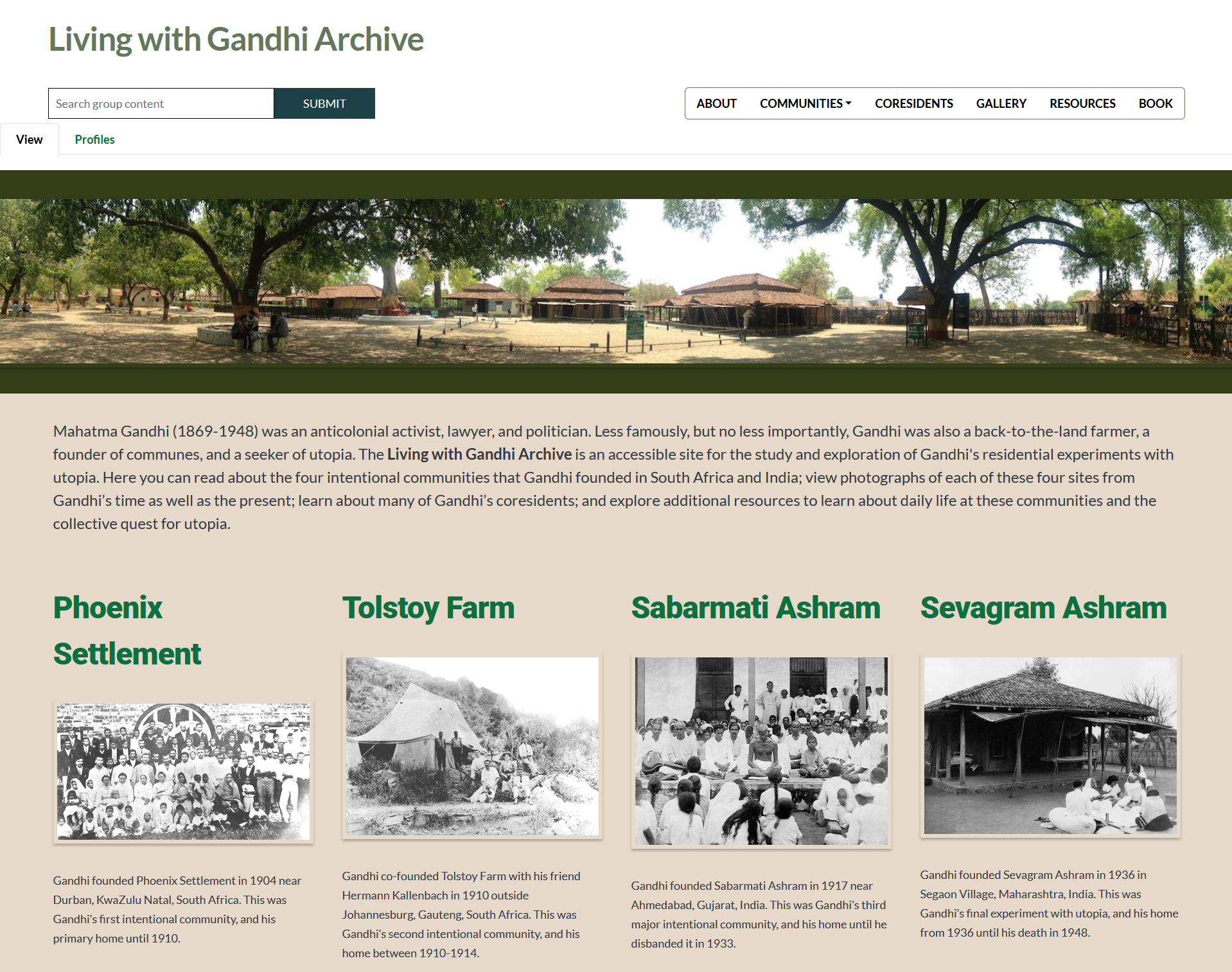
The Living with Gandhi Archive website: www.livingwithgandhi.org.
Introduction
Mohandas K. “Mahatma” Gandhi (1869–1948) attained global recognition for his method of nonviolent civil disobedience known as satyagraha. Gandhi was many things in his lifetime, including an anticolonial activist, a lawyer, and a politician. Less famously, but no less importantly, Gandhi was also a back-to-the-land farmer, a founder of communes, and a seeker of utopia. Throughout his adult life Gandhi experimented with intentional living arrangements, founding multiple residential communities where he and those who chose to join him experimented together with the ideals and methods for enhancing the collective good.
In South Africa, where Gandhi lived and worked as a lawyer for twenty-one years, he founded his first two communities: Phoenix Settlement (founded outside Durban in 1904) and Tolstoy Farm (founded outside Johannesburg in 1910). After returning to India, Gandhi founded two additional communities: Sabarmati Ashram (founded near Ahmedabad in 1915) and Sevagram Ashram (founded near Wardha in 1933). What was it like to live with Gandhi? Who elected to live with Gandhi at these communities? What values did they live by, and what rules did they agree to? The Living with Gandhi Archive is an online digital archive for the study and exploration of Gandhi’s residential experiments with utopia, which provides insight into these important questions.
Gandhi’s communities attracted a diverse group of residents who came from multiple religious, racial, and national backgrounds. Gandhi’s coresidents were drawn to both Gandhi and the collective effort to forge a community of equals that could challenge the inequalities and inequities of the colonial and capitalist status quo. For over four decades—from the founding of his first intentional community in South Africa in 1904 until his death in India in 1948—Gandhi not only tried to imagine utopia, he also tried to enact it, hoping with the establishment of each successive community to approach ever closer to his imagined ideal.
Gandhi’s communities are arguably among the most important communal experiments with utopia to have been undertaken in Asia and Africa. It was at these communities that Gandhi first began to articulate, and then continually sought to refine and implement, the utopian philosophy that he called sarvodaya, meaning “universal wellbeing.” Scholarship in the field of Gandhian studies has focused predominantly on Gandhi’s biography and his political philosophy, paying substantial attention to his method of nonviolent civil disobedience (satyagraha). However, the collective quest for utopic life at these communities was foundational to Gandhi’s developing political vision and nonviolent method of activism. Gandhi’s coresidents and their shared communal values were central to the political actions that Gandhi became famous for, such as the protest of the Asiatic Registration Act in South Africa and the anticolonial Salt March and Quit India campaigns in India.
Gandhi’s politics began at home. As such, his political method of nonviolent civil disobedience (satyagraha) cannot fully be understood without paying attention to the evolution of Gandhi’s philosophy of sarvodaya (universal wellbeing) at his intentional communities. Gandhi constantly experimented with the residential facets of daily life, engaging with his coresidents in communal trials with multifaith and multiracial community building, pluralistic co-housing, subsistence farming, cooperative labor, and alternative education, to name just some of the experiments undertaken at these communities in the shared pursuit of universal wellbeing. As Gandhi tried to imagine and enact utopia at these intentional communities, he also increasingly emphasized voluntary service, sacrifice, and suffering for the collective good. Residents were asked to sacrifice more and more over time in their shared pursuit of universal wellbeing, from offering up their labor and their individual possessions at Gandhi’s early communities, to offering up their freedom and, in some cases, even their lives in the pursuit of political self-rule and universal wellbeing at Gandhi’s final communities.1
What does it mean to live well in community with one another? Gandhi and his coresidents gave deep thought to this question as they sought to collectively enact utopia. Sometimes they debated the communal rules, particularly as more service, sacrifice, and suffering came to be expected. Some of Gandhi’s coresidents flourished at his communities and embraced his philosophy of sarvodaya, while others stayed for a time and then elected to leave. Some of Gandhi’s acquaintances, including many political allies who embraced Gandhi’s political tactics, had little interest in living at his communities and expressed skepticism about his communal experiments. Nonetheless, Gandhi came to believe that if he could create the ideal community before he died, then he could use it as a model to replicate throughout India and beyond. Examining Gandhi’s communities can help students to better understand Gandhi’s biography and his politics. It can also challenge students to think more deeply and intentionally about what it means to live well in community with one another, and the connections between our everyday life choices and our socio-political values.
1 For more on sacrifice at Gandhi’s communities, see chapter four in Karline McLain, Living with Gandhi: Experiments in Utopia (Association for Asian Studies, 2026). Two of Gandhi’s coresidents at Sevagram Ashram—his secretary, Mahadev Desai, and his wife, Kasturba Gandhi—both died in prison in 1944 as participants in the Quit India anticolonial campaign.
Lesson Plan
Students will learn about the concepts of sarvodaya (universal wellbeing) and satyagraha (nonviolent civil disobedience) by exploring them in the context of everyday life at Sabarmati Ashram, an intentional community that Gandhi founded in India. All of the materials required for this lesson plan are available, for free, online at the Living with Gandhi Archive. Additional recommended materials are discussed with suggestions for expanding this lesson plan into a longer unit. This lesson plan will be useful to instructors at the high school and/or undergraduate college levels who want to incorporate a new unit or expand an existing unit about Gandhi in courses about World History; Social Studies; Asian Studies, Global Studies, and/or Ethnic Studies; Peace Studies; Communal and/or Utopian Studies; and Imperialism and Decolonization.
Grade level: High School (9th–12th grade) or College (undergraduate).
Time: 2 x 50 minute classes, with suggestions for expanding into a longer unit if desired.
Learning Objectives: Upon completion of this lesson, students will be able to:
-
Define Gandhi’s philosophy of sarvodaya (universal wellbeing) and identify how Gandhi attempted to integrate this philosophy into everyday life at one of his intentional communities.
-
Identify some of the historical figures who elected to live with Gandhi at his Sabarmati Ashram community in India, as well as the rules the community members agreed to live by in their collective attempt to enact sarvodaya (universal wellbeing).
-
Analyze the relationship between Gandhi’s philosophy of sarvodaya (universal wellbeing) and his method of satyagraha (nonviolent civil disobedience) in the context of life at Sabarmati Ashram and the broader anticolonial movement for India’s independence.
-
Evaluate the ethics and practicality of Gandhi’s everyday lifestyle, both in his time and place and in our own context.
Glossary of Key Terms
Ahimsa: Nonviolence
Brahmacharya: Celibacy
Harijan: Literally “children of God.” A term for “untouchables” or “Dalits,” those people at the bottom of the Indian caste hierarchy, that was coined and used by Gandhi.
Khadi: Handspun cloth, or clothing made from handspun cloth.
Sarvodaya: Literally “the uplift of all.” Most commonly translated from Sanskrit into English as “universal wellbeing”; Gandhi sometimes translated it as “universal welfare.”
Satya: Truth
Satyagraha: Literally “grasping on to truth.” Gandhi’s term for nonviolent civil disobedience, which he sometimes translated from Sanskrit into English as “truth force,” “soul force,” or (less commonly, for he did not see it as passive) “passive resistance.”
Swadeshi: Economic independence. Gandhi often linked this term to a constructive program of labor in village and cottage industries, including daily farming and spinning to make handspun clothing.
Swaraj: Literally “self-rule.” This was the term typically used in colonial India to refer to the goal of political independence. Gandhi often discussed swaraj as self-rule on both the individual the national level.
Varna: Caste
Varna-ashrama-dharma: A Hindu concept that refers to one’s duty (dharma) as determined by their caste (varna) and stage of life (ashrama).
First Lesson: The Pursuit of Sarvodaya (Universal Wellbeing) at Gandhi’s Sabarmati Ashram
A. Warmup activity (approximately 10 minutes)
- Individual free write: If you were creating your own utopic community, what sort of rules would you ask all members who join it to agree to? Have students brainstorm and write down the first 3–5 rules that come to mind.
- Small group discussion: In small groups, students take turns reading aloud their individual lists of rules. Then they discuss whether all of the members in their small group can come to unanimous agreement about any rules for a shared utopic community. Ask one member to write down a new list of the rule(s) that all group members agree to, and to prepare to read this list aloud to the class.
- Whole class conversation: Teacher calls upon each small group to report out on (at least) one rule their group unanimously agreed to for their utopic community. Teacher writes these rules on the board to form a class list of rules for their own class utopia.
B. Mini-lecture (approximately 20 minutes)
-
Teacher provides an historical overview of Gandhi’s intentional communities, and introduces the key concepts of sarvodaya (universal wellbeing) and satyagraha (nonviolent civil disobedience) in the context of these communities.
-
Resource: use either the prepared slideshow (available for download) or the digital timeline (online) that are available on the Resources page of the Living with Gandhi Archive.
C. Primary source close-reading activity (approximately 10 minutes)
-
Have the students read the Sabarmati Ashram Constitution, focusing on the mission statement (“object”) for this community and the eleven observances that all members who joined it agreed to abide by in the pursuit of sarvodaya.
-
Resource: use the Sabarmati Ashram Constitution document (final approved version) available in the Documents section of the Living with Gandhi Archive.
D. Teacher-facilitated closing discussion questions (approximately 10 minutes)
-
How much overlap is there between our class-generated list of rules and the eleven observances/rules for Sabarmati Ashram?
-
Focusing only on the observances/rules that were important to the Sabarmati Ashram community but are not on our classroom list of rules, why do you think these observances were important for the Sabarmati Ashram community’s stated mission/object?
-
What connections do you see between these eleven observances and Gandhi’s philosophy of sarvodaya (universal wellbeing or universal welfare)?
-
Would you be interested in living in a community where all residents lived according to all eleven of these observances? Why or why not?
Second Lesson: Sarvodaya (Universal Wellbeing) and Satyagraha (Nonviolent Civil Disobedience) at Sabarmati Ashram
A. Review (approximately 5 minutes)
-
-
Teacher reviews the definitions of sarvodaya (universal wellbeing) and satyagraha (nonviolent civil disobedience). Ask the students to quickly help enumerate the list of the eleven observances/rules of Sabarmati Ashram discussed in the last class.
-
Resource: revisit the Salt March slide from either the prepared slideshow or the digital timeline available on the Resources page of the Living with Gandhi Archive for the definitions of sarvodaya and satyagraha, and to provide a quick introduction to the Salt March civil disobedience campaign.
-
B. Small group work (approximately 20 minutes)
-
-
In-class reading: Have the students number off from 1 to 5. Teacher then instructs each number to read a different biographical sketch of one of the historical figures who lived at Sabarmati Ashram: #1s read about Kasturba Gandhi; #2s read about Manilal Gandhi; #3s read about Mirabehn; #4s read about Pyarelal Nayar; and #5s read about Reginald Reynolds.
-
Resource: use the biographical sketches of Gandhi’s coresidents available on the Coresidents page of the Living with Gandhi Archive.
-
Group discussion: Have all #1s work together, #2s work together, etc. Students should discuss the following questions about their assigned historical figure in their group:
-
Where is your historical person from, and what motivated them to join Sabarmati Ashram?
-
What can you glean about what their daily life was like at Sabarmati Ashram?
-
Did your historical person have any role in the Salt March or broader Salt Sa-tyagraha civil disobedience movement? If so, what was their role?
-
-
Time permitting, each group can report out to the class their answers to the above questions, so that the whole class gains a basic level of familiarity with a handful of the residents of Sabarmati Ashram. As they do so, the teacher can also put the biographical sketch of each coresident available on the Coresidents page of the Living with Gandhi Archive on the classroom projector so that the class can see a photo of each person in turn.
-
C. Primary source close-reading activity (approximately 10 minutes)
- Have the students read Gandhi’s Salt March speech, which he delivered to his fellow coresidents at Sabarmati Ashram before they began the historic Salt March nonviolent protest in 1930.
- Resource: use the Gandhi’s Salt March Speech document available in the Documents section of the Living with Gandhi Archive.
D. Teacher-facilitated closing discussion (approximately 15 minutes)
-
Discussion questions:
-
Gandhi carefully handpicked the coresidents he wanted to join him on the Salt March in 1930, selecting residents who were Indian, male, and came from multiple religious communities (including Hindus and Muslims) and from many states across India. Why do you think Gandhi applied these criteria in selecting the seventy-eight people who marched with him? Why do you think Gandhi wanted to march only with his fellow residents from Sabarmati Ashram, rather than with other Indian politicians from the Indian National Congress political party? Why do you think Gandhi excluded residents who were female and/or non-Indian from the initial stage of the Salt March? What role did Gandhi’s coresidents have in the civil disobedience movement who did not accompany him on the Salt March?
-
Looking at Gandhi’s Salt March Speech and at the Sabarmati Ashram Constitution, what connections do you make between Gandhi’s philosophy of sarvodaya (universal wellbeing) and his method of satyagraha (nonviolent civil disobedience)? Which of the eleven observances or rules of daily life at Sabarmati Ashram does Gandhi reference in this speech as being foundational to undertaking this act of civil disobedience?
-
In Gandhi’s Salt March Speech, he uses strong rhetoric, describing the march he and his coresidents are about to undertake as a “life-and-death struggle” and as an “all-embracing sacrifice in which we wish to offer ourselves as oblation.” Gandhi anticipated that he and his fellow marchers might be beaten, arrested, and/or imprisoned. He asked his coresidents who joined him on the Salt March to be willing to endure such hardships for the greater good. Do you think some degree of voluntary self-sacrifice is necessary for universal wellbeing? Why or why not?
-
If you were a resident living at Sabarmati Ashram, would you have been interested in being one of the seventy-eight marchers selected to join Gandhi on the Salt March? Why or why not?
Options for Expanding this Lesson Plan into a Longer Unit
-
To introduce the figure of Gandhi in greater depth at the start of this unit, watch either the film “Gandhi: Pilgrim of Peace” (Noah Morowitz et al, A&E Home Video, 1997, 45 minutes) or “Gandhi” (dir. Richard Attenborough, Columbia Pictures, 1982, 3 hours and 11 minutes).
-
To examine life at Sabarmati Ashram in greater depth, assign the chapter “Sabarmati Ashram” in Karline McLain, Living with Gandhi: Experiments in Utopia (Association for Asian Studies and Columbia University Press, 2026).
-
To examine the Salt March in greater depth, assign the chapter “Civil Disobedience: The Salt Satyagraha” in Dennis Dalton, Mahatma Gandhi: Nonviolent Power in Action (Columbia University Press, 2012), 122–173.
-
On the Living with Gandhi Archive, students can also take time to explore the gallery of photographs of each of Gandhi’s intentional communities; read additional biographical sketches of many of Gandhi’s coresidents who lived at each community; and explore additional primary documents that are relevant to each of the communities.
-
Gandhi’s philosophy of sarvodaya (universal wellbeing) was constantly evolving as he experimented with his intentional communities, as was his political vision and action. To compare and contrast life at Sabarmati Ashram with life at one or more of Gandhi’s other intentional communities, have students explore the Phoenix Settlement, Tolstoy Farm, and/or Sevagram Ashram pages on the Living with Gandhi Archive. For a group project, the class could be divided into three groups, with each group assigned to a different community (Phoenix Settlement, Tolstoy Farm, Sevagram Ashram), and instructed to focus on that community to compare and contrast it with Sabarmati Ashram. Students could focus on who elected to live there, what the community’s mission and rules entailed, and how both sarvodaya (universal wellbeing) and satyagraha (nonviolent civil disobedience) were defined and enacted in this context. After adequate time to prepare, each group could then present on their assigned community to the whole class. To pair an assigned reading for each group with the materials available on the Living with Gandhi Archive, see the relevant chapters for each community in Karline McLain, Living with Gandhi: Experiments in Utopia (Association for Asian Studies and Columbia University Press, 2026).
-
To assign a reflective essay, consider using one or more of the discussion questions for the book Living with Gandhi: Experiments in Utopia as a prompt. These discussion questions are available in the Teaching Resources section of the Living with Gandhi Archive.
Recommended Resources
Dalton, Dennis. Mahatma Gandhi: Nonviolent Power in Action. Columbia University Press, 2012.
Fischer, Louis, ed. The Essential Gandhi: An Anthology of His Writings on His Life, Work, and Ideas. Random House, 2002.
Gandhi, M. K. Autobiography: The Story of My Experiments with Truth. Beacon Press, 1993.
Gandhi, M. K. and Judith M. Brown. Mahatma Gandhi: The Essential Writings. Oxford University Press, 2008.
Gandhi, M. K. with Anthony Parel. Hind Swaraj and Other Writings. Cambridge University Press, 1997. “Gandhi: Pilgrim of Peace.” Dir. Noah Morowitz, A&E Home Video, 1997. (Film, 45 minutes.) “Gandhi.” Dir. Richard Attenborough. Columbia Pictures, 1982. (Film, 3 hours and 11 minutes.)
Guha, Ramachandra. Gandhi Before India. Alfred A. Knopf, 2013.
Guha, Ramachandra. Gandhi: The Years That Changed the World, 1914–1948. Vintage Books, 2018.
Howard, Veena with Falon Kartch, eds. Gandhi’s Global Legacy: Moral Methods and Modern Challenges. Lexington Books, 2022.
Juergensmeyer, Mark. Gandhi’s Way: A Handbook of Conflict Resolution. University of California Press, 2005.
McLain, Karline. Living with Gandhi: Experiments in Utopia. Association for Asian Studies and Columbia University Press, 2026.
McLain, Karline (editor). Living with Gandhi Archive. Bucknell University: http://livingwithgandhi.org.