
If Statues Could Talk: Teaching “Comfort Women” History through Statues Using Visual Thinking Strategy
by Jing A. Williams and Phyllis Kim
Download the PDF version of this article for classroom use
Jing A. Williams is Professor of Social Studies Education at the University of South Dakota. Her teaching and research emphasize global perspectives and difficult history in social studies education. She serves as Book/Media Review Editor for the Journal of International Social Studies. Dr. Williams is the lead author of Teaching with a Global Perspective: Approaches and Strategies for Secondary Social Studies Teachers (National Council for the Social Studies [NCSS], 2024) and co-author of Teaching Conflict-Related Sexual Violence through Human Rights Education: The Case of the Japanese Military’s “Comfort Women” (NCSS, 2025).
Phyllis Kim is the Executive Director of Comfort Women Action for Redress and Education (CARE), a nonprofit, community-based organization in California, formerly known as KAFC. Kim and her organization have been involved in a number of campaigns to promote public awareness and education on “comfort women” issue in the United States, including the national and local resolutions, establishment of “comfort women” statues in Glendale and San Francisco, creation of online resource center at UCLA Center for Korean Studies, and coauthoring of an NCSS book, Teaching Conflict-Related Sexual Violence through Human Rights Education: The Case of the Japanese Military’s “Comfort Women.”
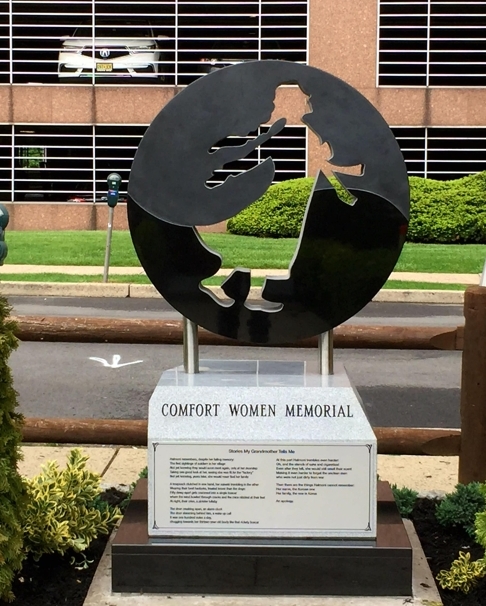
“Comfort Women” Memorial in Fort Lee, New Jersey. Photo by Phyllis Kim.
Introduction
Conflict-related sexual violence (CRSV), including rape, is as old as warring itself. As Bowcutt noted, “Wherever conflict erupts, sexual violence is present.”1 For centuries, particularly since the beginning of the 20th century, various groups and nations have intentionally used CRSV as a weapon of war and genocide2 for political, economic, and military gains, although, in rare cases, such as the conflict in the Democratic Republic of Congo, large-scale CRSV have also been caused by the agency of soldiers, the uncertainties of war, and the dysfunctional military structures.3
History textbooks have consistently addressed major aspects of war. However, as a sensitive topic, CRSV has, until fairly recently, been overlooked. Consequently, students are provided with limited opportunities to learn about this important aspect of wartime experience, which affects a fuller understanding of historical events. CRSV is now being documented in conflicts across Africa, Asia, Eastern Europe, the Middle East, and South America.4 Despite increasing international attention, accountability for these crimes remains limited, and responses vary across contexts. Legal, political, and evidentiary challenges often impede efforts to prosecute perpetrators and support survivors. These forms of violence also tend to receive limited coverage in educational materials and public discourse, which further contributes to their marginalization. As Dr. Denis Mukwege, a Congolese gynecologist and co-recipient of the 2018 Nobel Peace Prize, stated in his acceptance speech, “Turning a blind eye to this tragedy is being complicit. It’s not just perpetrators of violence who are responsible for their crimes; it is also those who choose to look the other way.”5
We argue that it is time for history teachers to address this long ignored yet significant topic and incorporate it into their classrooms.6 Teaching about wartime sexual violence enhances students’ global awareness, creates human rights awareness, and promotes humanistic teaching and learning.7
In this article, we will use one case—the Japanese military’s “comfort women”8 during World War II—to show history teachers how they can effectively teach CRSV-related topics through memorials. We first provide an overview of the historical background, followed by an examination of how the world has memorialized this history and its victims. Finally, we present teachers with a classroom-tested lesson plan that includes a range of teaching strategies to engage students in deep learning.
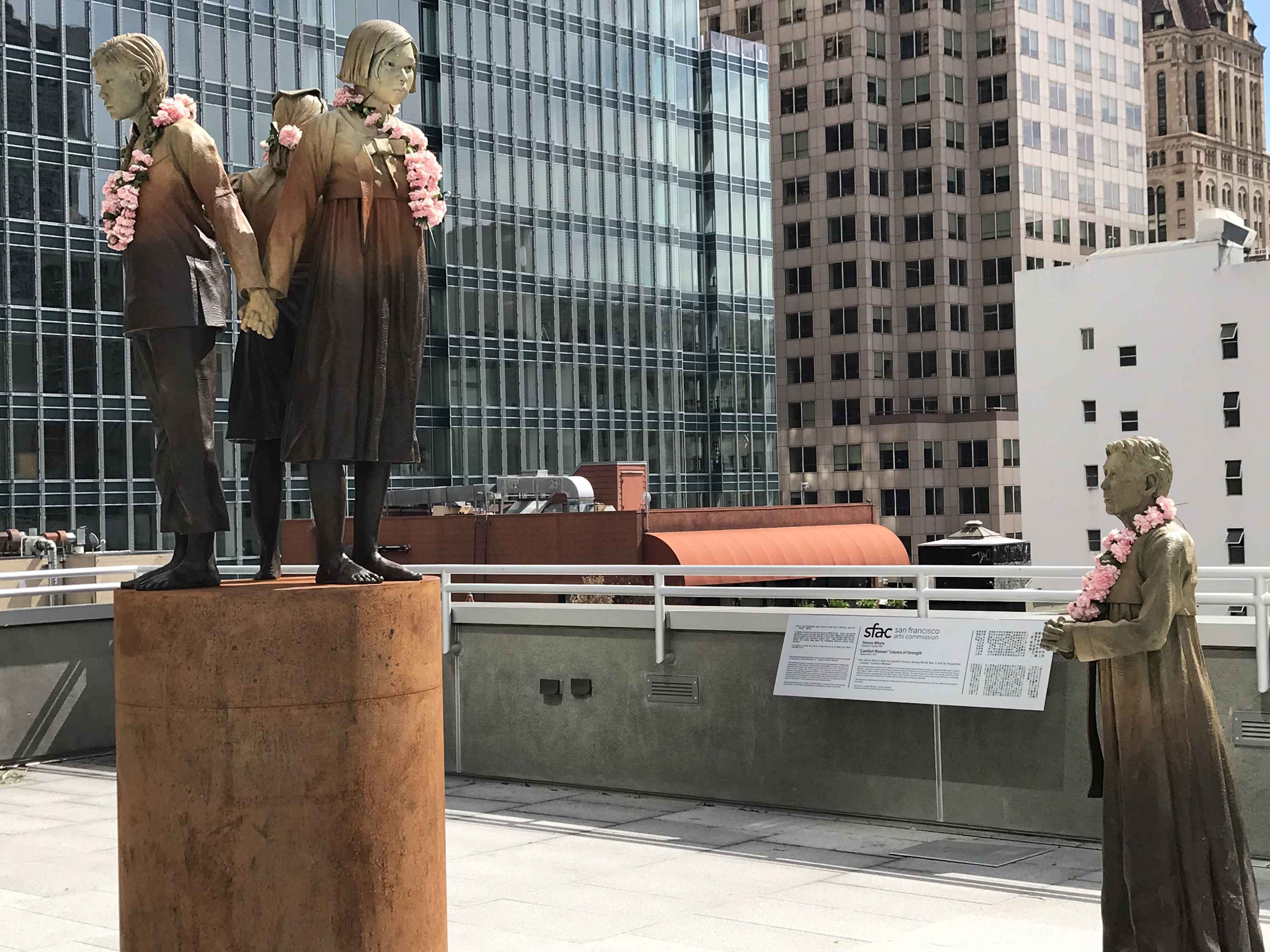
“Comfort Women’s” Column of Strength, San Francisco. Photo by Phyllis Kim.
The Japanese Military’s “Comfort Women”
A reader might wonder, “Of all the instances of sexual violence during conflicts, what makes the Japanese military ‘comfort women’ case so significant?” Several factors contribute to its importance, but most notably, the system of sexual slavery implemented by the Japanese military during the Asia-Pacific War and World War II stands out as one of the largest and most extensively organized systems of military sexual slavery in the twentieth century. This distinction is based on the sheer number of women affected, the vast geographical scope of the system, and its prolonged duration, spanning over a decade from 1932 to 1945.
The first “comfort station”—a specialized brothel designated for military use—is believed to have been established as early as 1932,9 a decade before the US joined World War II. The system was initially created to control the spread of venereal disease, boost troop morale, and reduce incidents of rape of local women in occupied territories.10 Following international outrage over the horrific reports of civilian massacres and mass rapes in Nanjing (mid-December 1937–early February 1938), the Japanese military rapidly expanded the system, establishing comfort stations throughout China, Southeast Asia, the Pacific Islands, and even in Japan and Korea (see Appendix A).11
Estimates vary, but scholars generally agree that at least 50,000 to 200,000 women and girls were forced into these military-run brothels.12 New research by Chinese scholars suggests there may have been over 200,000 Chinese victims alone who have not yet been fully accounted for, potentially raising the total number closer to 400,000.13 Many of the victims were from Korea—then under Japanese colonial rule—but women from China, the Philippines, Indonesia, Taiwan, other parts of Southeast Asia, the Pacific, as well as some European women in occupied territories, were also enslaved. These women were often deceived, abducted, or coerced, and subjected to unimaginable violence, including repeated sexual assault, physical abuse, and, in many cases, death.
What makes this case especially egregious is not only the scale and brutality of the system but also the Japanese government’s ongoing denial and refusal to accept legal responsibility. Despite overwhelming historical evidence—including survivor testimonies, confessions from former Japanese soldiers, and declassified military documents—Japan’s official responses have ranged from outright denial and minimization to symbolic gestures that fall short of genuine legal accountability.14
Since the early 1990s, survivors have spoken out courageously, demanding six key forms of redress:
(i) formal acknowledgment by the Japanese government; (ii) a sincere, unequivocal apology; (iii) legal reparations; (iv) full disclosure of all relevant documents; (v) prosecution of those responsible; and (vi) continued public education in Japan about this history.15 Prior to the 1990s, the existence of the “comfort women” system and its survivors had been publicly known in Korea, Japan, and its former occupied territories through memoirs, journalism, films, and earlier testimonies, including the case of Bae Bong-gi in the 1970s.16 However, it was not until 1991 that the survivors themselves began to speak out publicly and collectively, beginning with Kim Hak-sun in South Korea and followed by survivors in other countries. While the issue is often framed as a bilateral diplomatic dispute between Japan and its former colonies, the implications are far-reaching and global.17 The “comfort women” system stands as a landmark case in the international understanding of CRSV, significantly influencing key human rights frameworks, including United Nations resolutions addressing wartime sexual violence.18
For educators, the “comfort women” issue offers a vital historical case study and a powerful lens through which to examine the intersections of gender, war, colonialism, human rights, and justice. It underscores that sexual violence in armed conflict is not an inevitable byproduct of war, but often the result of deliberate policy decisions.19 Teaching this history with honesty and compassion honors the survivors, breaks the silence historically imposed on victims, and helps future generations understand the profound consequences of impunity.
Memorializing the Victims
Just as history textbooks recount the legacy of war, memorials across the globe commemorate conflict—most often honoring male warriors and generals. In contrast, memorials dedicated to women, particularly the victims of military sexual slavery during World War II, stand as powerful symbols of justice. These “comfort women” memorials not only demand accountability on behalf of survivors but also express solidarity from the communities that host them.20 They serve as places for education and remembrance, ensuring that future generations grasp the profound human cost of wartime sexual violence.
Over the past two decades, a global movement has gained momentum to recognize and memorialize the “comfort women” victims—from Seoul to Berlin, Sydney to Manila, and across North America. In these communities, memorials have been erected to honor the victims, speak truth to history, and confront persistent forces of denial. In the United States, cities like Glendale and San Francisco in California have become key battlegrounds in this movement, marked both by their victories in remembrance and the intense challenges they faced.
In July 2013, Glendale unveiled the first “comfort women” statue in a U.S. city park, following the earlier installation of a memorial plaque in Palisades Park, New Jersey, in 2010—the first on U.S. city property. The bronze statue in Glendale, depicting a seated girl beside an empty chair, was the fourth iteration of the original Peace Monument in Seoul. It quickly became a focal point of community solidarity and a flashpoint of international controversy. A lawsuit backed by Japanese nationalist interests sought to compel the city to remove the statue, arguing it interfered with U.S. foreign policy. The federal district court dismissed the lawsuit, and the Ninth Circuit affirmed the dismissal. In 2017, the U.S. Supreme Court declined to review the case, leaving the district court judgement intact and final.21
San Francisco followed in 2017 with the installation of the Comfort Women’s Column of Strength, selected through a call for artists. The memorial features three girls—Korean, Chinese, and Filipina—standing hand-in-hand, watched over by an elderly survivor. Like its predecessors, it sparked backlash. In a highly publicized response, Osaka, a city in Japan, severed its six-decade sister-city relationship with San Francisco in protest, underscoring how local remembrance can resonate globally.
Despite opposition, these memorials endure. They bear witness to historical truth, amplify the voices of survivors, and stand as lasting symbols of justice, solidarity, and resistance to erasure. In the next section, educators will find a lesson plan demonstrating how to teach this history through the lens of “comfort women” statues.
Using “Comfort Women” Statues in Teaching
This lesson plan is designed for two 45-minute class periods and can be used in high school or college-level history courses. It was piloted in a mixed-gender high school classroom in a Midwest rural town with approximately twenty juniors and seniors. To arrange the pilot, the first author contacted a social studies teacher and inquired about testing the lesson. The teacher agreed and selected her Social Issues course, noting that the ongoing controversy surrounding the “comfort women” history constitutes a representative case study for examining contemporary social issues. As described in the following section, this lesson avoided graphic images and explicit language. It was well received by students. This lesson can easily be taught in other courses, such as World History (particularly in the World War II unit), Global Studies, Human Rights Studies, and Women’s Studies. It is recommended that students complete a lesson on the historical background of the Japanese military’s “comfort women” before engaging with this lesson.
Since statues are a form of visual art, the primary instructional approach employed in this lesson is the Visual Thinking Strategy (VTS). VTS is an inquiry-based method that enhances students’ ability to describe, analyze, and interpret visual imagery through guided discussion. This lesson utilizes the Peace Monument, also known as the Girl Statue, in Glendale, California, as a case study to demonstrate how VTS can be effectively implemented in the classroom. The same strategy can be applied to other “comfort women” statues. Currently, there are fourteen such statues and memorials located throughout the United States.22
When using VTS in the classroom, teachers should be mindful of two key practices to avoid. First, refrain from praising individual student responses, as doing so may inadvertently discourage others from offering creative or divergent perspectives. Second, avoid providing factual information during the VTS discussion. Instead, encourage students to observe and reason through their interpretations. If a student arrives at a factually incorrect conclusion, offer gentle correction only if absolutely necessary—and do so during the broader classroom lesson, not during the VTS conversation. The primary objective of VTS is not to convey information, but to foster critical and creative thinking. More information about VTS is available in Appendix B.
Period 1: If Statues Could Talk
In this lesson, students will use their observational, inferential, and questioning skills to analyze a “comfort women” statue and demonstrate their understanding of its symbols by designing their own “comfort women” memorial.
As an opening discussion, the teacher can use the “think-pair-share” strategy and project these two questions on the board in front of the classroom: 1. Have you seen any statues or memorials before? If so, what was it? 2. What functions do statues and memorials serve? After students share their responses, inform them that there are numerous statues and memorials in the United States and other countries to commemorate the sufferings of the “comfort women,” and that they will continue learning about the “comfort women” through these memorials.
If this lesson is taking place on-site, ask students to look closely at the statue and examine it quietly for a minute or two. Ask them to focus only on the statue, not the plaque. If this lesson is taught in the classroom, teachers can use the images in Appendix C and project them on the classroom board. Ask students to look closely and examine it quietly for a minute or two. Next, ask VTS probing questions, which are listed in Appendix C. After the VTS discussion, thank students for their thoughts and share the information about the statue at the bottom of Appendix C.
For the rest of the class, students will work in small groups on a design activity. Ask each group to brainstorm a design of their own “comfort women” statue. Each group will sketch a design that must include a few symbols representing “comfort women.” Remind students that their sketches do not need to be perfect. Give students fifteen minutes to work on their designs. When each group finishes their design, ask them to take a photo of it.
As an assessment, each student will complete a reflection journal, addressing the following points:
-
Insert the photo of your group design at the beginning of the journal entry.
-
What symbolism has your group included in your design? Why did your group choose those symbols?
-
How has the statue/memorial analysis in today’s lesson helped you understand the “comfort women” issue?
Period 2: Why Are “Comfort Women” Statues Controversial?
In this lesson, students will examine why “comfort women” statues are controversial and analyze the efforts by history deniers to obstruct their installations or demand their removal. Students will also propose strategies to protect these memorials as sites of historical memory and human rights education.
Case studies may include the federal lawsuit against the City of Glendale seeking the removal of the Peace Monument from Central Park, as well as the removal of “comfort women” statues in Manila, Philippines, and Berlin, Germany, following sustained diplomatic pressure from Japan.
As an opening, the teacher first recaps the content of the last class and then informs students that there are numerous “comfort women” statues and memorials across the U.S. and in other countries. While statues and memorials serve an essential function of preserving history, many of the “comfort women” statues and memorials have become highly controversial.
Students will be engaged in a News Gallery activity. Divide the class into three groups. Give each group a news article to read.
-
Group One: “Berlin borough orders removal of ‘comfort women’ statue following pressure from Japan,” by Jang Ye-ji, Hankyoreh https://english.hani.co.kr/arti/english_edition/e_international/1150179.html
-
Group Two: San Francisco accepts “comfort women” statue, BBC https://www.bbc.com/news/world-asia-42092477
-
Group Three: Statue honoring WWII sex slaves removed in Philippines, Associated Press https://apnews.com/general-news-1a7abc1a5a744e2994fab609944eab5c
After reading the assigned article, each group will discuss the following questions and share their answers with the rest of the class.
-
What’s the title of your news article?
-
What does the title tell you?
-
Who is opposing the statue? Why?
Divide the students into groups of three or four. Assign a different testimony from this website to each group: https://www.international.ucla.edu/cks/care/comfortwomen_speakup. Ensure the chosen testimonies are similar in length so that groups can finish reading and discussing around the same time. Let students know that they will read or watch their assigned testimony and then, as a group, discuss these questions to be ready to share with the rest of the class:
-
Where was this survivor from?
-
What was her story?
-
How does her testimony deepen your understanding of why remembrance and memorialization matter?
-
What makes the “comfort women” statues/memorials controversial?
In the last five minutes of the class, assign the homework. Allow students to choose one of the following options to work on:
-
Reflection Journal
-
What makes the “comfort women” statues/memorials controversial?
-
What can you do to help protect the “comfort women” statues/memorials?
-
-
Create a Poster
-
Students will work in small groups to create a poster that raises public awareness of the importance of the “comfort women” statues/memorials. Exhibit the posters in the school (like the school library, gym, or hallways) or at a local public library.
-
-
Write a News Release
-
Students will work in small groups, write a news release, and send it to the local newspaper. In the news release, they must address the “comfort women” history and why the public needs to protect the “comfort women” statues/memorials.
-
-
Send a Letter of Support to Glendale/San Francisco or Berlin (Choose one)
-
Working in small groups, students can write and send a letter to the mayors of Glendale (CA) and San Francisco (CA), thanking them for protecting the memorials.
-
On October 17, 2025, the Peace Statue in the Mitte District of Berlin was removed. Working in small groups, students can write and send a letter to relevant Berlin officials or community organizations, expressing their support for restoring or relocating the memorial to a public site.
-
Conclusion
In the summer of 2025, at an international teachers’ conference on difficult history education in Seoul, South Korea, when asked why they chose to teach difficult histories in their classrooms, an American teacher responded, “If I don’t teach the correct version of history, the revisionists will.” This statement resonates strongly with the teaching of “comfort women” history, where presenting an accurate account is essential to counter historical revisionism. Using memorials or statues to teach the history of “comfort women” enhances students’ observational and critical thinking skills, inspires them to engage empathetically with the past, question dominant narratives, and recognize the enduring impact of historical injustices. By confronting these silences through tangible symbols of memory, educators empower students to become informed global citizens who understand that remembering is not just an act of looking back, but a commitment to justice in the present and the future.
Notes
1 Imperial War Museum, “Unsilenced: Sexual Violence in Conflict,” accessed on June 5, 2025, https://www.iwm.org.uk/events/unsilenced-sexual-violence-in-conflict
2 Carol Rittner and John K. Roth, Rape: Weapon of War and Genocide (St. Paul, MN: Paragon House, 2012).
3 Maria Eriksson Baaz and Maria Stern, Sexual Violence as a Weapon of War? Perceptions, Prescriptions, Problems in the Congo and Beyond (London: Zed Books, 2013).
4 Jing A. Williams and Phyllis Kim, Teaching Conflict-Related Sexual Violence through Human Rights Education: The Case of the Japanese Military’s “Comfort Women” (Silver Spring, MA: National Council for the Social Studies, 2025); David Averre, “Ukrainian Men Describe Rape Hell in Putin’s Worst Prison: Stripped Naked on Arrival. Constant Nightmare ‘Animal Screams’. And How Russians Codenamed Different Sexual Abuses ‘Calling Biden’ or ‘Calling Zelensky,’” Daily Mail, April 7, 2025, https://www.dailymail.co.uk/news/article-14579417/Ukrainian-men-rape-hell-Putins-worst-prison-Stripped-naked-arrival-Constant-nightmare-animal-screams-Russians-codenamed-different-sexual-abuses-calling-Biden-calling-Zelensky.html; Denis Mukwege, “Congo is Bleeding. Where is the Outrage?,” The New York Times, February 19, 2025, https://www.nytimes.com/2025/02/19/opinion/congo-rwanda-rebels-war.html; David Patrikarakos, “The Russian Rape Machine,” August 17, 2025, in Apocalypse Now?, produced by Phillip Wilding, podcast, MP3 audio, 00:45:19, https://open.spotify.com/episode/65VbcQIDgcP74Dtz7JFtkc; United Nations, “UN Special Representative Patten Urges for Immediate Action as Sexual Violence Surges amid Gang Violence in Haiti,” Office of the Special Representative of the Secretary-General on Sexual Violence in Conflict, June 4, 2025, https://www.un.org/sexualviolenceinconflict/press-release/un-special-representative-patten-urges-for-immediate-action-as-sexual-violence-surges-amid-gang-violence-in-haiti/.
5 Denis Mukwege, “Denis Mukwege Nobel Lecture,” The Nobel Prize, accessed on June 5, 2025, https://www.nobelprize.org/prizes/peace/2018/mukwege/lecture/.
6 Jing A. Williams and Phyllis Kim, Teaching Conflict-Related Sexual Violence through Human Rights Education: The Case of the Japanese Military’s “Comfort Women” (Silver Spring, MA: National Council for the Social Studies, 2025).
7 Jing A. Williams and Mary Johnson, “Comfort Women: Enhancing Students’ Global Awareness through Human Right Education,” Social Studies 111, no. 5 (2020).
8 We used the term “comfort women” in quotation marks because it is the term that appeared in Imperial Japanese military documents during the 1930s–1940s, rendered in Japanese as 慰安婦 (ianfu). Although the term is a euphemism that obscures the coercive nature of the system, it remains the historically documented terminology used by the military at the time. By retaining the term in quotation marks, we signal both its historical specificity and its problematic origins. We recognize that alternative terms such as survivors of the Japanese military sexual slavery system are used in contemporary scholarship to emphasize the coercion and human rights violations involved. However, because our lesson examines statues and public memory debates in which the term “comfort women” is still commonly employed, we chose to use the historically attested term, while marking it with quotation marks to avoid reproducing the euphemistic framing uncritically.
9 Yoshiaki Yoshimi, Comfort Women: Sexual Slavery in the Japanese Military During World War II (New York: Columbia University Press, 1995).
10 Ibid.
11 Yuki Tanaka, Japan’s Comfort Women: Sexual Slavery and Prostitution During World War II and the US Occupation (New York: Routledge, 2002).
12 See footnote 9.
13 Peipei Qiu, Chinese Comfort Women: Testimonies from Imperial Japan’s Sex Slaves (New York: Oxford University Press, 2013).
14 Pyong Gap Min, Countering History Denialism: The Assault on Truth about ‘Comfort Women,’ ed. Pyong Gap Min (Singapore: WSPC, 2025).
15 United Nations Economic and Social Council, Report of the Special Rapporteur on violence against women, its causes and consequences, Radhika Coomaraswamy, in accordance with Commission on Human Rights resolution 1994/45. New York, NY: UN Headquarters, 1996, https://digitallibrary.un.org/record/228137?v=pdf
16 Lee Jeong-gyu, “Remembering Bae Bong-gi, the First Comfort Woman to Testify about Her Experiences as Sex Slave,” Hankyoreh, March 18, 2019, https://english.hani.co.kr/arti/english_edition/e_international/886367.html.
17 See footnote 6.
18 UN Resolution 1820, https://digitallibrary.un.org/record/629882?v=pdf; UN Resolution 1888, https://digitallibrary.un.org/record/666430?v=pdf.
19 See footnote 2.
20 Vera Mackie, “An Avatar of Peace: Commemorating Human Rights Activism,” in Visualising Human Rights, ed. Jane Lydon (Crawley, Western Australia: The University of Western Australia Publishing, 2018), 113-140.
21 Agnes Constante, “Supreme Court Declined Case over Lawsuit to Remove ‘Comfort Women’ Memorial,” NBC News, March 31, 2017, https://www.nbcnews.com/news/asian-america/supreme-court-declines-case-over-lawsuit-remove-comfort-women-memorial-n740996
22 Blackburn Park II, Brookhaven, GA; Veterans Memorial Eisenhower Park, Westbury, NY; Fairfax County Government Center, Fairfax, VA; Palisades Park Public Library, NJ; Bergen County Courthouse, Hackensack, NJ; Trinity Episcopal Church, Cliffside Park, NJ; Constitutional Park, Fort Lee, NJ; Liberty Plaza, Union City, NJ; Korean American Society of Connecticut, Hamden, CT; Korean American Cultural Center, Southfield, MI; St.
Mary’s Square, San Francisco, CA; Glendale, CA; Garden Grove, CA; Sonoma State University, CA.
Appendix A. Map of “Comfort Stations”
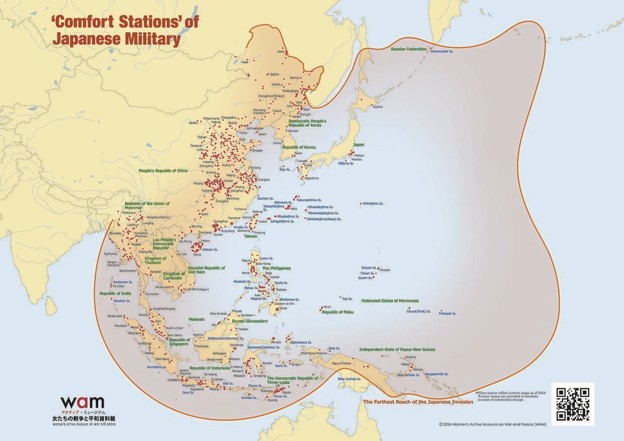
Japanese Military Comfort Station Map. Courtesy of © Women’s Active Museum on War and Peace (WAM), https://wam-peace.org/ianjo/
Appendix B. Online Resources for VTS
Key Sources:
-
VTS Home: https://vtshome.org
-
VTS Watershed: https://www.watershed-ed.org
Other Sources:
-
Edutopia. Using VTS in the Classroom: https://www.edutopia.org/article/using-visual-thinking-strategies-classroom/
-
Embracing Our Differences VTS: https://www.embracingourdifferences.org/vts
-
George W. Bush Library – Art Education Toolbox: VTS: https://www.georgewbushlibrary.gov/sites/default/files/2017-06/VisualThinkingStrategies_Web.pdf
-
Long Island Children’s Museum VTS: https://www.licm.org/media/filer_public/e6/2f/e62fecc5-2e9c-4043-b04f-ffed33204dad/art_ programs_download_basic-vts-at-a-glance.pdf
-
Miami Dade College VTS: https://libraryguides.mdc.edu/vts
-
Milwaukee Art Museum VTS: http://teachers.mam.org/resource/visual-thinking-strategies-vts/
-
New York Times VTS: https://www.nytimes.com/column/learning-whats-going-on-in-this-picture
Appendix C. Peace Monument, Glendale, CA
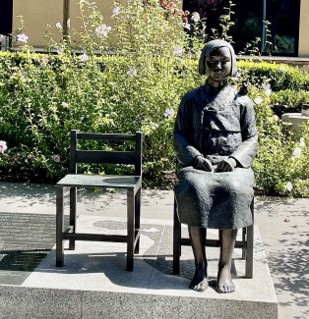
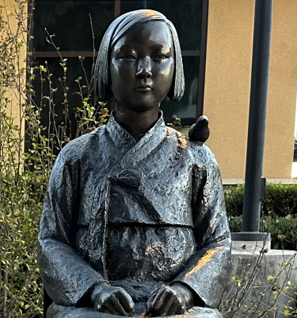
Image 1 (top). Peace Monument, Glendale, CA. This monument is the fourth iteration of the original Statue of Peace in Seoul, Korea, designed by Kim Seo-kyung and Kim Eun-sung. Image 2 (bottom) provides a closer look at the same statue. Photos by Phyllis Kim.
VTS Discussion Questions:
After asking each of the following questions, avoid praising students for their responses. Simply summarize student responses using neutral language and tone. For example, Maria notices the girl’s bare feet, or Ben suggests that… This keeps the conversation open to interpretations by other students.
-
What’s going on in this piece of artwork?
-
What do you see that makes you say this?
-
What more can you find?
Share the following information with the students after the VTS activity. The information below is directly from the plaque beside the statue. Let students know that art is open to interpretation, so the script on the plaque is not the only possible correct description; rather, it is the artist’s conceptualization, which does not diminish students’ interpretations of the art.
-
Torn hair symbolizes the girl being snatched from her home by the Imperial Japanese Army.
-
Tight fists represent the girl’s firm resolve for the deliverance of justice.
-
Bare and unsettled feet represent having been abandoned by the cold and unsympathetic world.
-
Bird on the girl’s shoulder symbolizes a bond between us and the deceased victims.
-
Empty chair symbolizes survivors who are dying of old age without having yet witnessed justice.
-
Shadow of the girl is that of an old grandma, symbolizing the passage of time spent in silence.
-
Butterfly in shadow represents hope that victims may resurrect one day to receive their apology.