
Chinese Food Beyond the Stereotypes: Eating, Encounter, and Adaptation from Northeast and Southwest China to Flushing, New York
by Jinglin Piao and Tami Blumenfield
Download the PDF version of this article for classroom use
Tami Blumenfield is a sociocultural anthropologist, China expert and educator, and media producer originally from Milwaukee, Wisconsin. She has published on gender, ethnic identity, cultural heritage politics, tourism, changing family forms, and gender-balanced communities, particularly the Mosuo of southwest China. Her work with the Mosuo has been featured on NBC, BBC Radio, and National Geographic Television. Dr. Blumenfield received PhD and MA degrees in Sociocultural Anthropology from the University of Washington and an MLIS from the University of South Carolina, and was a Kui Ge Scholar in the School of Ethnology and Sociology at Yunnan University from 2019–2024. She is Director of Scholar Programs and Education at the Elling Eide Center in Florida.
Jinglin Piao recently returned to China after completing her doctoral dissertation in Anthropology at Cornell University. Her research interests also include body, gender, ethnicity, and proliferation of trades. Her work has been presented at American Anthropological Association and Association for Asian Studies annual meetings, and she led a four-part Lunch and Learn Series about Chinese cuisine for the New York-based China Institute. She is a fluent speaker and reader of Mandarin Chinese, Korean, and English. Previously, she worked with Chinese food delivery drivers in Flushing, NY, for labor justice and work protection.
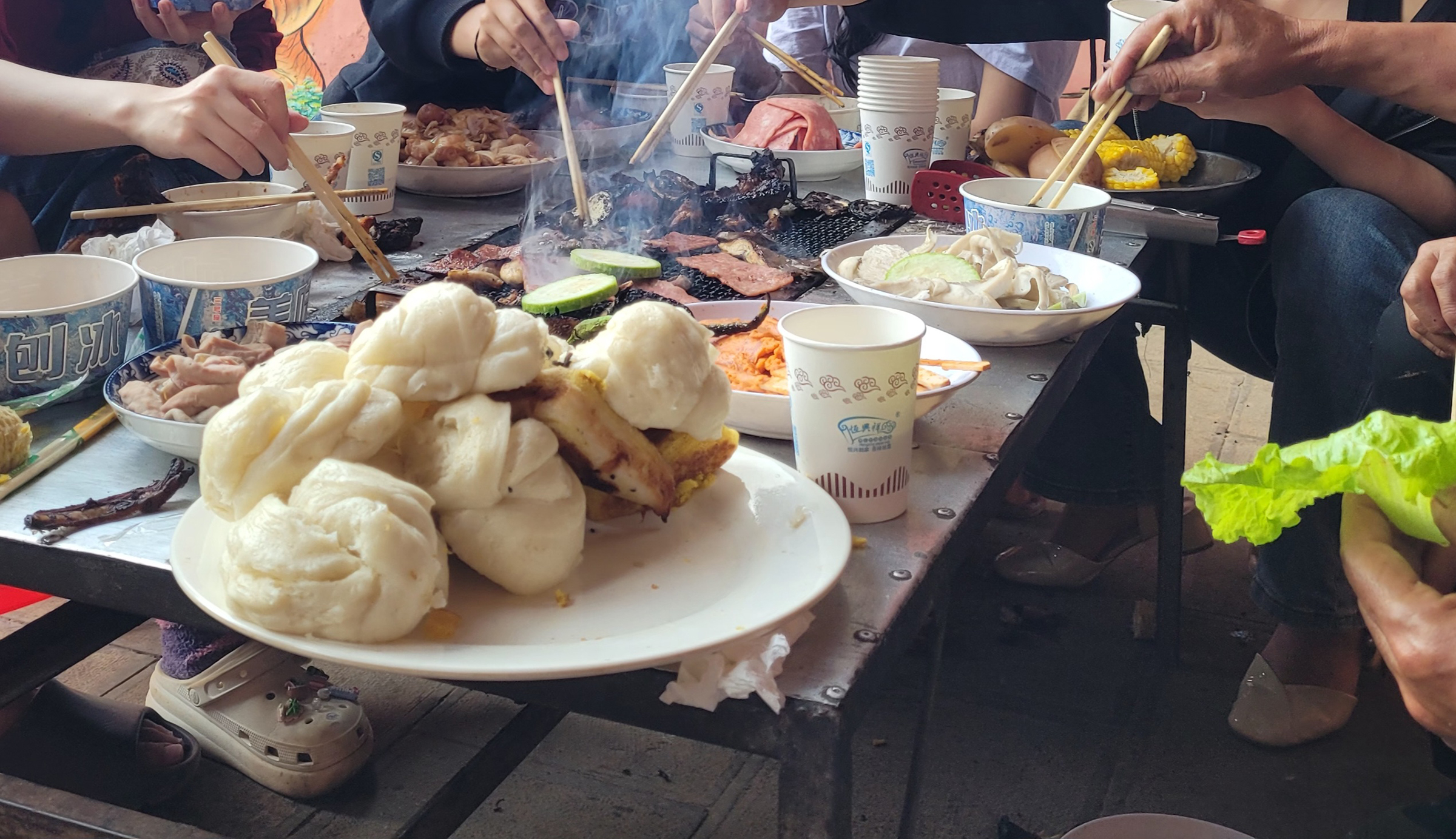
A Mosuo family in a southwest China village celebrates a child's birthday by grilling meats and vegetables, accompanied by steamed buns, corn, and potatoes. The foods and communal preparation reflect how diverse cultural and culinary practices are integrated in 21st-century China. Photograph by Tami Blumenfield.
Introduction
When people think about Chinese food, they often think about stir-fried dishes and rice, and maybe roast duck. But given that China is a vast country with a tremendously diverse population, the reality is much more complex. In this article, we will showcase China’s rich culinary landscape, thinking through what “Chinese food” means by examining a broader range of foods, as well as the practices of eating and the social mores built around food. We explore four key areas: clan and lineage solidarity; the migration history of the Han, the ethnic majority that makes more than 90 percent of China’s population; foodways of people from other ethnic backgrounds, both within China and across international borders; and the ways that translocal practices reestablish and reinvent themselves in new regions.1 Looking at how food is produced in Flushing (a New York City neighborhood) and at its community of eaters also opens up conversations about the population shifts and labor challenges that accompany global relocations.
This article draws on both ethnographic fieldwork and years of personal eating experiences by the authors. Jinglin Piao grew up in mainland China, at Yanij, close to the Korean peninsula. For Tami Blumenfield, growing up in Wisconsin, “Chinese food” meant special occasion dining at a fancy Northern Chinese-style family restaurant. Blumenfield was completely startled when she moved to southwest China’s Yunnan Province and encountered a riot of flavors that she had never before imagined. In contrast, Piao’s move from China to the northeastern United States—and subsequent adjustment to the restrained foodways of upstate New York—brought a new awareness of how taste, identity, and memory travel across borders. Later, in New York City, Piao encountered the vibrant immigrant food scenes of neighborhoods like Flushing, Queens—where she explored a wide range of Chinese regional cuisines.2
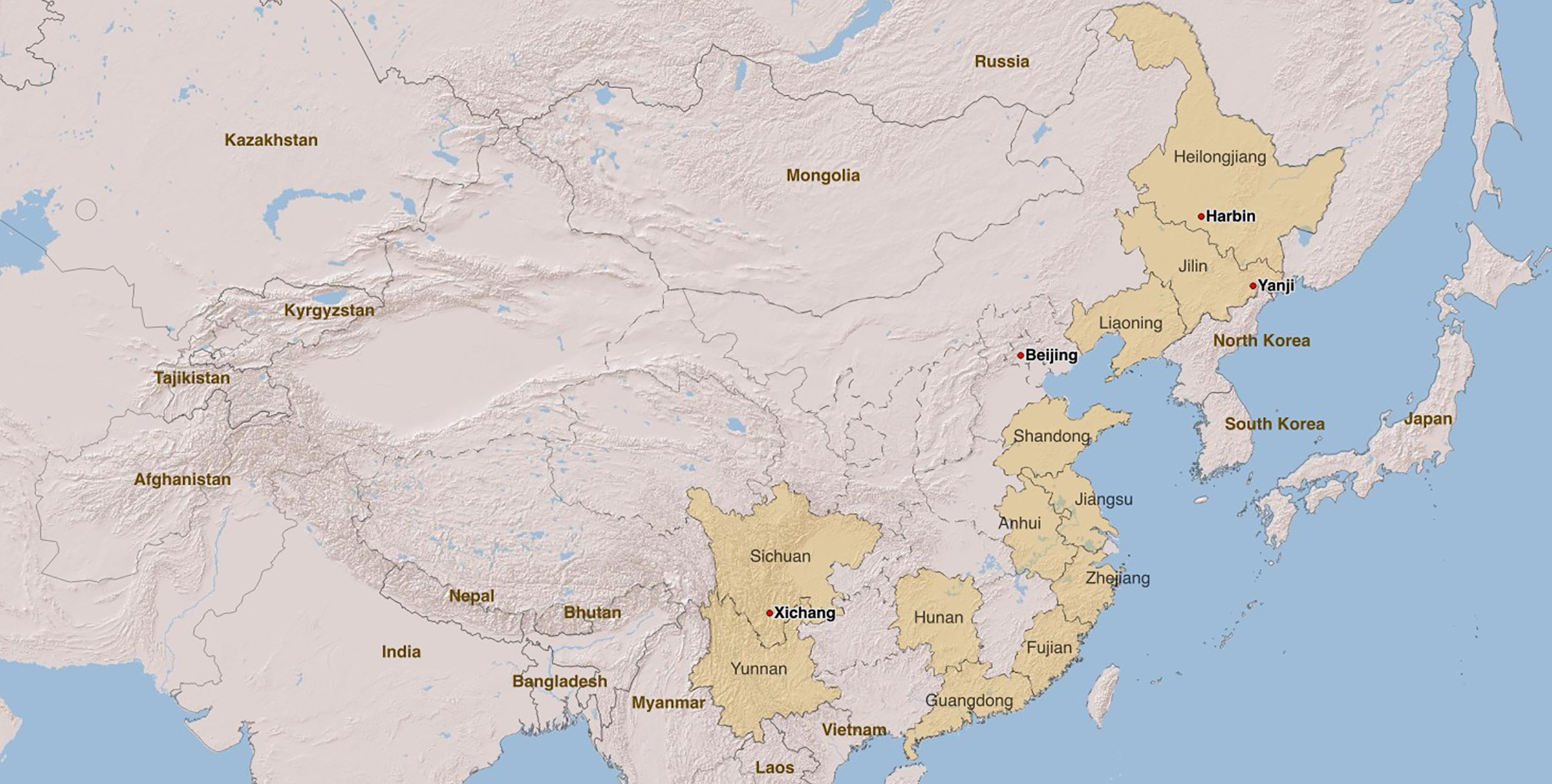
Figure 1: The People’s Republic of China and neighboring countries, highlighting areas discussed in this article. Map created by Rolph Recto.
Historical Cuisine Movements to the Northern Parts of China
To understand the diversity of what we usually oversimplify as “Chinese food,” we need to go back hundreds of years. Chinese regional cuisine is often classified into “Eight Great Traditions.” These include cuisine from the present-day provinces of Sichuan in the southwest; Guangdong (Canton) and Fujian in the southeast; Shandong, Jiangsu, Zhejiang, and Anhui in the east; and Hunan in the inland central area (Figure 1). Among these, Shandong (Lu) cuisine stands out as the only major northern school, known for its hearty, salty flavors, and strong historical ties to the imperial kitchen. Shandong (Lu) cuisine can still be found in the capital of China, Beijing, where its influences have been married with other regional flavors and ethnic traditions.3
Indeed, Beijing food reflects far more than a northern tradition or style. Beijing is best understood as a culinary meeting point. There, Shandong techniques intersect with delicate Huaiyang dishes (from Jiangsu province) brought by high-level officials’ personal chefs, Muslim halal food, and banquet customs from the Manchus, who invaded from Northeastern China to establish China’s last dynasty.4 One emblematic dish is Peking Duck, now considered the crown jewel of Beijing cuisine. Its origins, however, lie in Nanjing and the Jiangsu region, where roasted duck was a specialty during the Southern Capital period of the Ming dynasty (1368–1644). When the Ming dynasty relocated its capital from the south to the north in 1421, moving from Nanjing to Beijing, it brought chefs trained in the Huaiyang region to the northern court, where their refined methods and culinary techniques influenced imperial kitchens for centuries.5 These chefs—renowned for their elegant knife work and skillful balance of sweet and savory flavors—brought the roasted duck dish north. Generations of court chefs further refined Peking Duck, pairing crisp lacquered skin with thin pancakes and sweet bean sauce.
The influence of Lu (Shandong Province) cuisine in Beijing is equally significant. Its robust use of garlic, scallions, and long-simmered broths continues in popular Beijing staples such as zhajiangmian (noodles with fried soybean paste), braised pork, and a variety of wheat-based snacks. Meanwhile, the contributions of Hui Muslim communities—long established in Beijing’s neighborhoods—can be seen in halal offerings like lamb skewers, beef bakeries, and spiced offal dishes.6 And the legacy of Manchu influence lives on in Beijing’s formal dining customs: elaborate multi-course banquets, cold and pickled starters, and symbolic dishes served during major festivals.
In short, food eaten in contemporary Beijing reveals Chinese cuisine to be not a singular tradition, but rather a dynamic, layered phenomenon shaped by migration, empire, ethnicity, and class. It stands as an accessible yet complex example of how taste and power have long intertwined in Chinese history.
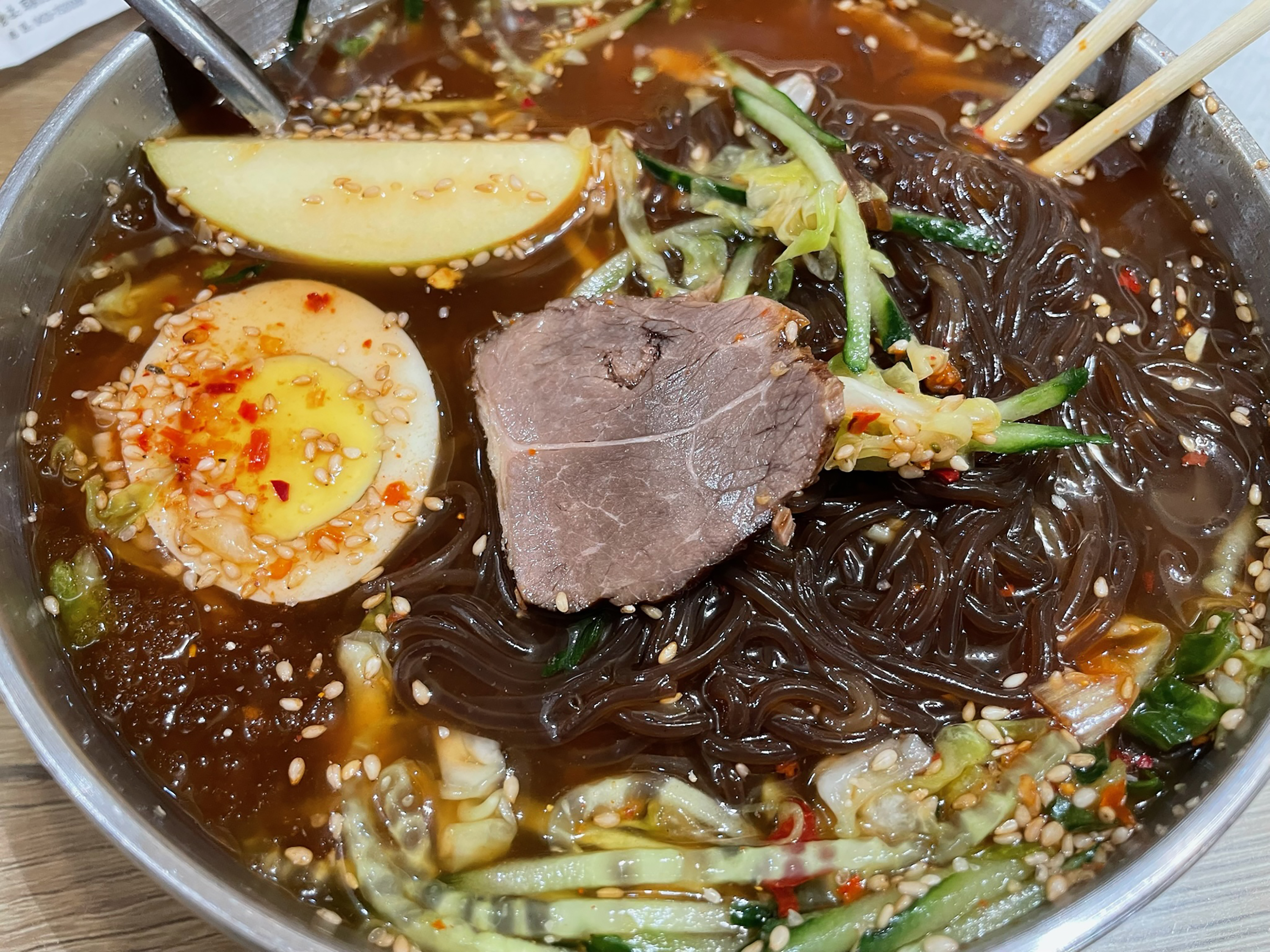
Figure 2: Yanbian-style Cold Noodles. In Korean, it is called naengmyeon 랭면. In Chinese, it is known as leng mian 冷面. It is served in a large bowl made of stainless steel or brass. The soup is ice-cold and made with beef. On the top of noodles were julienned cucumbers, lighted pickled radish or cabbage, slices of boiled beef, and a boiled egg. A few pine nuts and lots of sesame seeds were also sprinkled on the top. Photograph by Shiyi Li.
Food in the Northeastern Borderlands, Near the Korean Peninsula and Russia
In contrast to the imperial and aristocratic culinary heritage of Beijing, Dongbei (Northeast China)—which includes the borderland provinces of Liaoning, Jilin, and Heilongjiang—offers a food tradition rooted in frontier life, rural migration, and ethnic diversity. This area shows how migration, trade, and climate shape what we eat. As people moved, worked, and rebuilt their lives in Dongbei, their foods changed with them, leaving behind clues about how communities adapted to harsh environments and shifting political and economic circumstances.
Historically home to Manchu communities, Dongbei witnessed later waves of Han migration from Shandong Province during the late Qing and Republican eras—known as “Chuang Guan Dong”—who brought with them the wheat-based and braised dishes of Lu cuisine.7 As a result, Dongbei food features stews, pickled vegetables (suancai), and generous portions, seasoned heavily with garlic, vinegar, and soy sauce to tolerate the region’s long and difficult winters.
The Northeast’s Korean community—many descended from 19th-century migrants fleeing natural disasters, starvation, as well as Japanese colonization—created a distinct culinary subregion, especially in the Yanbian Korean Autonomous Prefecture and its capital city, Yanji. Their key contributions, including Korean-style pickled vegetables with red chili pepper powder, and other side dishes, became staples, even among Han Chinese. In addition, a regional adaptation of naengmyeon (a Korean cold noodle dish), using local buckwheat and icy broths of beef soup, became popular (Figure 2). This cold noodle soup was even served at state banquets when North Korean leaders visited China in the 1960s and decades later, in 2018, when North Korean leader Kim Jung Un visited South Korea.
Korean migrants also brought a shift in meat culture. Grilled meats, such as bulgogi beef, gained popularity, contrasting with traditional Dongbei pork-heavy dishes. Food became a marker of identity, especially during periods of political tensions, such as the Korean War (1950–1953). Recently, during the COVID-19 pandemic, Yanbian also emerged as an enclave for food tourism for domestic consumers thanks to the power of social media promoting Yanbian Korean food as a convenient way to enjoy something new without having to go abroad. Tourists to this region along the border with North Korea and Russia could not only try a big bowl of cold noodles and a plate of nicely grilled beef with locally produced dipping sauces, they could also consume Korean-style rice wine with different fruit flavors, specifically developed for the new, wider range of customers from diverse parts of China.
Historical contact with Russia—especially during the late Qing and Republican periods—has also left lasting culinary traces in Dongbei. In cities like Harbin, bakeries continue to sell Russian-style breads, borscht soups, and dairy products that remain uncommon in most other parts of China. These foods were introduced by the Russian engineers, merchants, expatriates, and later refugees who settled in northeastern China following the construction of the Chinese Eastern Railway (1897–1952). As these individuals established homes, businesses, and social institutions, they brought with them culinary traditions that gradually became incorporated into local foodways. For instance, the smoked sausages known as Harbin red sausages (hongchang) were adapted from Russian kielbasa and are now an iconic Northeastern snack. Rye bread, locally called “lieba,” also entered local diets. These foods reflect a legacy of migration, trade, and imperial competition, woven into local tastes.
At the same time, the railway also spurred urbanization, creating a working-class food culture of cheap, hearty meals for laborers—echoed today in street foods like griddle-fried egg rice. Cooked on Russian-style cast-iron griddles, this dish combined leftover rice, eggs, and pickled vegetables for a fast, hot meal.
Later, mass layoffs from state-owned enterprises in the 1990s–2000s devastated the Northeast’s industrial economy but reshaped its food scene. Unemployed workers began opening small food stalls, popularizing dishes like malatang (spicy numbing soup) and guobaorou (crispy sweet-and-sour pork). Carb-heavy, affordable meals, such as dabingzi (thick corn pancakes) regained prominence. Later, as workers moved south, they brought Dongbei cuisine with them—spreading jiaozi (dumplings) and disanxian (potato-eggplant-pepper stir-fry) nationwide.
Today, rapid urbanization and globalization introduce contradictions. While young professionals embrace international brands, older generations revive “collective canteen” dishes like baozi (stuffed buns). Also, traditional preservation methods have declined as refrigeration has become common, changing winter food habits.
From the mass Han settlement to Korean communities in Yanbian, from Russian railway towns to post-socialist layoffs, the region’s food tells a story of survival and reinvention. With its difficult winters, fertile plains, and cultural exchanges with neighboring nations, the Northeast’s food is a living record of resilience—from “chuang guan dong” survival strategies to post-layoff reinventions. Meals are never just sustenance; they are maps of power, movement, and memory.
Food in Southwest China, Home to Nuosu and Mosuo People
Food consumption in southwest China looks very different from that in other parts of the country. In part, geography and terrain explain the difference: this region is home to tremendous biodiversity, with steep river valleys and high mountains where a broad range of ecosystems can be found. Wild and cultivated plants, fungi and crops mean a plethora of flavors and textures, while trading routes passing through these areas bring new edible ideas. Essentials like tea and salt passed along these same routes. And the river gorges and rocky mountain slopes that divide one community from the next have created the space and independence for people to develop and sustain a vast tableau of customs and practices. Here we will look closely at two groups of people who have thrived in the mountain regions of two southwest China provinces: Yunnan (South of the Clouds) and Sichuan (Four Rivers). They are the Nuosu people, descended from fierce warriors with strong clan alliances, and the Mosuo people, whose matrilineal descent practices have created homes that pass down among family members for generations.8
This region is both fertile and difficult to farm. For a long time, Nuosu people practiced swidden cultivation, setting afire patches of forest and cultivating the nutrient-rich soil left behind afterwards, until it stopped producing well. They would then move on to the next place and repeat the process. In the high elevations where they lived, only a few hardy crops grew well: buckwheat and potatoes were staple foods. Many people also raised pigs, goats, sheep and chickens.
Nowadays Nuosu people no longer practice swidden agriculture, and many people have relocated to lower elevations, sometimes moving out of the villages entirely. Even in the cities, they continue to eat foods that draw on their culinary heritage and family traditions, when people would gather around an indoor fire pit waiting for a recently slaughtered pig, killed in honor of visiting guests, to be cooked in a huge pot over the fire (Figure 3). Hunks of meat (tuotuo rou) would be boiled along with buckwheat shaped into patties, producing a fragrant soup broth to complete the meal.9 In cities, the experience is a little different. Instead of sitting on mats on the floor around a smoky fire, holding bowls, people tend to sit on chairs next to large tables, which can accommodate food and drinking bowls. But even in Nuosu city restaurants, rice is usually nowhere to be seen (Figure 4).
Stews that involve boiled meat are also important for Mosuo people, who live in large, extended family households. Their practice has long been to raise pigs, then at a designated time in the autumn, to gather relatives together to butcher several pigs, then process them. First, the men round up and slaughter the pigs. Then they remove the bones and transfer the innards to large basins. Women work with the men to prepare what will eventually become sausages and also begin cooking the fresh meat for immediate consumption. After several very intense hours, the family members, along with neighbors and friends they have invited, join for a very flavorful and fragrant meal. Often, an entire table is filled with pork prepared in various ways.
One pig produces enough meat to last for many months, when preserved carefully and eaten a small bit at a time. Chickens, on the other hand, are eaten in their entirety right away, but only on special occasions. Mosuo families raise chickens for many months and wait until visitors come before taking a live one into the backyard and returning with what will become the centerpiece of the meal. Sharing this special food is a way for the hosts to honor their visitors while also demonstrating their largess and prosperity. After all, a chicken from one’s own flock represents months of effort. Women from the household feed the chickens every morning before shooing them outside to forage. Walking through a village in the late afternoon, one sees flocks of chickens on every doorstep, waiting to be let back in for dinner. To an outside observer, it seems remarkable that every chicken knows its way home. But Mosuo villagers laugh at this naïveté—of course the chickens can find their way! They know where they will be fed. And they trust that they will be tucked away into their coops and kept safe for the night. However, at the appropriate moment, it will be their turn to help those who have raised them have a nourishing, protein-rich meal (Figures 5 and 6).10
These food practices, especially communal eating and cooking, are imbued with creating and maintaining social relations—something of great importance to the Mosuo and Nuosu peoples. Sharing meals is integral to Mosuo families and meat consumption maintains people’s sociality. Mosuo and Nuosu peoples have nurtured foodways that reflect both their identity and spiritual belief. Animal sacrifice and meat preparation are part of people’s ritual and everyday life, structuring social relations. While butchering is professionalized and usually hidden from public sight in today’s modern life and urban settings of contemporary China, the slaughter of pigs, chicken, and sheep are not only frequent but also constitute social fabrics of Mosuo and Nuosu societies in both ritual and mundane manners.
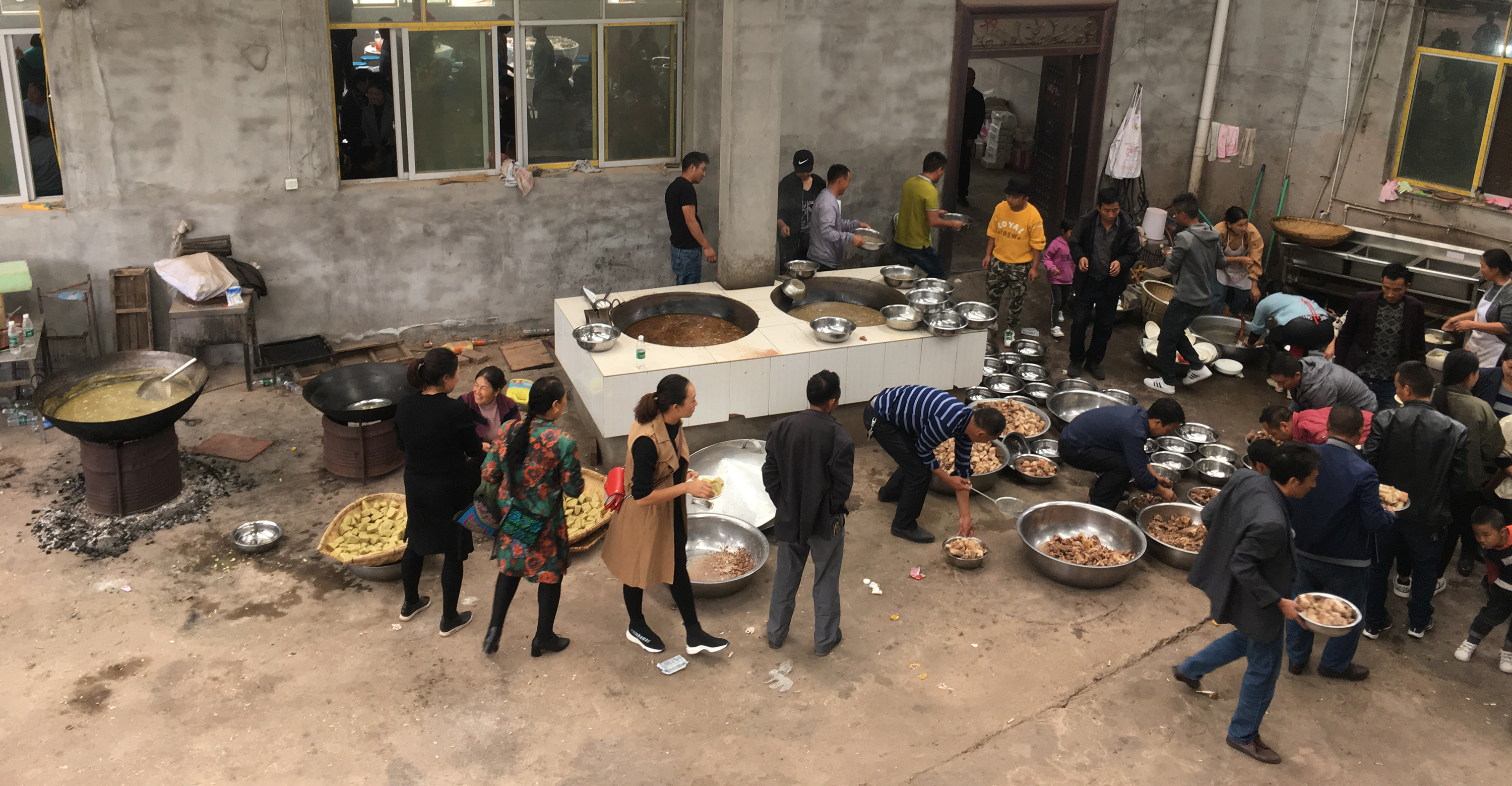
Figure 3: Preparing a Nuosu communal feast in Liangshan, Sichuan Province. In this makeshift courtyard kitchen, women prepare steamed buckwheat cakes while men handle large hunks of boiled pork (tuotuorou, 坨坨肉). Such gatherings typically involve extended family and clan members, reflecting Nuosu traditions of ritual slaughter and collective hospitality. Photograph by Jinglin Piao.
Figure 4: A Nuosu banquet in a Liangshan restaurant. Traditional dishes—tuotuorou (boiled pork), sausages, buckwheat cakes, potatoes, chicken, and tofu—once reserved for New Year feasts are now served year-round to honor guests. Seasonal stir-fried and cold dishes of vegetables, not part of traditional meals, reflect newer dining influences. Unlike home or yard feasts like that portrayed in Figure 3, restaurants adapt these customs for contemporary hosting. Photograph by Jinglin Piao.
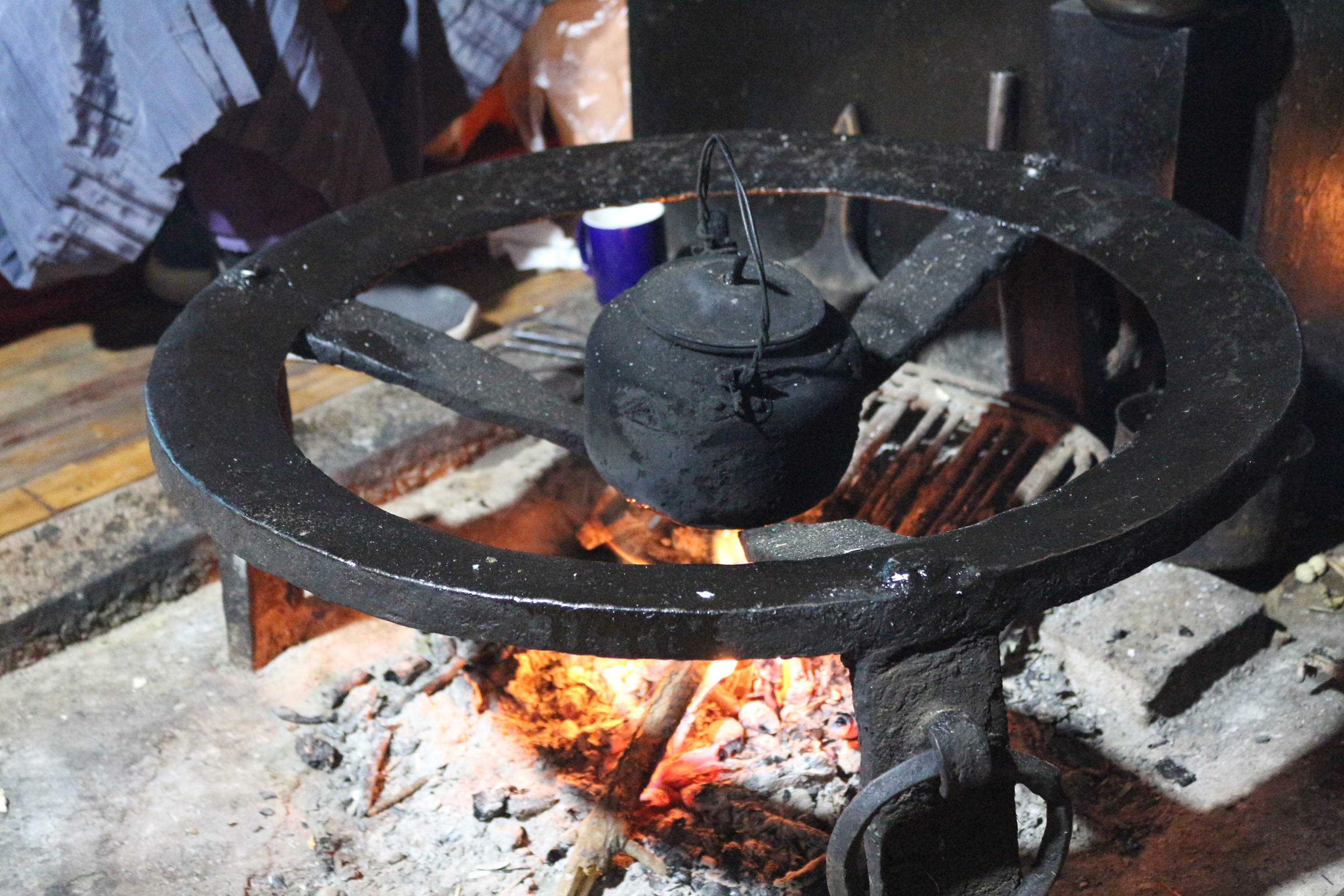
Figure 5: An iron tripod forms the center of the hearth in Mosuo households. Whenever a fire is lit, a tea kettle is usually at work, heating up water for thermos flasks that keep it hot all day. Photograph by Tami Blumenfield.
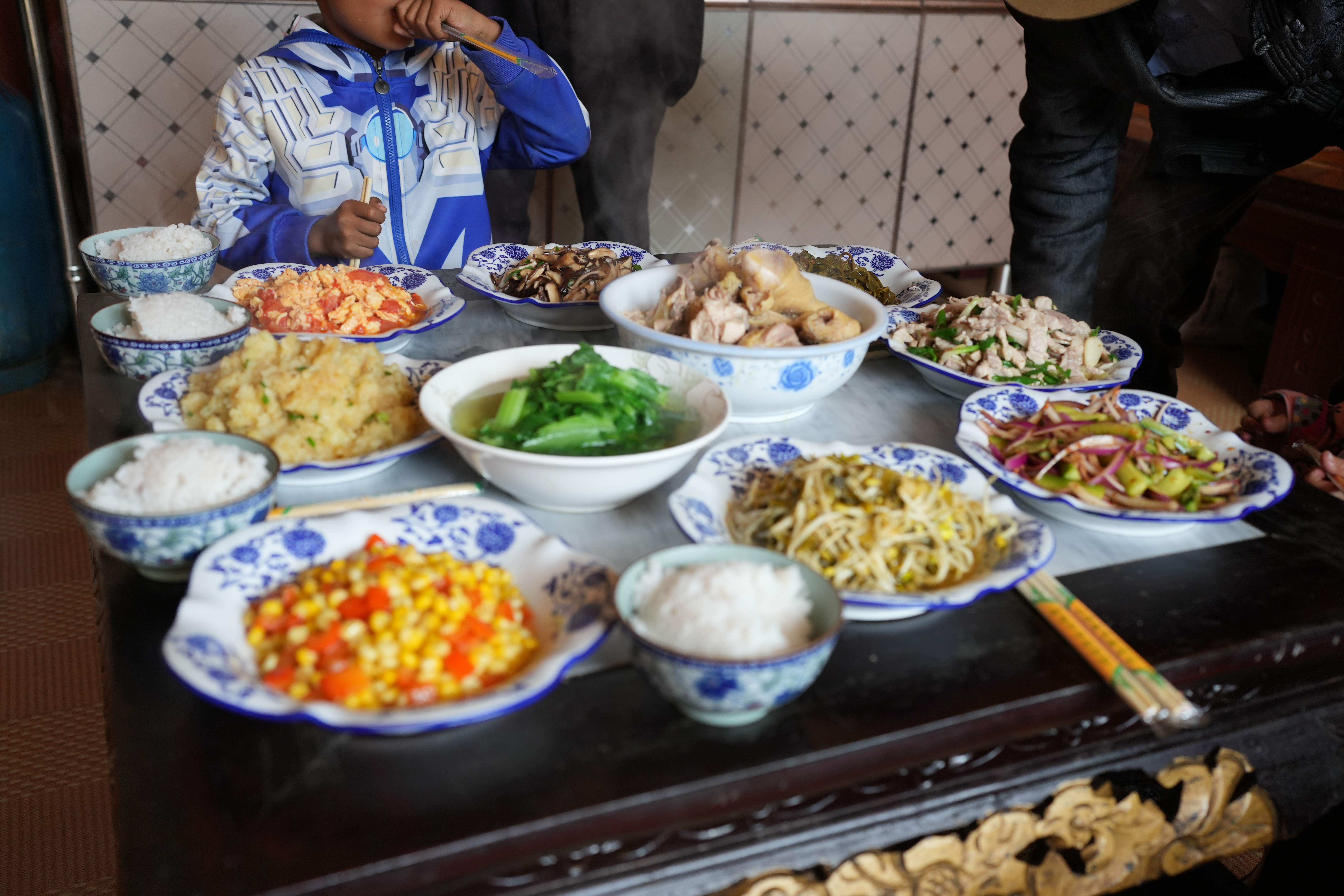
Figure 6: Mosuo dining table laden with chicken soup and vegetable dishes. When a special visitor arrives, families will kill a chicken in their honor, then prepare the chicken to serve the guest. Unlike pigs, whose preserved meat can sustain a family for many months, the entire chicken is eaten immediately. Photograph by Tami Blumenfield.
Move Over, Manhattan Chinatown: Exploring Chinese Cuisine in Flushing, New York
While most of the world’s Chinese restaurants are located in China or other parts of Asia, many Chinese people have moved overseas and established roots in other countries. In the United States, Chinese food has long been shaped by local tastes, from the rise of American Chinese chains like Panda Express—known for sweet, fried dishes such as Orange Chicken—to the recent emergence of more expensive, regionally specific restaurants that cater to new waves of middle-class immigrants and international students seeking familiar flavors. Just like in the Korean borderlands, their restaurants have adopted local flavors and adapted to different ingredients to produce something both familiar and completely new. This has happened in many different countries, but in one borough of New York City, the process has been particularly intense. Queens is an incredibly diverse place, with 47% of its two-million-plus residents born in other countries.11 Flushing is an area of Queens that is home to over 300,000 Chinese residents.12 This working-class part of New York City has an enormous concentration and variety of restaurants run by individuals from China, rivaling the well-known Chinatown in Manhattan.
Flushing is home to dozens of small eateries and large banquet halls that reflect the diversity of Chinese regional cuisines. Within a few blocks, one can move from a bowl of Henan-style hand-pulled noodles at a casual noodle shop to the buffet-style lunch boxes at Qingdao Restaurant, where affordable meals are piled high with braised meats, stir-fried vegetables, and stewed tofu—reminiscent of home-cooked food in northern China (Figure 7). At Old Luoyang, Henan cuisine is represented through hearty noodles and wheat-based dishes eaten in central China. At Yang Di Cun, a Dongbei-style restaurant, sizable platters of grilled lamb, pickled cabbage, and rustic stir-fries evoke memories of the Korean-borderland kitchens discussed earlier in this article. Meanwhile, Flushing’s Uyghur restaurants specialize in halal meat dishes and Central Asian-inflected flavors, including grilled lamb skewers, flatbread, and hand-pulled noodles seasoned with cumin and chili (Figure 8). The proliferation of Sichuan hot pot restaurants, some increasingly upscale in their interior design and service, reflects not only the rising popularity of bold, spicy foods but also a broader shift toward aesthetic presentation and middle-class dining experiences among Chinese diasporic communities.
Other places represent a different kind of dining experience. You Garden, a popular Shanghai-style dim sum restaurant, serves delicate soup dumplings and sweet-savory snacks in an atmosphere of orderly bustle. Not far away, Cantonese dim sum restaurants offer a different experience: large, banquet-style dining halls with ornate decorations and rolling carts full of shrimp dumplings, roast pork buns, and steamed tripe—reminders of southern China’s tea brunch dining culture (Figure 9).
Behind these restaurants are the people—chefs, owners, servers, and delivery workers—whose labor sustains Flushing’s food economy. Most of them are Chinese and Latino immigrants, working long hours under complex pressures, from immigration status to city health codes and platform-based gig work.13 Their stories, often invisible to diners, remind us that each dish carries the weight of personal histories, economic struggles, and cultural negotiation.
Figure 7: With the clatter of steam trays and takeout boxes, this Flushing lunch spot recreates the canteens of Chinese factory towns. For immigrant workers, these eight-dollar boxes of homestyle stir-fries are both comfort and necessity. Photograph by Jinglin Piao.
Figure 8: Uyghur cuisine in a food court in Flushing, New York. Lamb skewers and hand-pulled noodles, called “lamian” or “latiaozi” (拉面/拉条子), reflect the global journey of Central Asian flavors, carried by migration and reimagined in urban diasporas. Photograph by Rolph Recto.
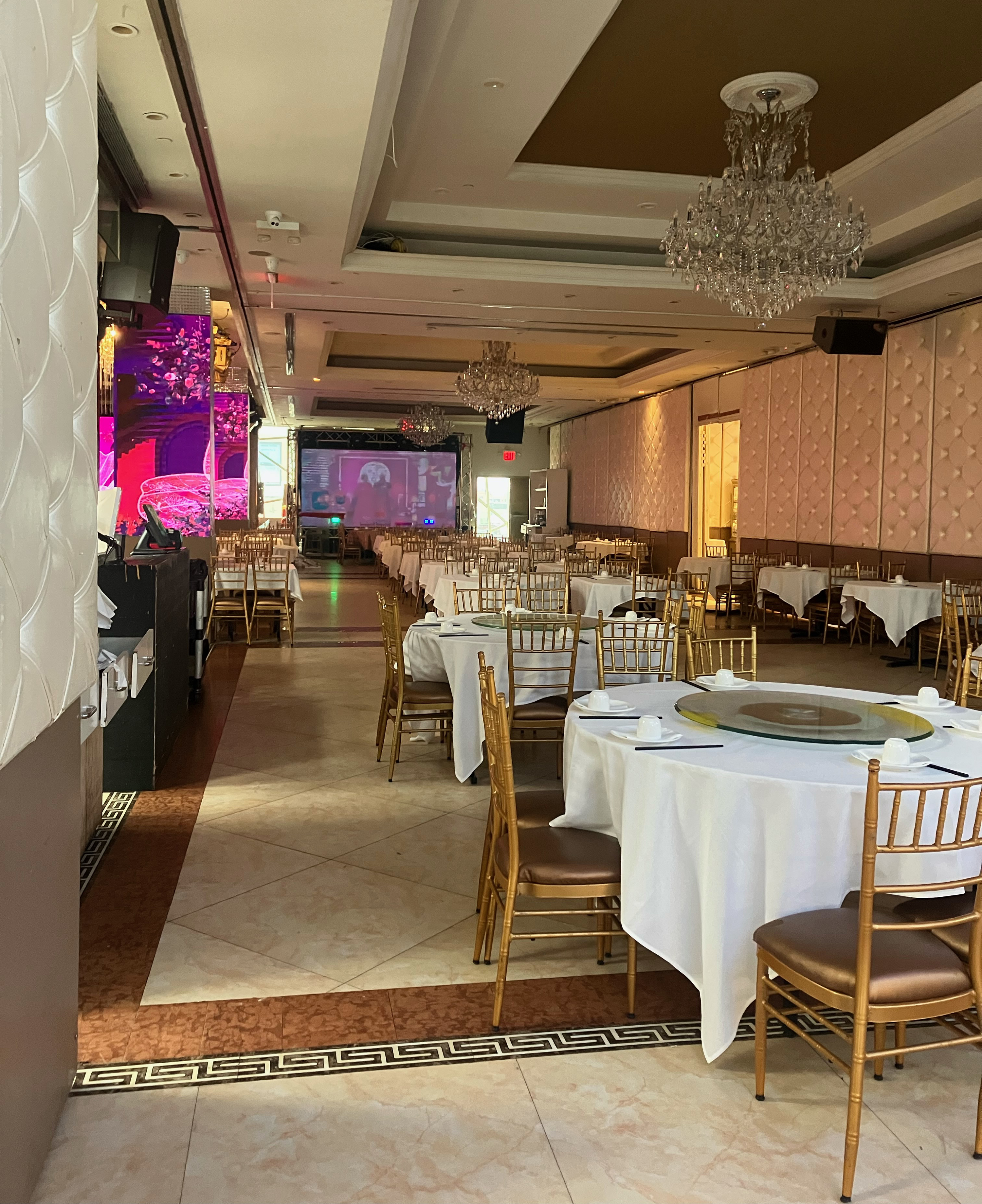
Figure 9: Inside a Cantonese dim sum restaurant in Flushing, New York. Its ornate banquet hall hosts wedding celebrations as well as daily morning tea and dim sum brunch, reflecting the dual role of Cantonese eateries as community gathering spaces. Photograph by Rolph Recto.
Conclusion: Chinese Food across Borders and Histories
From the imperial kitchens of Beijing to the borderland flavors of Yanbian, from the rural cooking of Dongbei to the highland stews of Nuosu and Mosuo families in Southwest China, and finally to the transnational foodscapes of Flushing, New York, Chinese cuisine emerges not as a fixed tradition but as a dynamic, living history. Each dish tells a story of movement and encounter: Ming dynasty chefs carrying Huaiyang roasting techniques north to create Peking Duck; Shandong migrants bringing Lu flavors into Dongbei kitchens; Korean-Chinese communities in Yanbian recreating cold noodle broths and kimchi side dishes; Nuosu households gathering around indoor fire pits to share boiled pork and buckwheat patties after a ritual pig slaughter; Mosuo families coming together each autumn to process and feast on home-raised pigs; and new generations of immigrants transforming the streets of New York into maps of regional Chinese tastes. These culinary journeys stretch across dynasties, ecological zones, ethnic communities, and oceans, reminding us that the notion of “Chinese food” is not bound by a single recipe or region, but is continually reinvented through migration, adaptation, and cultural exchange.
These pathways also highlight how food connects to power, memory, and belonging. A dish like Peking Duck carries the imprint of imperial banquets and political power shifts. Yanbian’s cold noodles speak of centuries of coexistence and borderland politics. Nuosu and Mosuo stews recall histories of clan alliances and ritual feasts that reaffirm kinship ties, while a buffet lunch box in Flushing tells of working-class resilience and creativity in navigating new cities. Across these sites, food is both everyday sustenance and a carrier of ancestral memory and social transformation, anchoring communities even as they move through changing landscapes and histories.
Understanding Chinese food requires looking beyond static menus to see who prepares the meal, under what conditions, through what journeys of exchange and survival, and through what pressures. Whether shared around a smoky hearth in the mountains of Southwest China, served on porcelain platters in a Qing imperial hall, eaten from dining tables in a Yanbian village courtyard, or delivered in a paper container on a New York street corner, Chinese cuisine remains a moving feast—continually reshaped by those who cook, share, and transform it across borders and generations.
Notes
We thank all the families and individuals who have hosted us for meals, taught us how to cook their special foods, and helped us better understand eating and food preparation practices in these regions. We also thank those who joined us for meals and helped us gain additional perspectives on the various foods discussed here—and those who provided vegetarian alternatives to the meat-heavy meals.
1 There are 55 officially recognized ethnic minority groups, or minzu, in the People’s Republic of China, in addition to the Han. They make up less than 8% of the total population in China. In this article, we focus on the Manchu [man zu], once the ruling people of China’s last dynasty (the Qing dynasty: 1644–1911); ethnic Koreans [chaoxian zu], concentrated in northeast China close to the Korean peninsula; and the Nuosu, living in the high mountain areas of southwest China. We also discuss the Mosuo, who traditionally live on the highlands in the southwest, but who are technically considered members of other officially designated minzu, and we note cuisines of far western regions, as well.
2 In this article we follow the Hanyu pinyin romanization system used in the contemporary PRC, and we use contemporary place names and spelling instead of those used historically. The exception is Peking, the former romanization of Beijing, whose traditional form has been retained because it has become inseparable from a popular dish bearing its name.
3 The concept of Chinese regional cuisine dishes is best represented by the classic culinary classification was long classified into Four Great Traditions but has recently been rethought as part of “Eight Great Traditions” (ba da cai xi). These include cuisine from the present-day provinces including Sichuan in the southwest; Guangdong / [Canton]ese and Fujian in the southeast; Jiangsu and Zhejiang in the east; Shandong in the north, and Hunan and Anhui in the inland central areas.
4 The Manchus, who hailed from the northeastern China region known as Manchuria, became the rulers of the last imperial dynasty in Chinese history. The Qing dynasty they established lasted from 1644 to 1911 and promoted the integration of Manchu culture with Han tradition. For details about imperial banquets throughout Chinese history, please see Thomas David Dubois, China in Seven Banquets: A Flavorful History (Chicago: University of Chicago Press, 2024).
5 Huaiyang is a region in Jiangsu Province, by the Huai He River, that encompasses places like Huai’an, Yangzhou, and Zhenjiang. These places are connected by a network of rivers and streams that linked the Yangtze and Huai He River and fostered the flow of cuisines from one area to another. Huaiyang chefs are famous for their intricate seafood preparation, such as a whole fish carved to look like a squirrel (song shu gui yu), and for their braised pork meatballs, called Lion’s Head (shi zi).
6 The Hui are one of the officially recognized minzu and live in many regions of China. Many Hui people living in Beijing originally came from the northwestern regions of China, while others migrated from elsewhere in China. For further details, see David R. Stroup, Pure and True: The Everyday Politics of Ethnicity for China’s Hui Muslims (Seattle: University of Washington Press, 2022).
7 Manchus were the ruling ethnicity of the Qing regime. Their history is explored in the monograph by Pamela Kyle Crossley, The Manchus (Oxford: Blackwell Publishing, 1997).
8 “Nuosu” is the term for some people of the Yi minority nationality group. Not all Yi are Nuosu. Most Mosuo people live in Sichuan and Yunnan and are officially part of the Naxi or Mongolian ethnic groups. Not all Mongolians are Mosuo, and vice versa. For further details, see Stevan Harrell, Ways of Being Ethnic in Southwest China (Seattle: University of Washington Press, 2001), https://muse.jhu.edu/pub/194/oa_monograph/chapter/2794610/summary.
9 For vivid descriptions of meals like these, see Bamo Ayi, Stevan Harrell and Ma Lunzy, Fieldwork Connections: The Fabric of Ethnographic Collaboration in China and America (Seattle: University of Washington Press, 2007).
10 For a detailed discussion of the role played by livestock in Mosuo villages, see Tami Blumenfield, “Resilience in Mountainous Southwest China: Adopting a Socio-Ecological Approach to Community Change” (Cahiers d’Extrême-Asie 23, 2014, pp. 293-294; http://www.jstor.org/stable/44167531).
11 Source: “U.S. Census Data – American Community Survey – Selected Characteristics of the Native and Foreign-Born Populations – 2019: American Community Survey 1-Year Estimates Data Profiles” (data platform: Center for Enterprise Dissemination Services and Consumer Innovation). U.S. Census Bureau. Retrieved September 14, 2021. “Queens” (View: tables. Table ID: S0501). [https://data.census.gov/table/ACSST5Y2019.S0501?g=060XX00US3608160323&tid=ACSST5Y2019.S0501]
12 Source: “Flavors of Flushing: Exploring New Yorks Biggest Chinatown: The Abroad Guide,” https://theabroadguide.com/flavors-of-flushing-exploring-new-yorks-biggest-chinatown. According to the DK Eyewitness Guide: New York City, more than two-thirds of Flushing is either Asian or Asian-American (New York: Dorling Kindersley Publishing, 2022, p. 300).
13 These challenges are not unrelated to the immigration past of Chinese migrant labor in U.S. cities. See Nayan Shah, Contagious Divides: Epidemics and Race in San Francisco’s Chinatown (Berkeley: University of California Press, 2001). Shah explains how Chinese migrant men in late 19th- and early 20th-century U.S. cities sustained their body and life by creating communal space and practices while isolated from their faraway families.
14 A guide to the Peking duck restaurant experience, including photos, is available here: https://www.thetravellingsquid.com/2019/07/14/quanjude-has-the-best-peking-duck-in-beijing/.
15 This used to be a small restaurant in Hunchun, Yanbian. Thanks to the booming economy in the last decade and strong tourism, the restaurant has expanded to more than a few locations in Yanji. It serves both the signature Yanbian cold noodles and a vast menu of traditional dishes and meals, including rice sausages, rice dumplings, steamed chicken rice, and more.
Resources for Further Exploration
Learning Food-Related Chinese Characters and Phrases
-
Nightwind Chinese offers a six-minute YouTube video that teaches three characters that include the fire 火 radical (character component): roast 烤, stew 烧, and braise 烩, while walking through an Asian grocery store. The video is called, “MASTER Chinese Characters| 3 Must-know Hanzi on Menus in all Chinese Restaurants!| Radical 火|烤 烧 烩.” https://www.youtube.com/watch?v=rofJtbIcyNM
-
Qiu Gui Su offers key Chinese phrases for ingredients and common dishes, with an audio pronunciation guide, on the Thought Co platform: https://www.thoughtco.com/chinese-food-vocabulary-2279642.
-
Linda Mandarin provides a list of 60 words and phrases in a “Food in Chinese” article: https://www.lindamandarin.com.sg/food-in-chinese.
Chinese Food History
-
The Travel China Guide website delves into greater depth about the history of Chinese food in China, including features on the Eight Chinese Cuisines (https://www.travelchinaguide.com/intro/cuisine_drink/cuisine/eight_cuisines.htm), Chinese Food History more generally (https://www.travelchinaguide.com/chinese-food-history.htm), and selected traditional Chinese foods (“11 Traditional Chinese Foods You Cannot Miss,” https://www.travelchinaguide.com/traditional-chinese-food.htm).
-
The Search for General Tso, a 2014 documentary by Ian Cheney, explores the reinvention of Chinese food in the United States: https://www.kanopy.com/en/product/13867557.
Maps and Travel
-
A customized Google Maps itinerary offers directions for a 59-hour road trip beginning at a famous Beijing roast duck restaurant, heading to northeast to Yanji, driving southwest to Xichang in Sichuan, and making a final stop at a Mosuo barbecue restaurant near Lugu Lake, in Yunnan. See https://maps.app.goo.gl/q3mPUyoWBJBjZUT48. To reach New York, follow this Google Maps itinerary for the 15-hour flight from Beijing to New York City: https://maps.app.goo.gl/CAxAHq19mLuBGXK8A.
-
A short video produced by CBS News, New York introduces viewers to the Chinese neighborhoods of Flushing, Queens: https://www.youtube.com/watch?v=IscSweWGtuY&t=103s.
-
The webpage for a two-hour food tour called “Flavors of Flushing: Exploring New Yorks Biggest Chinatown” offers additional information about Flushing’s Chinatown as well as logistical details for those interested in booking the guided tour: https://theabroadguide.com/flavors-of-flushing-exploring-new-yorks-biggest-chinatown.
Restaurant Information
The restaurant scene changes quickly, so readers are encouraged to verify information before visiting. The authors and publishers make no guarantees, so visit at your own risk, but prepare for some delicious food!
China
-
Beijing roast duck restaurant: Quanjude Roast Duck, 13 Shuaifuyuan Lu, Wangfujing, Dongcheng District, Beijing, China.14
-
Yanji restaurant featuring naengmyeon: Shenhua Lengmian 参花冷面 (Ginseng Flower Cold Noodle), 150 Changbai Lu 150, Yanbian Korean Autonomous Prefecture, Jilin Province, China.15
-
Xichang Nuosu restaurant: Nanyuan Yi Village 南苑彝庄, Nantan Market, 308 Sanchakou East Road, Xichang, Sichuan Province, China, 615099.
-
Mosuo barbecue restaurant: Luoshui Barbecue 洛水烧烤, 307 Shengdao省道, Ninglang Yi Autonomous County, Yunnan Province, China, Postal code: 674309
Flushing, New York
-
Qingdao Restaurant: 40-46 Main St.
-
Old Luoyang (specializing in rou jia mo, or stewed, minced meat stuffed between two flatbreads): 135-42 39th Ave.
-
Henan Feng Wei (a noodle house): 136-31 41st Ave.
-
Ming Xing BBQ (Chinese name, Yang Di Cun 杨地村): 35-14 Farrington St.
-
Tarim Uyghur Cuisine (a Uyghur food stand): in the New World Mall food court, 136-20 Roosevelt Ave.
-
Shoo Loong Kạn Hot Pot (小龙坎火锅): located in Tangram Mall, 133-36 37th Ave (beware of seriously spicy soup broths here, though less spicy options are available).
-
Shanghai You Garden: 135-33 40th Rd.
-
Royal Queen (a Cantonese dim sum restaurant): 136-20 Roosevelt Ave, 3rd floor.
Preparing Nuosu and Mosuo Food
-
Tartary Buckwheat Cake Recipe (mge fu in Nuosu, ku qiao baba 苦蕎粑粑 in Chinese) Combine 2 cups of bitter buckwheat (苦蕎) flour or common buckwheat (蕎麥) flour, 1 teaspoon of yeast, and 2 cups of warm water and stir until well mixed. Let rise for 30 minutes. Then, either pour into a lined steamer basket and steam for 15 minutes, or cook on a flat griddle, flipping when lightly browned. Slice into wedges and serve while warm.
Recipe adapted from the Shrine Kitchen, https://shrinekitchen.com/buckwheat-cake/. This site offers an entire page dedicated to Nuosu/Yi cuisine, with names of dishes given in both Chinese and Nuosu characters: https://shrinekitchen.com/cuisine/yi.
-
Nuosu Tuotuo Rou 坨坨肉 Recipe
First, scorch a freshly slaughtered pig over an open flame until its skin blackens. This cleaning method will not only remove hair but also add a chewy texture and smoky aroma to the meat. Then, chop the charred carcass into hefty, uneven chunks—bones included—and simmer in a large pot of water along with some herbs for several hours, until the meat is tender but still chewy and the broth is fragrant. Serve the boiled meat in one large bowl, and the broth in another. Offer small bowls of ground chili flakes and salt for dipping as well.
Note: Variations include boiling buckwheat patties along with the meat, or adding potatoes.
Instructions for Preparing Mosuo Zhubiao Rou 猪膘肉
To make the preserved-pork known in Mosuo communities as zhubiao rou 猪膘肉, use a long blade to kill one of your pigs (you’ll need several strong people to catch and pin it down first). Then cut open the stomach in order to remove the bones, innards, and lean meat, but leave the head intact. Once this is done, pour an enormous amount of salt inside the cavity and on the head, and sew the cavity closed using a sturdy iron needle. Move the deboned carcass to a sunny or shady area where it can dry for a few days, then find a cool, dry place where it can be stored. If you invite some family members and neighbors to help, some of you can work together to use the removed sections to prepare sausages and others can cook up a feast for everyone to share.
Done properly, the zhubiao rou can be kept for up to a year, or even longer. Simply slice off a tranche when needed, singe a large piece in the fire, chop it into smaller chunks, then boil it with greens and potatoes over the hearth before eating it with family members and guests.
Note: Wait until the rainy season is over, when the weather is sunny but cool, before preparing zhubiao rou, otherwise the meat will spoil. November is usually a good time of year. Keep in mind that this will not work in a humid climate, as dry mountain air and ideally, a hearth nearby, are both helpful for maintaining the right moisture level.
For further details (in Chinese), see: https://baike.baidu.com/item/%E7%8C%AA%E8%86%98%E8%82%89/6204517.