The Cultural Revolution—CR/10—Project at the University of Pittsburgh
by Haihui Zhang and Runxiao Zhu
Download a print-ready PDF version of this article.
Runxiao Zhu is Head of the East Asian Library at the University of Pittsburgh, where she oversees collection development, digital scholarship initiatives, and research services. Since her appointment in 2023, she has spearheaded projects integrating 3D technology to highlight East Asian book culture and facilitated Pitt’s 2024 partnership with Taiwan’s National Central Library through the TRCCS initiative. She earned a B.A. in Art History from Rutgers University, an M.A. in Tibetan Studies from Columbia University, and an MLIS from Indiana University, where her passion for librarianship was shaped through work in Tibetan and archival collections. Prior to Pitt, she served as East Asian Studies Librarian at Oberlin College, as Director of the Elling O. Eide Research Library, and Curatorial Assistant at Rubin Museum of Art, New York.
Zhang Haihui formerly served as the Chinese Studies Librarian and Head of the East Asian Library at the University of Pittsburgh. She edited the online volume, published by the Association for Asiasn Studies, “A Scholarly Review of Chinese Studies in North America” https://www.asianstudies.org/publications/asia-past-present/scholarly-review-of-chinese-studies-in-north-america/ and authored several reference works. CR/10 is one of the projects related to Chinese studies that she initiated. She retired in 2023.
Introduction
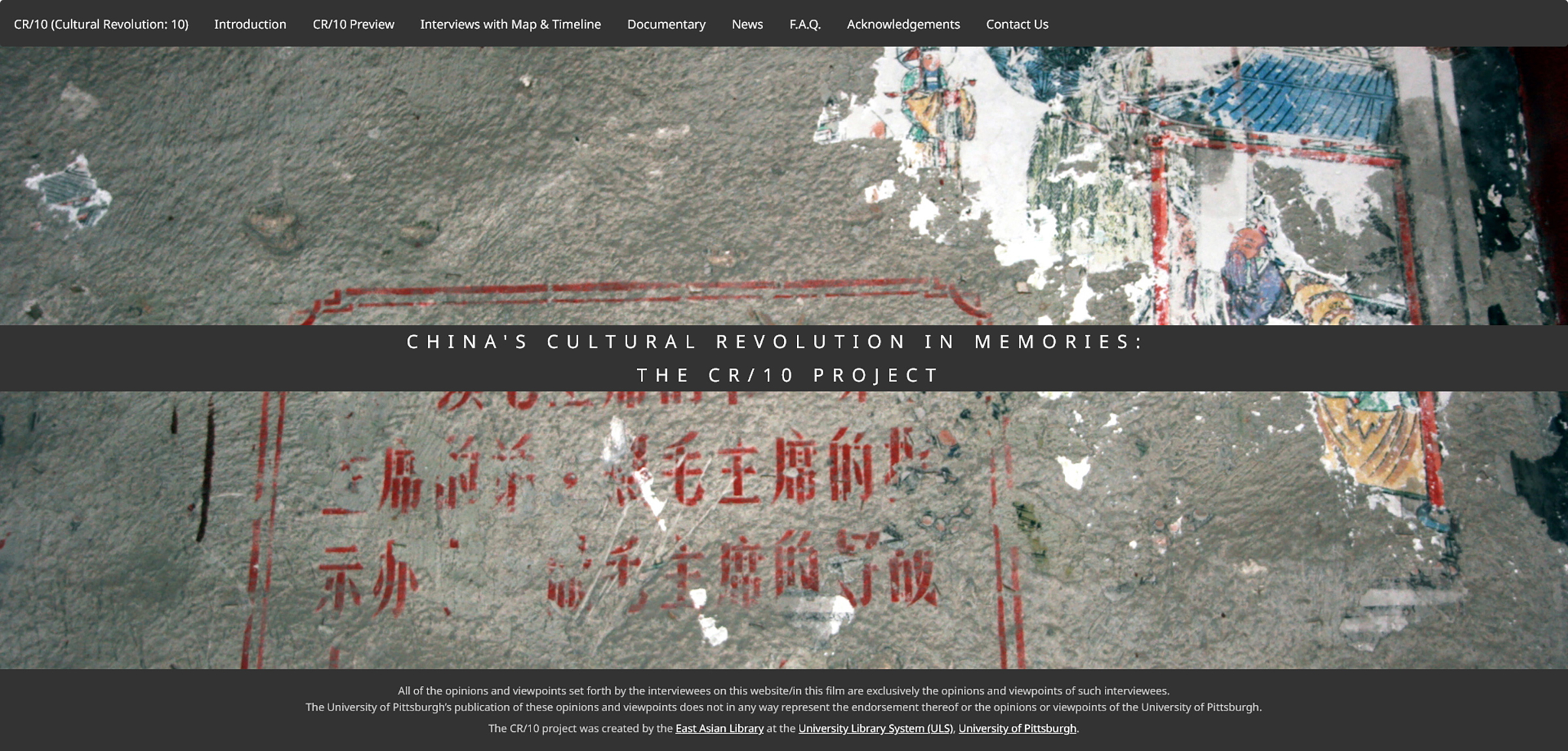
In 1966, China was thrust into a decade-long movement known as the “Great Proletarian Cultural Revolution.” Often referred to simply as the Cultural Revolution, it is generally regarded as one of the most transformative and disruptive periods in modern Chinese history. Fifty years later, in 2016, the East Asian Library at the University of Pittsburgh Library System, with the collaborative support of the Asian Studies Center and the University Center for International Studies, launched an oral history initiative known as CR/10: https://culturalrevolution.pitt.edu.
Bringing together East Asian Library staff and graduate students, the project was built on a shared commitment to preserving not just historical facts, but the memory itself, documenting the lived experiences of those who endured, witnessed, or inherited the legacy of this turbulent era. The firsthand interviews gathered through CR/10 have since evolved into invaluable primary sources. They represent a distinctive scholarly resource at the University of Pittsburgh while also serving as a powerful teaching tool, bringing the personal voices of history into high schools and college classrooms.
Launch of the Concept and Implementation of the CR/10 Project
Though the Cultural Revolution formally ended in 1976, it has remained a subject of enduring controversy and contested interpretation in both public discourse and academic scholarship over the past five decades. Fundamental questions and debates about how to understand this movement, and whose experiences have been left out, have never ceased.
In 2015, Michael Dabrishus—Associate University Librarian at the University of Pittsburgh Library System at that time, responsible for Archives & Special Collections—proposed that the East Asian Library organize an initiative to mark the approaching fiftieth anniversary of the Cultural Revolution in 2016. In response, the East Asian Library first established a clear project stance: to remain non-judgmental toward this historical event and focus on the collection and preservation of primary sources to support teaching and research rather than advancing a particular interpretation of this sensitive period.
One initial step was a comprehensive survey of existing primary and secondary sources related to the Cultural Revolution, both in print and digital formats. The process revealed an already extensive body of secondary literature and published memoirs. However, this abundance also exposed a critical gap: the relative absence of systematically collected, first person accounts from ordinary individuals. Recognizing this imbalance, the East Asian Library decided to develop an original, unique, and sustainable oral history initiative centered on interviewing ordinary people in an effort to document the lived experiences of people across China who directly or indirectly experienced the Cultural Revolution. The scope of the interviewees extended to the “post-Cultural Revolution” generation, capturing how historical memory of this movement has been transmitted and reshaped over time. This direction was based on three key considerations:
-
First, the Cultural Revolution was a nationwide political movement, yet its implementation varied dramatically across China’s diverse regions.
-
Second, beyond regional differences, individuals’ experiences were deeply shaped by factors such as age, family background, education, and profession. Existing narratives disproportionately highlight political elites, prominent intellectuals or cultural figures, leaving the voices of ordinary people underrepresented.
-
Third, video as a medium offers distinct ways to capture body language and tone while minimizing concerns regarding post-production alterations and editorial manipulation.
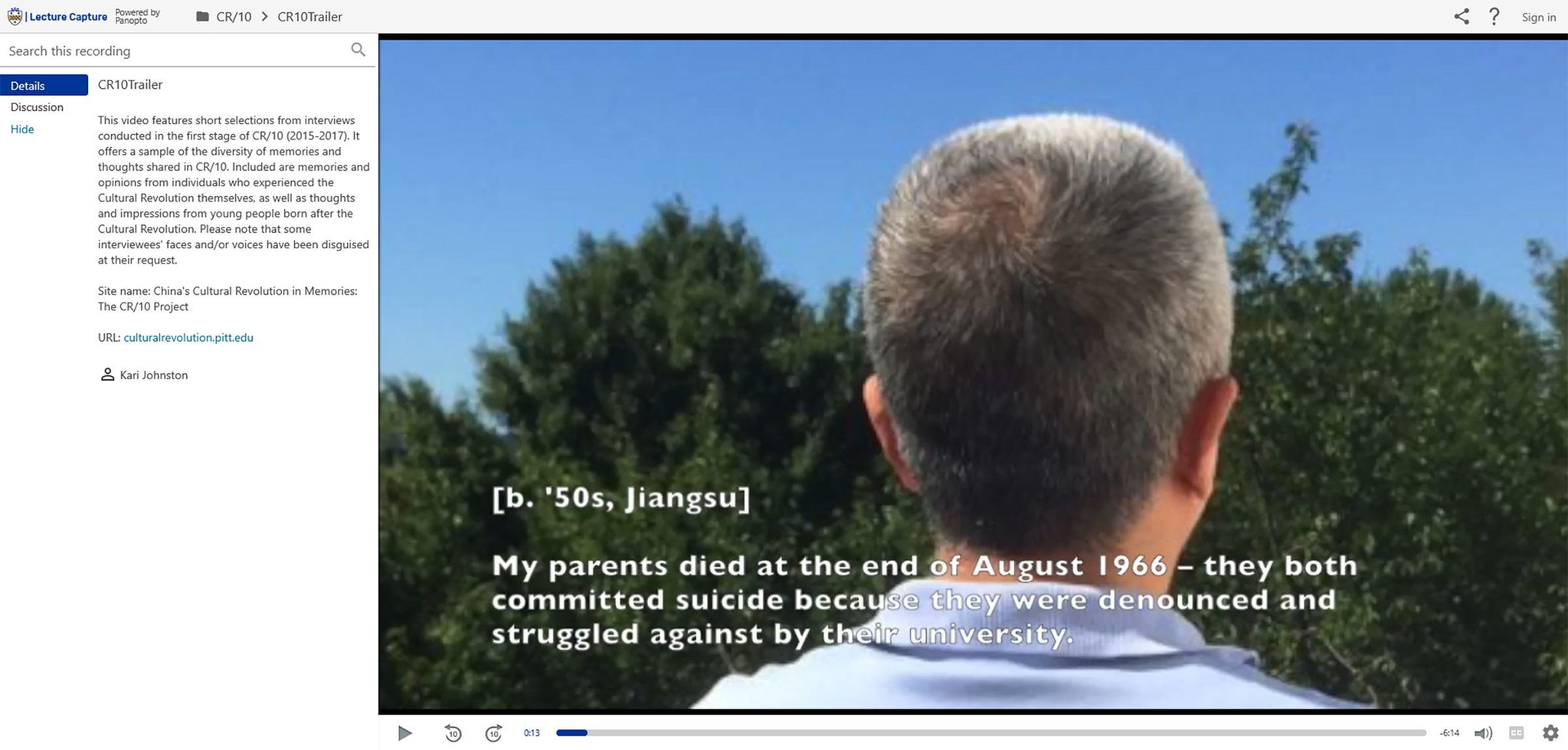
Each interview began with three baseline questions: the interviewee’s location during the period, their age or profession at the time, and a brief family background, before moving to the open-ended reflections on the events. The names of interviewees do not appear on the website. The core value of these interviews was to focus on the people and events that left the deepest impression on them. This approach was designed to empower participants to share their innermost significant memories while producing the recordings of manageable length, mostly 10–30 minutes, making them ideal for classroom use.
One of the earliest challenges was to identify individuals who were willing to share their memories on camera, regardless of whether their views of the Cultural Revolution were positive or negative. Even decades after the event, perceptions remain deeply divided, and political sensitivities continue to generate psychological reluctance among many potential participants. The second major challenge involved the translation of specific terminology and the production of accurate English subtitles for the interviews. To address this, the project adopted a streamlined and parallel workflow in which interviewing, translating, and subtitling were processed concurrently. This approach enabled completed interviews to be released for public access without any delay, ensuring efficiency. For more detailed information on the project’s origins, initiation, methodology and production workflow, please see “Collecting Oral History in an Academic Library: The CR/10 Project.”
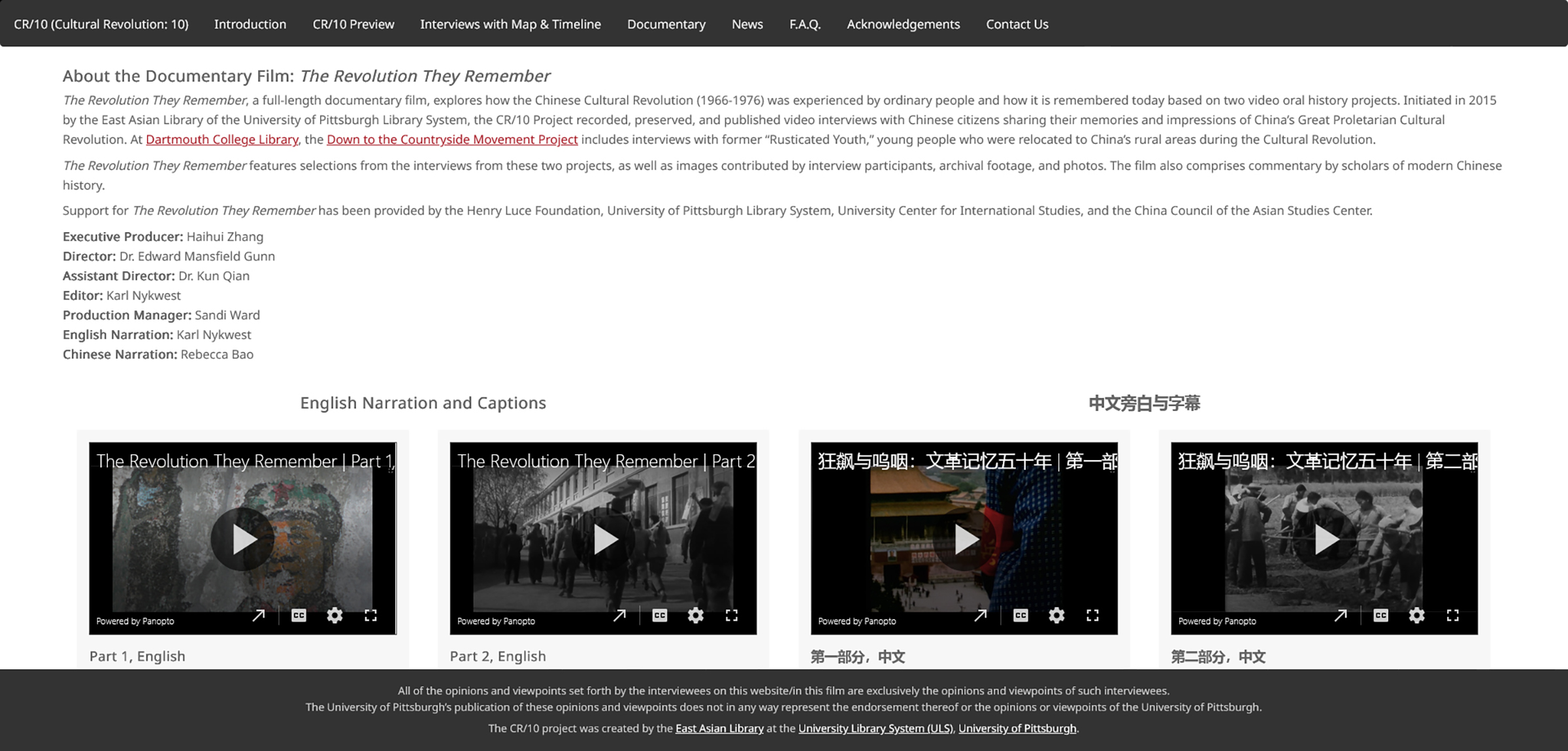
In 2019, the University of Pittsburgh Library System was awarded a one-year grant from the Henry Luce Foundation to support the creation and production of a feature-length documentary The Revolution They Remember (https://culturalrevolution.pitt.edu/#documentary). The film represents a collaboration between the University of Pittsburgh Library System, the East Asian Library, and Dartmouth Library. Drawing on two complementary video oral history initiatives, one developed by the East Asian Library at the University of Pittsburgh and the other by Dartmouth Library, this documentary brings together a diverse range of personal narratives to construct a multifaceted account of the Cultural Revolution as remembered by those who experienced it.
The Impact and Application of CR/10
The most significant contribution of the CR/10 project lies in its documentation and preservation of diverse, firsthand memories of the Cultural Revolution from ordinary individuals. As shown on the University of Pittsburgh Library System’s website, interviewees are located across the United States, mainland China, Japan, and Europe: geographic breadth that reflects the far-reaching diaspora of those touched by this transformative and turbulent era. Tragically, four participants have passed away in the years since their interviews, and many surviving interviewees are now in their seventies or eighties. Their testimonies stand as an irreplaceable record of lived experience. The project successfully archives the trauma inflicted by the Cultural Revolution on individuals, families, and society, while the varied experiences and divergent memories captured in these videos powerfully illuminate the inherent complexity of history and the necessity of multi-perspective interpretations. These primary sources are undoubtedly invaluable for the in-depth study and critical reflection of the Cultural Revolution, as well as for understanding the human cost behind any major historical upheaval.
Today, the video interviews and documentaries produced by the CR/10 project have become a cornerstone of the University of Pittsburgh Library System’s Archives & Special Collections. They represent unique and original primary source resources that simply could not have existed without the library’s direct initiative. The project’s success demonstrates that libraries can go beyond their traditional roles of collecting, preserving, and promoting materials to actively create and produce primary sources themselves. In doing so, the CR/10 project offers a compelling and meaningful model for the evolving functions and development of modern research libraries in the digital age.
Perhaps the most remarkable dimension of the CR/10 project is the breadth and depth of its educational impact, which has exceeded all initial expectations. Following its launch in 2017, over a dozen graduate students in Asian Studies at the University of Pittsburgh participated in the translation, subtitling, and post-production process. Despite many of their parents having lived through the Cultural Revolution, a striking number of these students knew very little about it—a testament to how deeply the trauma of that era shaped the silence that surrounded it in subsequent generations. For these students, the project offered a rare and transformative opportunity to engage directly with the authentic memories of ordinary people. Two students even took the initiative to interview their own grandparents and parents, turning a scholarly undertaking into a deeply personal act of intergenerational dialogue and healing.
Once the videos were made available through the University Library System, their reach expanded rapidly and organically. They were adopted not only by faculty and colleges in Pittsburgh, such as Carnegie Mellon University and Chatham University, but also by history teachers at high schools and universities across Pennsylvania, West Virginia, Maryland, New York, Connecticut, and many other states, reaching classrooms and communities well beyond what was originally envisioned. Although most of these students are unfamiliar with Chinese history and may not pursue it as a future career, the conflicting memories and perceptions shown in the CR/10 videos serve as a remarkably powerful pedagogical tool. They provide a vivid, human illustration of the concept that “history is complicated,” equipping students with the critical framework to examine historical narratives, resist oversimplification, and develop genuine independent thinking. In this way, the CR/10 project has grown from a preservation effort into a living educational resource—one that continues to shape how new generations understand not just the Cultural Revolution, but the very nature of history itself.
CR/10 Current Status and Its Future
The CR/10 project was originally created by Haihui Zhang, Head of the East Asian Library (2014–2023) at the University of Pittsburgh Library System. Under her leadership, what began as a single library initiative has grown into a nationally recognized oral history archive. Using a snowball sampling technique for interviewee selection—in which existing participants recommend others from their networks—the project has grown to collect more than one hundred interviews, and it remains active today, continuing to welcome individuals who are willing to share their personal memories on camera.
The CR/10 website—https://culturalrevolution.pitt.edu—has been thoughtfully designed to maximize accessibility and usability for a wide range of audiences. It currently features over 120 video interviews accompanied by an interactive map, offering users a rich, geographically situated way to explore these personal testimonies. Users can search and browse interviews by keyword, location, and theme, allowing both casual visitors and specialized researchers to navigate the archive in ways that suit their needs. Each interview is subtitled in English, ensuring the content remains accessible to viewers without fluency in Chinese and broadening the collection’s reach across disciplines and institutions. The interactive map adds a spatial dimension to the collection, enabling users to visualize the geographic distribution of interviewees and appreciate how experiences of the Cultural Revolution varied across regions, generations, and life circumstances. Together, these features reflect a deliberate commitment to making the CR/10 website not merely a repository, but a dynamic and user-friendly platform for education, research, and public engagement. The project has continued to receive sustained attention and institutional support from the University of Pittsburgh Library System, which has been instrumental in ensuring both its operational continuity and its long-term preservation. This backing has enabled the ongoing production of new interviews, the continued maintenance of the website’s infrastructure, and the expansion of the project’s collaborative networks. Looking ahead, the project aspires to further deepen its interview collection, broaden community engagement, and enhance the platform’s accessibility and discoverability, with the aim of building the most comprehensive English-language oral history collection of the Cultural Revolution available anywhere in the world.
The CR/10 project stands as a significant and enduring contribution to digital public humanities, oral history preservation, and the collective memory of one of the twentieth century’s most consequential historical events. What began as one librarian’s vision to rescue a generation’s worth of memories from the passage of time has grown into a living, ever-expanding archival collection that bridges continents, generations, and disciplines. As the survivors of the Cultural Revolution grow older and their numbers diminish, the urgency of this work only intensifies, and the value of what has already been preserved becomes ever more irreplaceable.