
Teaching Japan through Restaurant Menus
by Willa Zhen
Download the PDF version of this article for classroom use
Willa Zhen, PhD is Professor of Liberal Arts and Food Studies at the Culinary Institute of America in Hyde Park, NY. Trained as a sociocultural anthropologist, she researches and teaches classes on food and culture. She is the author of Food Studies: A Hands-on Guide (Bloomsbury, 2019).
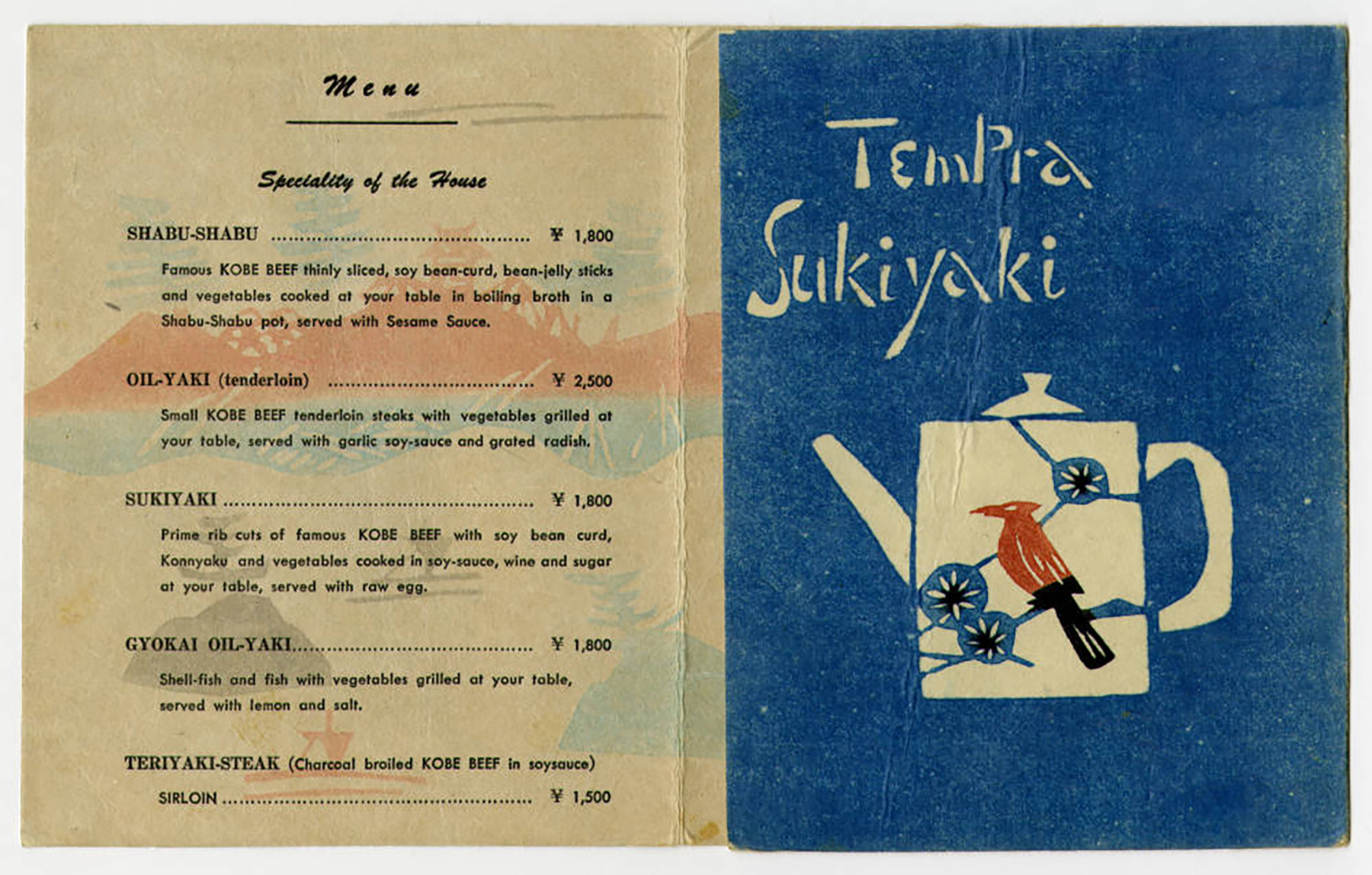
Figure 1: “Zakuro.” Menu, undated. Japan. Courtesy of the Culinary Institute of America.
Introduction
Japan’s global soft power is felt through art, anime, manga, movies, music, video games, and consumer goods. One of its most popular exports is its food and cuisine. There are approximately 187,000 Japanese restaurants outside of Japan1 and approximately 23,000 in the United States alone.2 Clearly, Japanese food has become a global food phenomenon.
Yet what exactly is Japanese food? How can menus be used in the classroom to explore Japanese culture? Menus can be used as important teaching tools. Because menus sit at the intersection of food, culture, and identity, they offer students an accessible way to explore culture. This article provides support for high school and undergraduate teaching by providing a guided lesson plan. First, it provides an overview of Japanese food including suggested readings. Next, it provides a lesson plan that instructors can use and modify as a framework for classroom instruction. Lastly, there is a list of resources including digital archives with Japanese menu collections.
What is Japanese Food?
There are different ways to approach the study of Japanese food. The task is to help students understand that food extends beyond the material aspects of cooking. Before diving into menus, it is useful to spend time establishing what makes Japanese food Japanese. This lesson approaches Japanese food through three frameworks: geography and environment, ingredients and foodstuffs, and cuisine.
Geography and Environment
Japan is an archipelago of 3,600 islands. Collectively, these islands are about 2,174 miles long, roughly the size of the state of California. The coastline stretches roughly 18,480 miles and no location is more than 93 miles from the coastline. Approximately four-fifths of the land is mountainous with very little arable land. This geography thereby shapes what the Japanese can access for food. A proverb declares that Japanese food is “umi no sachi, yama no sachi”: food from the seas and food from the mountains. Fish and seafood have historically been the primary forms of animal protein in Japan.
The geography and environment of Japan shape the outlook towards eating and culinary practices. The scarcity of natural resources and challenges of growing food in Japan have also resulted in a deep respect for seasonality and appreciation for available ingredients, resulting in the Japanese philosophy of mottainai—the sentiment that everything is precious and has value: in other words, “waste not, want not”. The Japanese celebrate the ephemeral nature of seasonal foods and rejoice in each region’s special delicacies. Instructors may opt to pair this lesson with Theodore Bestor and Victoria Bestor’s article “Japan and the Sea”3 and Monika Dix’s “Water, Tradition, and Innovation: Flowing through Japan’s Cultural History”4 to provide broader framing.
Ingredients and Foodstuffs
We also consider how geography and the environment, as well as trade and economic exchange, impact what is grown and eaten. Rice is the core staple of the traditional diet and one of the most important foods in Japan. Yet rice is not an indigenous crop. Rice cultivation is believed to have originated in the Yangzi River Delta in China around 9,000 years ago and later spread to Japan around 2,400 years ago either via the Korean peninsula or directly from China. It has since become essential to Japanese senses of identity. Japanese civilization developed around rice cultivation, including the formation of rituals and religion and a calendar system based on rice production. During the twentieth and twenty-first centuries, rice has been subjected to protectionist economic policies, with consumer and government resistance towards imported rice due to the deep symbolic importance to cultural identity. Instructors may choose to assign selections from Emiko Ohnuki-Tierney’s book Rice as Self: Japanese Identities through Time5 or Richard Moore’s article, “The Japan Rice Paradox”6 to support the lesson.
Cuisine
Next is the concept of Japanese cuisine as a cultural creation. There are different ways of speaking about food in Japan. The term nihonshoku (literally “Japan-food”) is all encompassing, ranging from everyday foods, regional specialties, and formal traditional meals. Nihonshoku includes foreign-influenced yoshoku (Western-style dishes) like curry rice and tonkatsu (fried pork cutlet), and chuka ryori (Chinese-style dishes).
Nihon ryori and washoku are terms that emerged in the late nineteenth century to distinguish Japanese food from foreign foods, particularly Western dishes. Nihon ryori is often translated as “Japanese cuisine,” and is defined by skilled techniques, seasonal ingredients, artistic presentation, and formal traditional dining. Kaiseki—a highly choreographed, ritualistic, multi-course fine dining meal that centers around seasonality, tradition, as well as craftsmanship and artistry in its presentation—is sometimes seen as the pinnacle of nihon ryori. Historically associated with tea ceremony, kaiseki today is often considered an exemplar of Japanese cuisine.
Washoku also refers to Japanese cuisine. Recognizing its connection to nature and sustainable use of resources, UNESCO inscribed washoku as an Intangible Cultural Heritage of Humanity. UNESCO declares washoku “a social practice based on a set of skills, knowledge, practice, and traditions related to the production, processing, preparation and consumption of food” that incorporates respect for nature and sustainable principles.7 Historian Eric Rath notes that washoku is less a designation for food and more about the customs and rituals of eating.8 The typical way of Japanese eating is described as ichiju-sansai, or literally “one soup and three dishes.” This traditional dining format includes a bowl of steamed white rice, a soup (often miso soup or broth-based soup), a small plate of pickled vegetables (tsukemono), a main dish (usually a protein), and two side dishes (often vegetables). Scholars have observed that the boundaries between nihon ryori and washoku are not always easily distinguishable.9
Lesson Plan: Bringing Menus into the Classroom
This lesson plan is designed around the use of menus. Depending on the students’ language abilities, English-only, bilingual, or Japanese-only menus can be used. For language classes, bilingual menus or Japanese-only menus can aid in building vocabulary related to food and dining out. Instructors can exercise a lot of creativity in their choice of menus and mix up selections based on classroom objectives.
Where possible, physical copies of menus are preferred as students can engage with the materiality of these objects and think about them as artifacts to study. Some places to look for physical menu collections include local public libraries, local historical societies, local restaurant associations, or Japanese or Japanese American community groups. Another option is to collect your own or encourage students to bring some to class. eBay and Etsy are two places to purchase vintage menus online. Crowd-sourcing menus through friends, family, and community members—even students—is another way to build a collection.
This assignment can also be completed with digital collections. Several resources are identified at the end of this article. While students will engage differently with online collections, losing that physical connection to the materiality of the menus, they will still be able to learn a lot about menus through digital scans.
Estimated Time:
Two class periods of approximately 60 minutes. This can also be held as one extended 90-minute session or otherwise modified according to class needs.
Learning Objectives:
-
Students will learn to analyze a restaurant menu as a primary source document
-
Students will learn to identify cultural assumptions embedded in a menu
Materials:
-
Japanese menus
-
Writing instruments and paper
Activity 1: Opening Discussion and Brainstorming
Nearly all students have eaten some form of Japanese food before. Common responses include familiarity with ramen (of both the instant and labor-intensive varieties), snack foods (such as Pocky), and sushi. Students’ lived experiences can be used to start a dialogue about what they do and do not know about Japanese food.
Discussion prompts for Activity 1:
-
What do you know about Japanese food?
-
Where and how did you learn about Japanese food?
-
Have you ever eaten at a Japanese restaurant before? Where was it? What was that experience like? How did it compare to what you’ve learned about Japanese culture and traditional Japanese food?
-
What makes a food “Japanese”? Can a dish become Japanese even if it originated elsewhere?
A useful distinction to draw in this opening discussion is between what students know about Japanese food and what they have personally experienced. Students may have heard about many foods through media or social media without having had the opportunity to try them. For instance, students may have heard of okonomiyaki, a savory cabbage pancake. This dish is most closely associated with Osaka and Hiroshima, each of which has its own style of okonomiyaki. But most students have never had the opportunity to try it because okonomiyaki restaurants are uncommon outside of Japan. Instructors may wish to pair this activity with Theodore Bestor and Victoria Bestor’s “Cuisine and Identity in Japan Contemporary Japan”10 as they work through distinguishing their ideas of Japanese food versus how a Japanese person or a scholar of Japan might approach it.
Activity 2: “Reading” the Menu
After the opening activity, we then analyze the menus. Each student is given a menu to “read” and are asked to take notes on what they observe (and are told that these notes will be shared in class). This activity can be completed in different ways depending on class size and structure. Options include assigning students to work together as a think-pair-share to examine and discuss, or students can work on menus individually with their thoughts to be shared back with the larger class.
A productive constraint for this activity is to ask students to set aside their technology and refrain from using Google, AI tools, or other Internet tools during their initial close reading. The goal is to simply be with the menu; to let the menu reveal information through careful reading. Encouraging students to record and trust their own observations before seeking external validation helps build confidence in their own analytical instincts and reinforces their skills in primary source analysis.
Discussion prompts for Activity 2: General questions
-
What do you immediately notice about your menu?
-
How would you react if you were handed this menu at a restaurant?
-
What is on the menu? What is included? How are things described?
-
What language(s) are used? In what way?
-
What time period is this menu from?
-
Who would have eaten at this restaurant?
-
What information is missing? What are things you do not know from the menu alone?
Discussion prompts for Activity 2: Materiality of the menu
-
How big is the menu? What is the material the menu is printed on?
-
What is the text like? Consider the fonts and use of printed text.
-
Are there images? What is represented (or not)?
-
Are there other marks or elements (burn marks, handwriting, food stains, etc.)?
-
Does this menu have a smell or odor?
Discussion prompts for Activity 2: Japanese culture on the menu
-
How is Japanese culture represented on the menu?
-
How are Japanese foodstuffs and ingredients represented on the menu?
-
How is Japanese cuisine represented on the menu?
-
What does the menu (and establishment) assume about the customer’s knowledge of Japanese culture and food?
-
Is this a menu for Japanese customers or for non-Japanese customers? Can you tell the difference?
The image below illustrates how these questions can be applied in practice. Tokyo-Tei was a restaurant in New York City and this menu is part of the archives at the Culinary Institute of America.11 This undated menu is from the 1930s and the only menu in the collection from before World War II. Because it is undated, this menu offers an opportunity to discuss how archivists and others studying menus can still determine an approximate age of a document through contextual information like the addresses, telephone numbers, fonts, images, and prices. In this case, this menu still uses a telephone number that reflects a neighborhood switchboard system.
Tokyo-Tei is a 17 x 5 15/16-inch menu printed on now yellowing paper, a single sheet of rectangular paper devoid of illustrations. Its text is printed in black, with a special lunch set and two special sukiyaki dinners printed in red for emphasis. There are 49 items on the menu, plus the lunch special and two special dinners. The Japanese text is written in a mixture of kanji, hiragana, and katakana. The English translation is written in simple language with minimal descriptions. For instance, item 32 is “Noodle, Hot or Cold”. There is no further information. This item is listed for 20 cents, which, adjusted for inflation, would be somewhere in the range of $3.77 to $5 today.
We then engage in a discussion. What does this menu assume about the clientele’s knowledge of Japanese food? Who was the customer base? How might we classify the type of food represented here? Did this establishment serve nihonshoku or is it better described as nihonryori or washoku? Does this menu allow one to follow the ichiju-sansai pattern of eating? The straightforward format of the menu, limited descriptions, and low prices suggest that this establishment might have served primarily a working-class Japanese clientele who was familiar with the food.
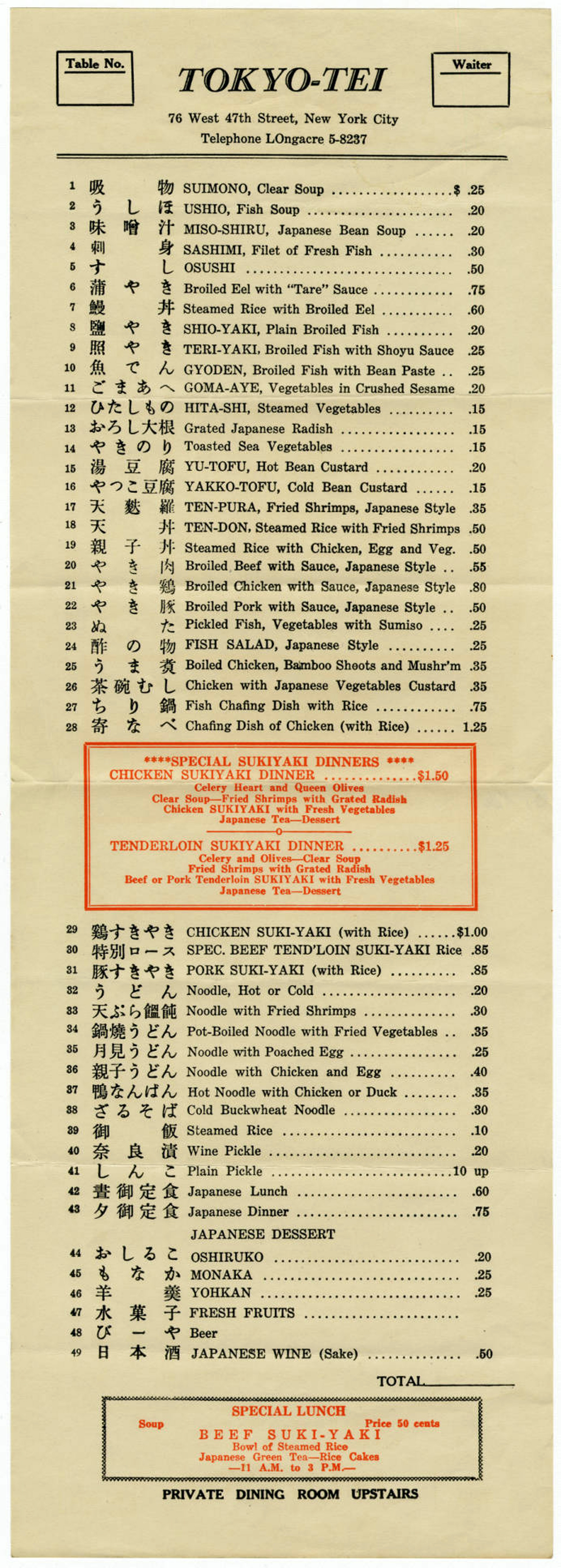
Figure 2: “Tokyo-Tei”. Menu, undated 1930s. New York City. Courtesy of the Culinary Institute of America.
Conclusion
Art critic John Berger noted, “The relation between what we see and what we know is never settled”.12 As this article has shown, Japanese restaurant menus function as far more than lists of dishes. They are rich cultural artifacts that reveal social values, tastes, customs, and identities. By engaging with menus as texts, students can develop a more nuanced understanding of Japanese food and culture, as the act of “reading” menus invites critical thinking and cultural empathy. They are invited to think about what they see and what they know through the process of interacting with menus. Japanese menus are a valuable and engaging resource for educators. Bringing menus into the classroom invites students into conversations and fosters critical thinking. It helps students hone skills in analyzing primary sources and allows them to approach an everyday object as a window into culture and history. Ultimately, studying menus helps us appreciate not only what is cooked, served and eaten, but also how food can communicate information about history, geography, and culture.
Notes
1 Kyodo News, “No. of Japanese restaurants abroad triples in last decade to 187,000, November 19, 2023, https://english.kyodonews.net/articles/-/44191?phrase=submarine&words=
2 Washoku Agent, “23,000 Japanese Restaurants in the United States?? Latest Information on the Japanese Food Industry in the U.S. in 2023,” Washoku Agent, https://washoku-agent.com/en/23000-japanese-restaurants-in-the-united-states-latest-information-on-the-japanese-food-industry-in-the-u-s-in2023/.
3 Bestor, Victoria Lyon, and Theodore C. Bestor. “Japan and the Sea.” Education About Asia 19, no. 2 (2014): 50–55.
4 Dix, Monika. “Water, Tradition, and Innovation: Flowing through Japan’s Cultural History.” Education About Asia 22, no. 2 (2017): 48-51.
5 See Ohnuki-Tierney, Emiko. Rice as Self: Japanese Identities through Time. Princeton University Press, 1993.
6 Moore, Richard. “The Japan Rice Paradox.” Education About Asia 9, no. 3 (2004): 10-13.
7 “Washoku, traditional dietary cultures of the Japanese, notably for the celebration of New Year,” UNESCO In-tangible Cultural Heritage, accessed May 1 2026, https://ich.unesco.org/en/RL/washoku-traditional-dietary-cul-tures-of-the-japanese-notably-for-the-celebration-of-new-year-00869.
8 Rath, Eric C. Japan’s Cuisines: Food, Place and Identity. Reaktion Books, 2016.
9 See Cwiertka, Katarzyna Joanna. Modern Japanese cuisine: Food, power and national identity. Reaktion Books, 2006. The blurriness between nihon ryori and washoku is also discussed Eric Rath’s Japan’s Cuisines, cited above.
10 Bestor, Theodore C., and Victoria Lyon Bestor. “Cuisine and Identity in Contemporary Japan.” Education About Asia 16, no. 3 (2011): 13–18.
11 “Tokyo-Tei, menu”. Menu. Undated. CIA 57-126. Conrad N. Hilton Library, Hyde Park, N.Y.
12 Berger, John. Ways of Seeing. Penguin Books UK, 2008, 7.
Glossary
Chuka ryori: Chinese-style dishes like ramen, gyoza (pan-fried potstickers), and chahan (Japanese-style fried rice).
Ichiju-sansai: Literally “one soup, three dishes.” The traditional Japanese meal format consisting of steamed white rice, a soup, a main dish, two side dishes, and pickled vegetables.
Kaiseki: A traditional multi-course fine dining meal that celebrates craftsmanship, artistry, and seasonali-ty. This meal is usually formulaic and ritualistic.
Nihon ryori: Japanese cuisine, defined by the use of skilled techniques, seasonal ingredients, and artistic presentation and formal traditional dining.
Nihonshoku: All food consumed in Japan, ranging from everyday dishes, traditional high end meals, and food with foreign origins.
Washoku: Traditional Japanese food culture, the customs, values, and practices surrounding food. Rec-ognized by UNESCO as an Intangible Cultural Heritage in 2013.
Yoshoku: Western-style dishes that emerged during the late 19th century, such as Japanese curry and tonkatsu (fried pork cutlet).
Digital Menu Collections
Below is a list of some digital menu collections that include Japanese menus. Due to copyright restrictions, these menu collections focus on historic menus.
Seattle Public Library: Seattle Room Digital Collections: https://cdm16118.contentdm.oclc.org/digital/collection/p16118coll5