

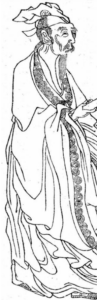
Image source: http://en.wikisource.
org/wiki/Author:Bai_Juyi
To help cement alliances south to Tibet, west to Kashgar, north to Mongolia, and east toward Korea, emperor Xuanzong brought to court women from powerful families.
THE HISTORICAL BACKGROUND
Edwin G. Pulleyblank’s 1955 study remains the definitive analysis of the array of political and economic factors that caused widespread discontent.1 For almost a thousand years before the 755 rebellion, Chinese power with its capital Chang’an (modern day Xi’an) had expanded the territory under its control. By the time of Emperor Xuanzong (685-762), the Emperor was responsible for a vast bureaucracy selected by an examination system. The Silk Road trade that enriched the capital city called for large public outlay of funds. The Chinese realm was connected by public roads and many great walls, and it was protected by a conscripted military growing to the hundreds of thousands, and paid for by ever-increasing taxes. To help cement alliances south to Tibet, west to Kashgar, north to Mongolia, and east toward Korea, Emperor Xuanzong brought to court women from powerful families. In the 750s, new Arab powers successfully challenged the Chinese in Central Asia, and the need for more troops grew. Then a leader patronized by the Emperor rebelled. This was An Lushan, a general whose father was a Sogdian and whose mother was Turkic. During the Rebellion, soldiers swept into the capital city and Emperor Xuanzong fled. Between 755 and 764, perhaps as many as thirty-five million people died. This is comparable to the worldwide deaths of World War I from civil disruption and war.THE PRIZED CONSORT YANG GUIFEI
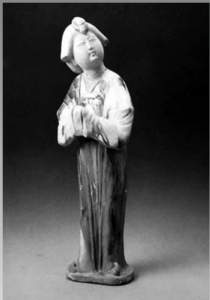
“I grant you your wish” have been used to illustrate Yang Guifei in books and academic journals such as the cover
of a program for the Association of Asian Studies.
Image source: Columbia University Web site at http://www.exeas.org/resources/
yang-guifei.html.
Photo: © Xiang Gang Lianhe Chubanshe
BAI JUYI NARRATIVE 807 POEM: "SONG OF LASTING PAIN"
The title’s key words have been translated as “Everlasting Sorrow” or “Regret,” but the word “Pain,” used by a foremost scholar of Chinese literature, Stephen Owen, conveys the intense feeling when loss of a loved one is compounded by responsibility and guilt. After the first part of the poem’s story ends with Lady Yang’s death, the second part focuses on the Emperor’s grief. The third part features a supernatural being finding Yang Guifei in an afterlife. Bai Juyi’s metaphors as Lady Yang remembers her love for the Emperor are so lyrical that they establish Lady Yang’s innocence. How could a woman so in love with Xuanzong possibly dally with An Lushan and conspire against the Emperor and his Empire?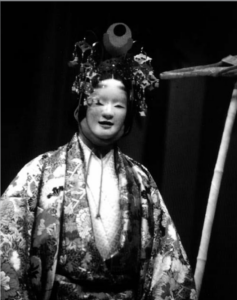
(Leiter, 53).
Image source: Japanese Theater in the World, New York: The Japan Society 1997.
THE POET: BAI JUYI
Bai Juyi was born about twenty years after Yang Guifei died. From the Tang Dynasty, three poets stand out: Du Fu (Tu Fu 712–770) has a position in Chinese culture of highest respect based on his exemplary Confucian ethics; Li Bai (Li Po 701–762) balances Du Fu; generally considered Daoist, he is dearer to Chinese people’s hearts. Bai Juyi is considered the third prominent Tang poet. Yet he was so highly regarded in Japan that Zeami featured him in a Noh play where his literary influence threatens to dominate Japanese culture; it takes a Shinto god to blow Bai Juyi back to China.4 The “Song of Lasting Pain” is available in multiple English translations, and in his anthology, Stephen Owen provides a context by printing related poetry and prose about Yang Guifei.5 Bai Juyi’s life is even more of an open book, in the form of a biography published in 1949 by Arthur Waley (The Life and Times of Po Chu-i: 772–846).6 Literary work and biography together provide a lively, quirky, and fascinating entry to a very significant part of Chinese history and culture. For a literature teacher, one often teaches history to understand a poem, but here we will also seek to understand the poet, Bai Juyi, to see how his poem interpreted and shaped Chinese history.BAI JUYI'S CONFUCIAN BACKGROUND
Bai Juyi was by education and early career a distinguished member of the Confucian official-scholar-literati class. He earned a rare “First Class” in the Confucian state examinations of the year 800. Moreover, his recorded governmental actions, and hundreds of his poems, demonstrate anger and diligent action against government corruption. Bai Juyi’s patrons in Chang’an were the highest Chief Ministers to the emperors who succeeded Xuanzong. Bai Juyi’s constant subject matter is loss; he complains so much about only briefly being governor of Suzhou and Hangzhou, that one overlooks that he was appointed to govern two of the most powerful cultural and economic cities of the Silk Road. In Suzhou today, he is referred to as “Lord Bai,” the builder of canals and great benefactor of the populace. Confucian classics underlying the Tang Dynasty examination system and governing bureaucracy expound an ethical system based upon a simple lifestyle and concern for a society in which the Emperor was held accountable for the welfare of all. In contrast, the court of Emperor Xuanzong and Yang Guifei supported a luxurious, extravagant lifestyle that was injurious to the Empire. The disparity between ideals and reality could have led Bai Juyi to write a poem reinforcing traditional Confucian advice to not let women draw near and become “immodest.”7 Indeed, in a preface to his poems Bai Juyi wrote, “I wish those who read them to understand them easily; the wording is straightforward and incisive, as I wish those who hear them to absorb deeply their admonitions.”8If warning is the key concept, the poem and account both offer a variety of temptations to eschew—women, sensuality, sleeping late, nepotism, trust, and general over-indulgence.
Nevertheless, a comparison to a prose “Account,” published by Bai’s friend Chen Hong to accompany “Song of Lasting Pain,” shows that Bai Juyi gives a much more positive report of Yang Guifei and the Emperor than does Chen Hong. Chen begins his “account” with “a world at peace” and “no problems in the land within the four circling seas”; this historically false idyllic scene is spoiled when Yang Guifei gains power by assuming a “seductively coy manner . . . suiting herself to His Majesty’s wishes by thousands of fetching ways.”9 In contrast, Bai Juyi begins his poem with the Emperor longing for beauty and finding it when Yang Guifei turns round with a “smiling glance”; her natural grace, with “Tresses like a cloud, face like a flower,” contrasts with the “powder and paint” of the Emperor’s other court women. If warning is the key concept, the poem and account both offer a variety of temptations to eschew—women, sensuality, sleeping late, nepotism, trust, and general over-indulgence. Only the sweetness and lightness of Bai’s adjectives, the elegance of Yang Guifei rising in “helplessness so charming” glowing from her bath, the beauty of phrases that sway to her steps along with the gold pins in her hair—only the entire craft of the poem—war with the censorious frame. Superficial didacticism appears at odds with a deeper meaning of the poem.DAOISM
In Bai Juyi’s “Song of Lasting Pain,” the third section begins when a personage Paul W. Kroll translates as a “Daoist adept” visits Emperor Xuanxong and offers to find the spirit of Yang Guifei. Kroll identifies the island where Yang Guifei is found after death as Penglai, the Daoist island of immortality. Here Yang Guifei is called “T’ai-chen” and her otherworldly maid Shuang-ch’eng, Daoist names.10 Why would Bai Juyi want his poem to appear Daoist? I suggest that Bai Juyi was making this a specifically Chinese story and deliberately mixed Daoist references with images that have a long cultural history in China. There have been Chinese references to the immortals’ island of Penglai since the fourth century CE and to the Weaver Maid’s love story since 1500 BCE. A kingfisher had been the symbol of beautiful and vulnerable Chinese women for hundreds of years. Bai Juyi’s famous image of two trees mingling their branches “leaf entwined with leaf ” combined with a pair of flying birds can be found in the Han Dynasty “Southeast the Peacock Flies.”11 Through these references, the experience of lost love no longer belongs to a specific Emperor and his exotic consort accused of causing untold death and destruction; they become every anguished, sincere, yearning lover of any time period. While Bai Juyi’s Daoist celestial maids are forgettable, his secular images of a rain swept blossom, un-swept autumn leaves, two birds sharing one wing, and a hairpin wrenched apart have become an integral part of Chinese culture. Chinese tourists now flock to the places such as Hua-qing pools outside present-day Xi’an and Mount Li because they are mentioned in this poem. A judgment that the Daoist elements are superficial is reinforced by another Bai Juyi poem that Waley quotes: “Traveller, I have studied the Empty Gate [Buddhism];/I am no disciple of the [Daoist] Fairies. / The story you have just told / Is nothing but an idle tale. . . .When I leave the earth it will be to go / To the Heaven of Bliss Fulfilled. [The Buddhist Paradise of Maitreya].”12 It seems probable, therefore, that the Daoist references are not part of a belief system that attracted the poet, but of a calculated defense of Yang Guifei by Bai Juyi. It is time to consider why, if Bai Juyi’s poem is only superficially Confucian or Daoist, he told the story and took care to put it in easily understandable language. Suzanne Cahill, a historian of medieval China, writes about the interrelationships between the Daoist and Buddhist systems when she discusses Bai Juyi,13 and suggests that images of paradise are coming from Buddhist and Hindu ideologies.14 To analyze the poem “Song of Lasting Pain” and its “construction” of Yang Guifei, we must turn to Tang Dynasty Buddhism.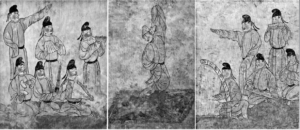
Image source: Zhang Hongyiu, A Collection of China’s Tang Dynasty Frescoes 150–151, 1995.
BAI JUYI AND BUDDHISM
A fascinating aspect of Bai Juyi’s biography concerns his intense study of Buddhism after 806. Buddhism is the grand story of the Tang Dynasty. The early Tang Emperor Taizong allowed the Buddhist Monk Xuanzang to go on his epic journey to India; Taizong greeted the monk on his return and supported his translation of Sanskrit sutras and narratives into Chinese. Empress Wu, Xuanxong’s grandmother, was a devout Buddhist. By the time of Emperor Xuanzong and Yang Guifei, many Buddhist Indian monks were visiting the Chinese capital; in 807–808, when Bai Juyi wrote “Song of Lasting Pain” Japanese Buddhist monks also came to Chang’an, including the famous Kukai, who brought back to Japan a syncretic form of Buddhism sympathetic to women. The reception of Bai Juyi’s poetry in Japan demonstrates that his interest in Buddhism was linked to the imperial court. In 838, his collected works were presented to the Japanese Emperor Ninmyo; in 847 a Japanese Buddhist “pilgrim” Jikaku brought back to Japan Bai Juyi’s Works and a separate copy of “Song of Lasting Pain.” Approximately one hundred and fifty years after Bai Juyi’s death in 846, Murasaki Shikibu read his poems to the Empress to whom she was lady-in-waiting. While Buddhism has remained a religion of the Japanese court, in China after the 755 Rebellion, Buddhism began to be blamed for political misfortune. The Tang court in exile used destructive Buddhist Uigher forces to take back the capital. Later, Buddhists from a powerful Tibetan kingdom ruled from Chang’an for a brief time. By Bai Juyi’s lifetime, the Buddhist kingdom of Nan-Chao ruled areas that had been administered from Chang’an, including Sichuan where Yang Guifei’s cousin Yang Gaozhong had been in charge.15 Waley gives much evidence that the Yang extended family was Buddhist. Despite growing hostility toward Buddhism, to the end of the Tang Dynasty in 907, Emperors conducted elaborate Buddhist rituals at court. In the center of the controversy over Yang Guifei’s role in the An Lushan Rebellion is her whirling dance. In “Song of Lasting Pain,” Bai Juyi refers to her dance “Coats of Feathers, Rainbow Skirts” shaken apart by the kettledrums of war, and again when her sleeves rise and billow as her spirit appears in the island of immortals. The historical meaning of this dance is central to understanding both Yang Guifei and Bai Juyi’s interest in her. Masako Nakagawa Graham records that Japanese scholars traced the melody from India, northwest to Sogdiana, and then east along the Silk Roads to Chang’an.16 He Zhang has suggested that the dance is part of Zoroastrian funerary rituals or widespread shamanistic practices or later Sufi Muslim whirling dervishes.17 Insight into the dance can be gained by reference to all these traditions, but much evidence exists that An Lushan and Yang Guifei were dancing before Emperor Xuanzong as part of elaborate Buddhist rituals at court.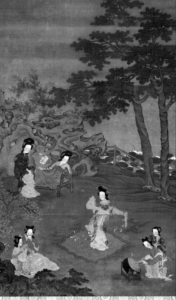
Rainbow Dance, ‘nichang wu,’which is distinguished by the dancer's colorful costume. Rainbow Dance music, described by Tang poets as the ‘Sogdian whirl is thought to have originated in India and was presented to the Tang Dynasty Emperor Xuanzong (reigned 712–756), who in turn modified the composition.” Besides the “Rainbow Dance”itself, the other detail that ties the picture to the Bai Juyi poem are the two trees, with branches intertwined; the woman dances on a rug as the Central Asian figure did in the 745 tomb painting.
YANG GUIFEI AND TANG DYNASTY BUDDHISM
Murals depicting a whirling dance in the Tang Dynasty court are found on the walls of eighth century Dunhuang Buddhist caves. According to Chinese scholar Duan Wenjie, the murals are depictions of paradise with a Buddha in the center, a bodhisattva on either side and music and dance in the front.18 The setting shows “magnificent palaces and pavilions where deities gather and watch performances of music and dance.”19 As Emperor Xuanzong produced more and more lavish displays of dance and music, with himself as central viewer, he was placing himself in the position of a Buddha incarnate. The female dancers represented “apsaras,” celestial beings who fly. The Chinese have long recognized the association between the Buddhist murals in Dunhuang and Xuanzong’s court: Duan Wenjie quotes an “eminent monk-scholar of the Early Tang”: “No wonder people these days compliment the palace women as Bodhisattvas.”20 When looking at the Buddhist Dunhuang mural, an early Chinese scholar remarked, “This is the Tang style. It is often said that Lady Yang had a delicate frame in full bloom.”21 After her death, Yang Guifei was accused of intending to entrance Emperor Xuanzong literally, and to distract him from his duties protecting the Empire. Yuan Chen (779–831) wrote a poem beginning: “The Turks were planning strife, / The Turks on purpose sent a girl / skilled in dancing the Whirl . . . a beguiling Turk came suddenly / to the Palace of Lasting Life”; “real truth” was that the “universe” could be changed through a “rainbow dance.”22 According to Victor Mair, “whirling dancers were presented at court as tribute from Sogdiana in 718, 719, 727, and 729.”23 As we have said, An Lushan had a Sogdian father and Turkic mother, and Chen’s “beguiling Turk” was An Lushan. There is a mural from a tomb built during An Lushan’s lifetime that shows a non-Chinese minority figure in a whirling dance pivoting on a rug, and today in China, this picture is frequently used to represent An Lushan (see Figure 3). Dunhuang still produces Central Asian rugs with Buddhist mandala designs. Sogdians during the Tang Dynasty included literate merchants who had sponsored translations of Buddhist texts from Chinese into their own language, and An Lushan’s family could easily have been Buddhist in the century before his group converted to Islam.BAI JUYI, YANG GUIFEI, AND BUDDHISM
Waley states that Bai Juyi actually saw a performance of the dance of “Rainbow Skirts” at court in 808–809.24 Bai Juyi later began to try to recreate the dance. As Governor of Hangzhou, 822–823, he gathered his own troupe of courtesan-musicians to perform “Rainbow Skirts, Cloak of Feathers” and again in Suzhou; Waley considered him obsessed with this particular music and dance (see Figure 4). Significantly for us, Bai Juyi seems to have been introduced to Buddhism by a pair of Yang male family members. He married a member of the large Yang clan shortly after publishing “Song of Lasting Pain.” The poem could be considered a love poem, yet it is improbable that Bai Juyi knew his wife before marriage; Waley indicates that Bai Juyi seemed more interested in the rocks that the Yang brothers gave him for his Buddhist garden than in the Yang woman after they married. When Bai Juyi was Governor of Suzhou in 825, he was a member of a society of those who aspired to be reborn in the Buddhist Vairocana’s Paradise.25 He chose to be buried near the Vairocana statue erected by Empress Wu (see Figure 5); his tomb is on Xiangshan hill where he spent his last years in convivial Buddhist retreat.CONCLUSION
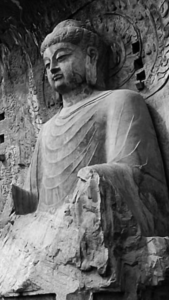
resemble the bodhisattva later associated with Yang Guifei.
Photo: Copyright Mark Schumacher, http://www.onmarkproductions.com
/html/longmen_54.html.
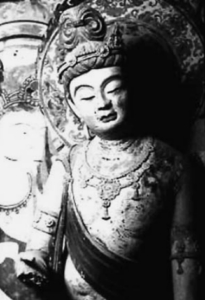
body type and its association with Avalokiteśvara (who becomes Guanyin in China), preceded her. The bodhisattvas
in Cave 45 of the Dunhuang Caves in Gansu province, China, pointed out as following Yang Guifei’s style, were cut in
713–741, before her rise in fame. The cause and effect relationship must be that Yang Guifei was chosen because she fit the religious ideal rather than establishing that ideal. Compare the androgeny and width of
the face and body to Figure 5.
IImage source: Columbia University Web site at
http://www.exeas.org/resources/yang-guifei.html.