

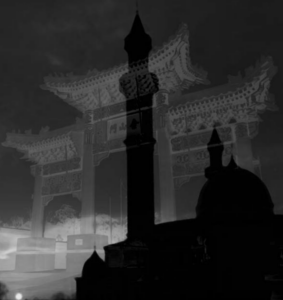
Early History of Sino-Islamic Contacts
Muslims from West and Central Asia started to arrive during the Tang (618–907) era in China. A cosmopolitan dynasty, the Tang welcomed foreigners, challenging the perception of Chinese isolationism and government limitations on outsiders. Muslims lived among Southeast Asian, Hindu, and Korean communities, and Islam was one belief system among several, including Nestorian, Zoroastrian, and Manichean religions in Tang China. Changan, the Tang capital, was the destination for many foreign Muslims, but other towns and cities in the Northwest and Southeast also housed small Islamic communities. Some traveled overland by the traditional Silk Roads from Iran via Central Asia and the oases of Turfan and Hami to China, while others traveled by boat through the Persian Gulf and the Indian Ocean to the ports of Southeast China. Nearly all were merchants lured by the profits to be made from providing Chinese products to the Arab and Iranian worlds. A few settled in China, where they received cordial receptions. As long as they did not proselytize, the government did not interfere with the practice of their religion. Nor did it impose itself on their communities, which had their own judges who administered Islamic law. They formed virtually self-governing entities. Other than one disastrous episode, relations between China, the Islamic communities, and the world were amicable. A conflict erupted between Tang and Arab armies near the Talas River in Central Asia. In 751, Arab forces defeated the Chinese, but had to return to West Asia because of the temporary turbulence accompanying the Abbasid overthrow of the Umayyad Caliphate (661–750). The Abbasids, one of the most glorious West Asian dynasties (750–1258), claimed descent from one of Muhammad’s uncles, portrayed themselves as more legitimate than their enemy, and capitalized on Umayyad discord and corruption. However, much more typical patterns in Tang-Islamic relations were peaceful trade and Tang recruitment of Muslims as interpreters, translators, and craftsmen. Although the Tang professed economic self-sufficiency, they actually required horses for their cavalry and sought the profusion of products listed in Edward Schafer’s The Golden Peaches of Samarkand. Muslim merchants often conveyed these goods to China. In short, both the Tang and the Muslims accommodated to, and benefited from, contact with each other. Yet again, other than one incident, the Muslim and Chinese communities interacted peacefully. However, according to the contemporaneous Arab historian, Abu Zayd, the Tang rebel Huang Chao killed over 100,000 Muslims, Nestorians, and Jews in his attack on Guangzhou in 878. Abu Zayd exaggerated the number, but the violence points to commercial rivalries and Chinese scapegoating of the Muslim and foreign communities for the troubles plaguing the late Tang. There is no earlier evidence of such hostility, but neither is there any evidence of the construction of a mosque during this time, despite the later claims of Chinese Muslims. Mosques in Guangzhou and Xian were not built until the early part of the Ming dynasty (1368–1644). Until then, Muslims worshipped in simple buildings which have not survived into the modern world. Sources offer maddeningly few details about prayer halls, rituals, and knowledge of Islam. The Song dynasty (960–1279) witnessed the arrival of an increased number of Arabs and Iranians along the Southeast coast of China. A Muslim cemetery in Quanzhou attests to their presence and to their positions, mostly as merchants and artisans. Zhao Rugua, a superintendent of maritime trade, gathered information from them about South, Southeast, and West Asia, which he then incorporated into a monograph on some of the Islamic countries and the goods they produced.Conflicts in Sino-Islamic Relations
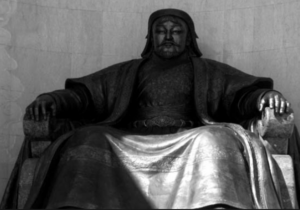
Square, Ulaanbaatar.
Image source: http://en.wikipedia.org/wiki/File:Genghis_Khan
_statue_UB_MGL.JPG.
Despite such Islamic accommodations, the succeeding dynasty’s relationship with the Muslim community deteriorated. In the 1750s, the Qing dynasty (1644–1911) annexed territories in the Northwest, which had substantial non-Chinese Muslim peoples. The Qing court instructed its officials to permit the local people to practice their religion and not to allow Chinese merchants to exploit them. Still, many officials either disobeyed or ignored these instructions, leading to predictable results. A Sufi order, which emphasized a mystical union with God and a form of Islam not influenced by Confucianism and Buddhism, justified establishment of a separate Muslim state. Rebellions erupted, most of which religious leaders led or actively embraced. Leaders known as Khojas were often the principal rebel commanders. This violence culminated in a major rebellion in the Northwest from 1862 to 1878 and in a Muslim and multi-ethnic revolt in Yunnan from 1856 to 1873. The loss of life in these outbreaks was staggering. One source estimates that fifty percent of the Yunnanese population either succumbed to the violence and attendant epidemics and starvation or migrated to nearby Southeast Asian states. These conflicts resulted in increasingly negative Han (or Chinese) views of both Chinese Muslims (now labeled Hui) and non-Chinese Muslims. Stories spread among the Han that Muslim merchants were avaricious, dishonest, and did not abide by such precepts of their religion as abstention from liquor and pork. They also emphasized a so-called Muslim predilection for violence. These unfavorable images precluded hopes for integration and additional accommodations that might have led to a cessation of hostilities. Tensions persisted throughout the late nineteenth century.The Mongol invasions of the thirteenth century ushered in an era of considerable contact between China and the Islamic world and an even greater increase of foreign Muslims into the Middle Kingdom.
Islam in China: Post-Imperial Developments
The fall of the Qing in 1911 offered the non-Chinese Muslims in the Northwest region of Xinjiang the opportunity to break away from China. The Hui, who were scattered throughout the country, would not attempt to do so because they perceived themselves to be Chinese. Yang Zengxin, a Chinese warlord, assumed power in Xinjiang and ruled until 1928. Aware of China’s deteriorating economic and political conditions, he fostered good relations with, and received economic aid from his neighbor, the Soviet Union. Simultaneously, he adopted less oppressive policies toward the Muslim community. After 1928, new leaders restored the more restrictive and discriminatory dicta against the Muslims, most of whom began to be referred to as Uyghurs. Turkic nationalists in Xinjiang responded by proclaiming an independent Eastern Turkestan Republic. Because the central government, dominated since 1928 by Chiang Kai-shek and the Guomindang (Nationalist Party), had scarcely much influence on Xinjiang, the local community appeared to have a great opportunity to create its own state. However, the Chinese Communists’ victory in 1949 prevented independence for Xinjiang and had an impact on the Hui. The government first asserted that China consisted of fifty-six nationalities, including the Han who constituted the bulk of the population. Although the Hui were ethnically Chinese, the Communist Party classified them as a separate minority nationality, and listed the Uyghur Muslim population as the most important group in Xinjiang. It reputedly committed itself to protecting the minorities’ customs and religious practices. Establishment of the Uyghur Autonomous Region in Xinjiang in 1955 supposedly attested to these intentions. However, many in the mostly Han People’s Liberation Army, which had occupied Xinjiang, formed the Production and Construction Corps (PCC) and set up semi-military economic enterprises in the region. Accounting for more than ten percent of Xinjiang’s population, the PCC had substantial economic power, and could serve as a security to stamp out Uyghur calls for greater autonomy or independence. At the same time, the Chinese government encouraged or compelled Han to migrate to Xinjiang. As of this writing, about one-half of Xinjiang’s approximately twenty million people consist of Han. The government had doubtlessly hoped for more intermarriages and assimilation by this time, but that has not been the case. Government policies toward the Hui and the non-Chinese Muslims in Xinjiang have varied over the past six decades. The government designated the Hui as a minority nationality, but these ethnic Chinese often shared more with Chinese in their own regions or provinces than with fellow Hui in distant areas. Although violence erupted on occasion between Hui and Han, the Hui did not seek independence. The government has been much more concerned with the Muslims in Xinjiang but has not developed a consistent and viable policy toward them. In such radical periods as the Great Leap Forward and the Cultural Revolution, it suppressed Uyghur expressions and affirmations of their language, religion, and culture, jailing and sometimes killing dissidents whom it labeled “splittists.” The Red Guards “destroyed mosques, forced many religious leaders and ordinary Muslims to raise pigs, and frightened the various Turkic peoples into shedding their habitual clothes, adornments, scarves, and donning Mao suits.”3 At other times, the government adopted a more tolerant attitude, though even then it initiated “strike hard” campaigns against splittists. Current relations between the Uyghurs and the government remain uncertain. Uyghurs still constitute a relatively low proportion of the top leaders and managers in the Communist Party, local government, and economic enterprises, with the mostly Han PCC wielding considerable authority. The State increasingly emphasizes Uyghur study of the Chinese language, with less effort devoted to encouraging Han study of the Uyghur language. Censors continue to screen literature, historical writings, films, and music to weed out undesirable ethnic affirmations or nationalism. The government periodically limits religious expression, especially religious study groups or overly ardent manifestations of Islam. To be sure, it has adopted affirmative action policies in education and employment, which are somewhat beneficial to the Uyghur and other minorities in Xinjiang. Also, the one child per family regulation is not applied to the so-called national minorities, partly to deflect criticism that the State seeks to reduce the number of non-Han people in China. Chinese government leaders have worried that the Uyghurs of Xinjiang would follow the model of the former Soviet Central Asian republics in seeking independence, and have tried to avert this “threat” by defusing Central Asian support for Uyghur splittists. Increased trade, as well as treaty arrangements with China via the Shanghai Cooperation Organization (founded in 2001), have prompted the Central Asian countries to avoid support for and impose control on the Uyghurs within their borders. In 1996, the Central Asian states “signed protocols with China affirming that they would neither harbor nor support separatist groups.”4 The establishment of the Shanghai Cooperation Organization and the 2001 Treaty of Good Neighborly Relations, Friendship, and Cooperation helped allay Chinese fears of Russian involvement with Uyghur nationalists because the Treaty stated that neither party would permit “the establishment on its territory of an organization or group which harms the sovereignty, security, and territorial integrity of the other party.”5 The government turned US efforts after September 11, 2001, to its advantage. In August 2002, it persuaded the US Deputy Secretary of State, Richard Armitage, to label the East Turkestan Islamic Movement—a group demanding Uyghur independence—a terrorist group.