

The Origins of the Korean Population in Modern Japan
People from the Korean peninsula had been sailing to the Japanese archipelago and shaping Japanese history since the beginning of surviving records. Yet these past influxes and influences have little direct bearing on the contemporary Korean population in Japan. Only several thousand Korean nationals were in the main Japanese islands at the time of Korean annexation in 1910. Rather, it was the labor shortage in the 1920s that led to the rapid expansion of the ethnic Korean population in the main Japanese islands. By 1945, there were about two million Koreans in Japan. After the formal annexation in 1910, ethnic Koreans were Japanese imperial subjects (kōkoku shinmin), but ethnic hierarchy was a structural feature of the Japanese empire. The imperial ideology of formal integration intensified after the 1930s, and Japanese policy thereafter sought to assimilate Koreans. The policy of Japanization reached its apogee in the idea that the Japanese and Koreans shared the same ancestors—at least a third of Japanese were said to be “mixed blood”—and the promotion of mixed marriage between Japanese and Korean subjects. Nonetheless, status inequality and social discrimination marred ethnic Korean lives.According to a 1951 study, sixty-three percent of Zainichi were born in Japan, and forty-three percent of them could not speak Korean.
With Japan’s World War II defeat, the majority of ethnic Koreans left the Japanese archipelago (given the absence of official census, these numbers are rough estimates). In spite of suffering racial discrimination and economic exploitation, some 600,000 ethnic Koreans remained in Japan and constituted the Zainichi population (zainichi means “residing in Japan” and can refer to non-Koreans, but the term has become synonymous with the ethnic Korean population in Japan). Some had achieved viable livelihoods, while others were weary of the unrest and poverty in the Korean peninsula. Risks of financial loss and political instability were far from the only reasons Koreans stayed in Japan. Many ethnic Koreans had married ethnic Japanese. Moreover, many ethnic Koreans born in Japan were linguistically and culturally Japanese. According to a 1951 study, sixty-three percent of Zainichi were born in Japan, and forty-three percent of them could not speak Korean. Ethnic Koreans had been Japanese nationals under colonial rule, but they gradually lost their rights, including ‘imperial citizenship,’ after the war. Quite frequently, the Japanese authorities had it both ways. Ethnic Koreans were stripped of their suffrage in 1945, presumably because they were not Japanese, but their effort to create ethnic schools was denied in 1948 because they were Japanese nationals. Although some Koreans were arrested as Japanese war criminals, other Koreans were fired from government jobs because they were no longer Japanese nationals. By the 1952 San Francisco Peace Treaty when Japanese sovereignty was restored, ethnic Koreans in Japan, the Japanese authorities, and the larger Japanese public regarded the Zainichi population as irredeemably Korean.The Rise of Sōren and the Project of Repatriation
Postwar ethnic Korean organizations sought to combat discrimination, aid fellow ethnics, and engage in homeland politics. By far the most powerful group was Zainichi Chōsenjin Sōrengōkai (General Federation of Resident Koreans in Japan; usually called Sōren, Chōsōren, or Chongryun), established in 1955. At a time when Japanese banks were loath to lend to ethnic Koreans, the financial arm of Sōren provided loans for ethnic businesses. Sōren schools sought to prepare pupils for eventual return to Korea and therefore stressed the teaching of Korean language and history. By the late 1950s, Sōren’s hold over ethnic Koreans in Japan was nearly total. In the late 1950s, Sōren launched a repatriation project by projecting North Korea as the mirror image of the miserable existence in Japan. In the two-year period between 1960 and 1961, some 70,000 Zainichi returned to North Korea, but the number dropped to about 3,500 in 1962 and steadily declined thereafter. The repatriation project officially ended in 1984, but it had effectively ended by the early 1960s.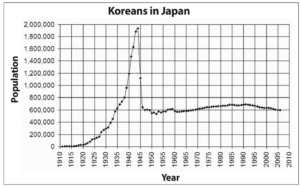
Image source: http://en.wikipedia.org/wiki/File:Population_of_Koreans_in_Japan.gif.
Zainichi Identification
In spite of the unrealistic prospect, the ideology of return would long survive beyond the early 1960s. The false promise of colonial-era assimilation and the brute reality of contemporary discrimination left the future repatriation as the best hope for ethnic Koreans in Japan. The 1965 Normalization Treaty between Japan and South Korea marked a major turning point. For ethnic Koreans in Japan, it provided incentives to seek South Korean citizenship, which would provide relatively secure footings in Japan, the relative freedom to travel abroad (and return to Japan), and access to Japanese medical and welfare benefits. The Treaty also signaled to the Korean population that unification was far from being imminent and increased the likelihood of prolonged, perhaps permanent, residence in Japan. This realization would in turn cause an irreversible decline in Sōren membership. Why didn’t Mindan—the ethnic organization affiliated with South Korea—become the dominant force among the Zainichi? The political and ideological rift between South Korea and the Zainichi population was deep and wide in the 1970s. Living in democratic Japan, many Mindan members found the South Korean government’s human rights abuses unpalatable. The military dictatorship in South Korea alienated the Korean population in Japan.Exclusion and Inclusion
Between the end of the Korean War (1953) and the oil shock (1973)—symbolized by the 1964 Tokyo Olympics—Japan achieved phenomenal growth and popular democracy. However tentatively, ethnic Koreans became enmeshed in the dominant trends of Japanese society. Nonetheless, job discrimination was an unquestioned fact in the postwar period. All public-sector jobs were reserved for Japanese nationals until 1972. Outside of baseball for boys and singing for girls, self-employment in the ethnic economy, whether scrap recycling or running yakiniku (Korean-style barbecue) restaurants, was regarded as the fated lot of Koreans in Japan. Ironically, employment discrimination spurred ethnic Koreans toward entrepreneurial pursuits, and though most of the establishments were modest, some became remarkable successes, such as Lotte and Softbank. Beyond employment discrimination, ethnic Koreans faced the exclusionary practice of national and local governments. Although the postwar Japanese Constitution guaranteed basic human rights, the Japanese welfare state systematically left them out as foreigners. In spite of equal treatment as taxpayers, non-naturalized Koreans categorically lacked access to social welfare provisions, ranging from child support to old-age pensions. Discrimination manifested itself at critical life junctures—education, employment, housing, and marriage. Government policy came close to apartheid or Jim Crow laws, but the Japanese stress was on excluding Koreans as “aliens” rather than establishing separate institutions.Self-hatred, hatred of things Korean, and guilt for hating the self and the group stirred many Zainichi psyches, damned to ponder endlessly on the irresolvable question of identity.
Disrecognition
Beyond the statistics and the structures of discrimination, what seared Zainichi consciousness was their fundamental illegitimacy—disrecognition, or lack of recognition—in postwar Japanese society. By recognition I refer to a complex of attributes—acknowledgement, acceptance, and respect—that endow people with a sense of rightful existence and legitimate life. In the prewar period, ethnic Koreans may have been deemed inferior, but they were recognized as a familiar group with their place in Japanese society. In the postwar period, though the legacy of colonial hierarchy was slow to dissipate, ethnic Koreans were often objects of dislike, disenfranchisement, and degradation: in short, disrespect and disrecognition. The most blatant display of disrecognition was that the name of the group also served as a racial epithet (usually, there is a distinction between a “correct” name and a “racist” one). The baffling situation is expressed well by Fujiwara Tei, whose bestselling 1949 memoir depicted her family’s arduous return to Japan after the end of the war: “We were called Japanese. No one got angry about it since it was obvious. Yet, when we called Koreans ‘Koreans,’ they got very angry.” What was puzzling to the colonizer was profoundly obvious to the colonized: Chōsen signified undesirable attributes and traits, e.g., the usual racist litany of dirty, smelly, lazy, and stupid. The Korean pronunciation of the name for Korea, after all, is Chosŏn, not Chōsen; only a Japanese person would employ what for native Korean speakers is an odd-sounding word, a signifier of colonial conquest. Be it language or food, things Korean were negated, and they became sources of shame. Self-hatred, hatred of things Korean, and guilt for hating the self and the group stirred many Zainichi psyches, damned to ponder endlessly on the irresolvable question of identity. An inferiority complex was pervasive, leading to a denial of Korean ancestry and to the unwelcome embrace of Japanese identity.Which Side Are You On?
The Zainichi population faced the infeasibility of returning to Korea, the implausibility of being Japanese, and the impossibility of being otherwise. Rather than assimilation or repatriation, Zainichi faced the choice between Japanization or Koreanization. Only a minority pursued the ostensibly obvious path of naturalization. Throughout the 1960s, there were several thousand naturalization cases per year. It would be tempting to blame the xenophobic policies on the Japanese government. Between 1952 and 1985, the Japanese government projected an ethnoracially homogeneous vision of Japanese society—one race, one ethnicity, one nation. In effect only people who could claim blood descent, and preferably a pure one at that, deserved citizenship. Yet it would be misleading to focus solely on restrictive Japanese policies and practices. Having assimilated culturally, most ethnic Koreans hesitated to take the next step. Zainichi resistance reflects not only the instinctive anti-Japanese sentiments, but also the nationalist mindset that precluded the possibility of a hybrid identity. The category of Korean American or Korean Canadian is widely accepted where the question of citizenship is decoupled from that of ethnic identification. Given the nationalist mindset that asserted a homogeneous Japan and Korea, the very possibility of an in-between identity was dismissed. Colonial and historical memory made naturalization a gesture of national betrayal, an act of treason. Because naturalization required the adoption of Japanese-sounding names (based on approved Chinese characters) until the 1990s, it reprised the 1940 edict that outlawed non-Japanese names (sōshi kaimei). Naturalization also mandated compliance with the Japanese practice of household registration (koseki), which became transposed to the traditional Korean landlord practice of lineage registry (chokbo). Challenging the Confucian and Korean value of venerating ancestors, to Zainichi, naturalization implied a brutal uprooting of the family tree. Never mind that lineage registry was a province of the landed elite: the group that was underrepresented in the Zainichi population. More prosaically, Japan remained the ideological enemy that had never atoned for its colonial-era brutalities, or continuing maltreatments and injustices, and therefore had not been exonerated.Unable or unwilling to return to Korea, but unwilling to become naturalized, passing became the default option for Zainichi.
Retaining Korean nationality was the only legitimate way to be Zainichi. This was literally true in the sense that the population figure of Zainichi depends on the census, which in turn only has categories for foreigners. Because neither the Japanese government nor social scientists systematically collect data on ethnic diversity, there are only Japanese nationals and Korean nationals. To be a Japanese citizen means to assume Japanese ethnicity as well. The logic of Japanese government demographers was shared by most ethnic Koreans. The ideology of monoethnicity affected both ethnic Japanese and ethnic Koreans. The vocabulary of blood purity was frequently invoked by Zainichi to shun intermarriage and to resist naturalization. In effect, the belief in ethnic essence, presumably carried by “blood,” accompanied the pursuit of purity.Passing as a Way of life
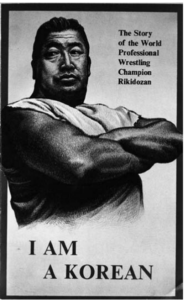
Image source: http://masterleemovies.wordpress.com/
2007/12/28/wrestling-nostalgia/.
The Politics of Recognition
The possibility of claiming a Zainichi identity presented the third way beyond repatriation and assimilation. The most sensational manifestation, albeit expressed negatively, was the Kim Hiro or Sumatakyō Incident. In 1968, Kim Hiro (Kin Kirō) shot two Japanese gangsters and then held some eighteen people hostage for nearly four days. When he was given a chance to air his “motives,” he spoke to the national media about ethnic discrimination: surely Kim’s indictment of Japanese disrecognition reached a larger audience than any prior, and possibly later, Zainichi voice. Remarkably, he succeeded in coaxing an apology in front of national television from a police chief who had made a racist statement. In fact, there was a harbinger of the Kim Hiro case: the Komatsugawa Incident. The eighteen year-old Ri Chin’u allegedly raped and killed two women in 1958, and was convicted and executed four years later. Although it is unclear whether he was in fact guilty of the crimes, it is clear that he became a notorious criminal. Arrested on the thirty-fifth anniversary of the post-Kantō earthquake massacre, when Japanese mobs massacred hundreds of Koreans as scapegoats, Ri faced the Japanese police, judiciary, and mass media that had entrenched preconceptions of Korean criminality. Sensational violence came to exemplify the hopeless situation of Zainichi, but the two cases, a decade apart, shook some Japanese and many Zainichi people into considering and acting on the problematic status of Zainichi in Japanese society. These individual harbingers would find collective expressions in the course of the 1970s. As assimilation advanced, ethnic identity was asserted. Most significantly, in 1970, Pak Chonsok sued Hitachi for dismissing him after the disclosure of his ethnic background. He won the ensuing lawsuit in 1974. The Hitachi case opened a decade of legal struggles, which were the Zainichi equivalent of the civil rights years in the United States. The Zainichi population and its supporters made a series of striking court victories that restored the social, civil, and political citizenship rights they had lost in the immediate postwar years.The declining impact of discrimination and the rise of ethnic recognition made Zainichi a significant presence in Japanese cultural and social life by the turn of the twenty-first century.
By the early 1980s, Zainichi had become a “problem” that was no longer ignored outright. The anti-fingerprinting (or fingerprinting refusal) movement began with a “one man rebellion” by the Zainichi Tokyo resident Han Chongsok in 1980, followed soon thereafter by many others. Their narrow contention was that forced fingerprinting during alien registration was a violation of human rights and dignity. Their wider concern was the systematic discrimination against Zainichi and other non-ethnic Japanese people in Japan. If Pak Chonsok’s suit against Hitachi had opened the possibility of legal struggles to combat disrecognition, then the anti-fingerprinting movement denoted its popular political realization. The mid-1980s ethnic political mobilization capped at least a decade’s worth of the Zainichi civil rights movement. By the early 1980s, authorities in Osaka, as well as those in other localities began to hire Korean nationals for civil service positions—the right that was denied immediately after the end of the war. The Zainichi legal and political struggle for recognition pricked the conscience of ethnic Koreans and ethnic Japanese. Zainichi disrecognition in Japanese public life was clearly in retreat by the 1980s.Changing Japanese attitudes and Policies
Having conquered Korea in the pre-war period, the Japanese continued to presume superiority over Koreans in the postwar period. South Korea was consistently one of the most disliked countries among Japanese people in the 1960s. However, from the 1988 Seoul Olympics to the 2002 World Cup, sports kindled Japanese interest in South Korea. Along with growing tourism, Korean food became a “boom.” By 2000, kimchi was the most produced pickle in Japan, far exceeding the more traditional takuan. The growing respect for South Korea—though North Korea remained a country to fear and parody—occurred in tandem with the decline of ethnic discrimination. The Japanese government’s effort to be in line with the “advanced” countries, as well as in response to pressures from human rights and anti-discrimination groups, led to its extirpation of outright policies of discrimination, whether in opening up public-sector employment or disbursing medical and welfare benefits. Social movements certainly played a part in raising Japanese consciousness about societal evil. By the late 1980s, discrimination (sabetsu) had become a dirty word.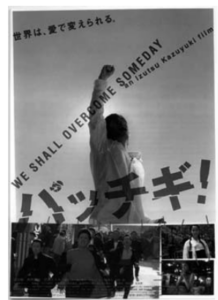
Image source: http://asianmediawiki.com/File:
Breakthrougposter.jpg.