

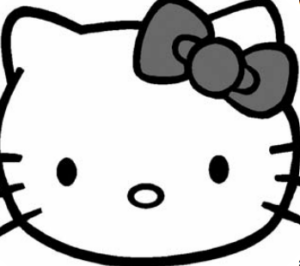
 The cute characters and commercial goods emerging from contemporary Japanese popular culture have quickly spread around the globe, capturing the attention of teenagers and adults, most of whom were not even considered as target consumers of these products. Their popularity is much more than a passing phenomenon of fashion-conscious people looking for the latest thing. In fact, the steady development of cute culture in Japan since the 1970s signals more than even the most avid consumer of “cute” may realize. Cute culture reflects the changing modes of social, economic, and political conditions, especially young women’s ideas about work and marriage and young male perceptions about their future. Learning about the history and contexts of cuteness in Japanese culture, from classical aesthetics to the economic growth that led to recession, will help readers understand the many meanings underlying the seemingly simple concept of “cute.”
The Shōwa Emperor, who was the symbol of wartime Japan’s military aggressiveness and dictatorship, passed away in 1989, and thousands of Japanese people gathered in the front yard of the imperial residence to pray for his peaceful rest. Among these people were groups of teenage girls, who commented, quite unexpectedly, that the emperor was cute.1 At the time, this youthful obsession with cuteness seemed mysterious, like some sort of psychopathological disease unique to adolescence. Then Hello Kitty, an emblem of cute merchandise, recorded a $96 million profit for North and South America in 2002.2 Somewhat perplexed by the success of “cute,” Business Week Online reported on “Japanese cute” in an article entitled “In Japan, Cute Conquers All,”3 which was soon followed by a flood of articles and news coverage about the rise of Hello Kitty and cute characters in North America. Students quickly caught on to this trend.
The cute characters and commercial goods emerging from contemporary Japanese popular culture have quickly spread around the globe, capturing the attention of teenagers and adults, most of whom were not even considered as target consumers of these products. Their popularity is much more than a passing phenomenon of fashion-conscious people looking for the latest thing. In fact, the steady development of cute culture in Japan since the 1970s signals more than even the most avid consumer of “cute” may realize. Cute culture reflects the changing modes of social, economic, and political conditions, especially young women’s ideas about work and marriage and young male perceptions about their future. Learning about the history and contexts of cuteness in Japanese culture, from classical aesthetics to the economic growth that led to recession, will help readers understand the many meanings underlying the seemingly simple concept of “cute.”
The Shōwa Emperor, who was the symbol of wartime Japan’s military aggressiveness and dictatorship, passed away in 1989, and thousands of Japanese people gathered in the front yard of the imperial residence to pray for his peaceful rest. Among these people were groups of teenage girls, who commented, quite unexpectedly, that the emperor was cute.1 At the time, this youthful obsession with cuteness seemed mysterious, like some sort of psychopathological disease unique to adolescence. Then Hello Kitty, an emblem of cute merchandise, recorded a $96 million profit for North and South America in 2002.2 Somewhat perplexed by the success of “cute,” Business Week Online reported on “Japanese cute” in an article entitled “In Japan, Cute Conquers All,”3 which was soon followed by a flood of articles and news coverage about the rise of Hello Kitty and cute characters in North America. Students quickly caught on to this trend.
The Japanese idea of cuteness in fact emphasizes the sense of pathos that the powerless and helpless object inspires in the observer’s mind.
Youth culture captures student interest, leaving many teachers behind. In fact, the increased demand for teaching about “cute” has deeply confused me, even though I have taught courses on Japanese popular culture and literature. What do we gain, teachers or students, from researching and studying about this seemingly frivolous culture driven by teenagers and young women? How do we extract values and morals, or any cultural meanings, from the phenomena wedged in marketing strategies and elusive youth subcultures? In this article, I will present an overview of the history of cute culture, hoping to place cuteness in historical, political, and social contexts in order to help teachers and their students build a better understanding of Japan. While the visual signal of cuteness has an almost universal effect on humanity, people’s reactions to, and definitions of, cuteness greatly differ across cultural borders. “Cute cues are those that indicate extreme youth, vulnerability, harmlessness, and need,” Natalie Angier states, citing scientists in her article “The Cute Factor”.4 The concept and culture of cuteness in modern Japanese language has uniformly been ascribed to the single word, kawaii, an adjective fairly similar to the English word, cute. In general use, kawaii is made up of two kanji (Chinese characters) that respectively signify “able” (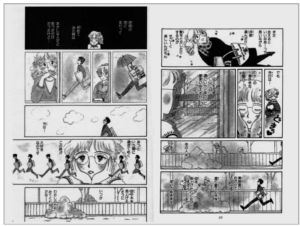
An excerpt from Mutsu A-ko’s Days of Roses and Roses (Bara to bara no hibi) published in Ribbon in 1985. Reprint in Mutsu A-ko Jisensh, Volume 1, published by Shōeisha in 1996. In this example you can see the sentiment and imagery of romantic “otome”identity for adolescent girls.
What predominates the idol culture of cute is women’s pretension to be small children by means of childish talk, pastel-colored fashion, and their love of cute stationery goods and fluffy animals.
The cute fad continued into the 1980s and saturated mainstream culture through popular idol singers, especially Matsuda Seiko.9 Her fashion, hairstyle, speech, and gesture came to acquire the name burikko, a term supposedly originating from kawaiko burikko, a child or a girl who pretends to be kawaii. Kinsella describes burikko as young people “dressing themselves up as innocent babes” who refuse to become adults and take social and familial responsibilities.10 What predominates the idol culture of cute is women’s pretension to be small children by means of childish talk, pastel-colored fashion, and their love of cute stationery goods and fluffy animals. This 1980s trend of women’s denial to grow up is often represented by the popular term shōjo, “females between puberty and marriage”11 who provide the cultural model of girls as carefree consumers rather than as producers.12 One of the reasons women choose to stay in the interim period of shōjo is the limited range of alternative paths available for women who aspire to pursue a career after completing education. Women thus embrace the harmlessness and innocence of shōjo by enthusiastically consuming cute merchandise, while delaying their roles as wives and mothers.A new wave of kawaii arrived with the protracted economic crisis. The Hello Kitty revival happened in the mid-90s when the value of the Japanese yen fell drastically and major Japanese banks went bankrupt.
The culture of shōjo and kawaii declined toward the late eighties to early nineties, as Sanrio “fancy goods” disappeared from stores. The first half of the 1990s also saw stagnation in both the idol culture and anime industry. In the meantime, more self-conscious portrayals of young women’s identity associated with kawaii caught critical attention in publications such as Yoshimoto Banana’s Kitchen (Kicchin, 1988), which illustrates a new concept of family from a shōjo’s perspective. Some representative works of shōjo manga also challenged existing family norms by portraying daughter figures who refuse to be passively cute and dependent.13 Contrary to the eighties notion of kawaii that linked pretentious cuteness with the sense of self-pity, these female characters struggle to achieve family bonds and youth freedom, a trend that set the stage for the nineties revival of kawaii culture.
TarePanda, or the drooping panda that is so lazy that it simply lies on the floor. This lazy panda’s popularity coincided with the trend word iyashi (heal, solace) and the nation’s overall mood for ganbaranai, or “don’t work hard.
The CD cover of the tango song about three “dango” (sweet dumplings) brothers from NHK. This children’s song illustrates the funny, yet warm and intimate, relationship of the three brothers that may be rare in Japan today, where
the average number of children per nuclear family household barely exceeds 1.0.
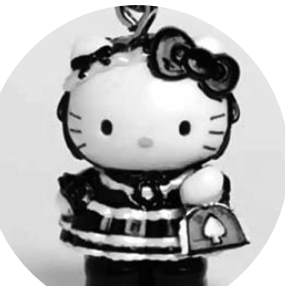
Gothic-Lolita Hello Kitty cell phone strap charm designed by Takemoto Nobara, a leading figure in the Goth-Loli fashion community. The Gothic Lolita combines Lolita (a fashion similar to Rococo-style children’s clothing, represented by pink and white colors, puffed sleeves, laces, and ribbons) and Gothic (characterized by black or dark colors, Gothic symbols and patterns, and some influences from punk rock).

When Cicadas Cry (Higurashi no nakukoroni) is a PC game series that also turned into anime, manga, CDs, novels, a Play Station game, and a live action film. Its media deployment continues from 2002 to the present, and sales are promoted through images of violent murders and complex mysteries. The mass media tend to associate murders by youth, especially girls, with this character, Rena, who wears a Lolita-style white dress and hides a hatchet in the back. The image is the front cover of a
fan book that analyzes the plot and characters, published under the title Character & Analyze Book published by JIVE in 2006.
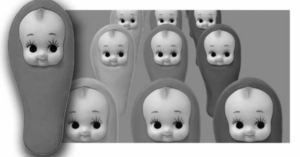
Tarako (cod roe) Kewpie, a commercial mascot character for cod roe spaghetti sauce produced by Kewpie Corporation (aka Q.P. Corporation). The TV commercial of this product shows a number of Tarako Kewpies marching on the street, which is more disturbing than cute. Image source: http://www.kewpie.co.jp/tarako/index.html.
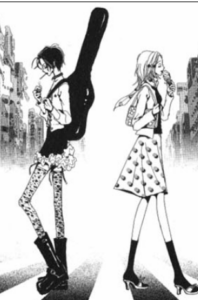
An illustration of the two NANAs from Yazawa Ai’s manga NANA, Vol. 2, Shōjo
Beat Manga Ed edition (February 7, 2006). Although they are best friends, their contrast is clearly shown. Nana
(left) appears in punk rock fashion, smoking a cigarette. Nana (right) wears a feminine skirt and scarf, eating an ice cream cone.
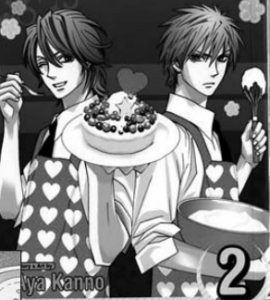
Otomen, a shōjo manga written by Kanno Aya and published in Hakusensha’s Hana to yume since 2006. The image comes from the front cover of Volume 2.
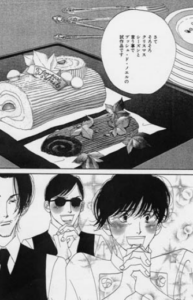
Four handsome men who have lost interest in career pursuit, commercial success, or heterosexual romance, gather and run a fancy bakery in Yoshinaga Fumi’s manga, Antique Bakery (Seiyōkottō
yōgashiten). In this scene from Volume 2, two men get excited like “otome” about Buche de Noel for Christmas. The manga
has been serialized in Shinshokan’s Wings since 1999, adapted into TV drama and anime, and translated into English since 2005.
The relationship of Japanese culture and cuteness has developed on several different levels in the country’s cultural environment. After defeat in World War II and postwar recovery, Japan’s cultural proclivity toward dependence and indulgence seemed to lead the nation to conclude that its political and economic dependence on the United States was the key to success.19 This subservient relationship has perhaps nurtured Japan’s “childish” popular culture.20 The “cute” emperor at the end of the Shōwa reign could symbolize the nation’s conversion from military despotism to pacifism. Cuteness also mirrors the changing conditions of culture from the viewpoint of the disempowered, especially women and children, who are forced to play the roles of incapable and subservient dependents on men. The current trend, seen in the symbiosis of cuteness and aggressiveness, further complicates kawaii as an icon of defiance and resistance of the oppressed groups to traditional gender norms and procreative roles. Cuteness today is a means for expressing identity from the margin of society where powerlessness can lead into subversion. Trifling as the culture of cuteness may seem, it is actually an excellent starting point for students to look at their personal interests and expand their horizons to a deeper understanding of Japan. Teachers in various disciplines will find “cute” to be a useful critical tool for introducing scholarly approaches to popular culture and visual media.
Trifling as the culture of cuteness may seem, it is actually an excellent starting point for students to look at their personal interests and expand their horizons to a deeper understanding of Japan.