
Image source: The Defence Talk Global Defense & Military Portal at http://www.defencetalk.com/pictures/showphoto.php/photo/17395.
WHAT IS MARITIME HISTORY?
While the history of human experiences at sea has always elicited a certain amount of interest, it has grown into a discipline in its own right. The first step for newcomers is to conceive of maritime history as a distinct field of inquiry and endeavor, and to do so without oversimplifying. This is harder than it might seem. It is commonplace, even among those well versed in oceanic affairs, to reduce maritime history to a chronicle of naval derring-do, and understandably so. Sea warriors have exuded romance since the Age of Sail, while a fleet battle could decide the fate of nations in an afternoon. However, exaggerating the importance of naval encounters like Trafalgar or Leyte Gulf, or the individual heroics of Lord Horatio Nelson, distracts from a richer field of study. A quirk of historical fate obscured the economic, social, and cultural dimensions of maritime history for most of the twentieth century. Scholars only began systematically exploring the intersection between human events and the sea near the close of the nineteenth century, when antagonism among the great empires was building toward the bloody crescendo it would reach during the world wars. The prevalence of geopolitics during the founding era of maritime history naturally tilted the field in the direction of diplomatic and military affairs. It is important to acknowledge the breadth of the field, then, even while conceding that political and military history dominates not only any overview of twentieth century maritime Asia, but also most of the essay that follows. Commerce, industries like fishing and oil production, and cultural interchange are as much a part of maritime history as broadsides between opposing lines of battle. For instance, Fernand Braudel’s The Mediterranean stresses how factors like geography, demographic patterns, and agriculture shaped European civilization.1 Fishermen and merchant sailors ply their trades out of public view, disguising the economic value of the sea, but maritime history clearly involves far more than naval actions.The prevalence of geopolitics during the founding era of maritime history naturally tilted the field in the direction of diplomatic and military affairs.
Indeed, the hardest thing about teaching maritime history is to set boundaries. One way to do so is to refuse to divide the subject up in the usual ways, by discipline, historical epoch, or geographic region. Instead, we can ask what the sea is, how seagoing societies interact with the oceans and one another, and what uses they make of these nautical expanses. Metaphorically speaking, the high seas are a “commons” beyond the sovereign jurisdiction of any government, where shipping is generally exempt from interference. That is, the sea is a medium for transporting goods hither and yon, extracting natural resources, pursuing scientific inquiry, and projecting military force.2 The sea has other uses, too. It is a nautical “highway”—a thoroughfare that connects every seaport with every other port across the globe and, in the case of navigable rivers like the Yangtze or the Mississippi, with the heartlands of great nations. It is a “moat,” a marine belt conferring strategic depth. Control of offshore waters provides coastal nations with a defensive rampart against rival navies, not to mention scourges like piracy, terrorism, and weapons or narcotics trafficking. Surveying how these metaphors applied to twentieth-century Asia offers a glimpse of potential futures for the region.NINETEENTH-CENTURY PRECEDENT
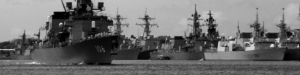
The twentieth century witnessed Asian fleets return to the sea after centuries of Western supremacy. Hindu kings forbade extended voyages in the fourteenth century, abandoning their claim to sea power. China’s Ming Dynasty followed suit in the fifteenth century, scrapping the world’s greatest navy scant decades before Portuguese adventurer Vasco da Gama dropped anchor at Cochin. For seafaring societies, control of maritime movement equates to control of national life—a fact lost on land-bound Asian rulers who neglected the military means for protecting trade. After da Gama’s arrival, recalls K. M. Panikkar, merchants could ply their trade only at the sufferance of European “Lords of the Sea.” Command of the maritime commons—and thus dominion over Asian societies—passed into outside hands by default. Relinquishing control of the sea resulted in Asians forfeiting their prosperity, security, and in many cases, even independence. This was especially hard to bear for Imperial China, which found itself displaced from the Middle Kingdom’s historic maritime periphery. From the 1830s onward, British and French expeditionary forces repeatedly defeated the Qing Dynasty, compelling the Dragon Throne to surrender seaports like Hong Kong and Qingdao and to sign “unequal treaties” granting foreign gunboats the right to patrol Chinese rivers and lakes—as they did until the 1930s. This “century of humiliation” remains a point of departure for Chinese strategic discourses. Nationalism—the impulse to right historical wrongs, thereby restoring China’s dignity, honor, and prestige—impels the Chinese people and their rulers seaward as much as any economic or geopolitical motive does. As the nineteenth century ended, Meiji Japan sought to substitute its own maritime dominance for that of Westerners. Commodore Matthew Perry’s “black ships” induced the Tokugawa shoguns to reopen the nation to foreign commerce in the 1850s, delighting Japanese magnates who clamored for trade. Perry’s mission awakened the shogunate to the coercive potential of modern navies, especially against island nations like Japan. Following the “restoration” of imperial rule, accordingly, the Meiji emperor decreed a material transformation of Japanese society—including its navy. Japan leapt into the forefront of the industrial world within decades, an historical blink of an eye. For foreign admirers like President Theodore Roosevelt, Imperial Japan embodied the “strenuous life” of entrepreneurial and martial vigor.3 Bolted together from a jumble of imported components, Japan’s Combined Fleet overpowered a capable Chinese Navy in 1894–1895 before sending two overmatched Russian fleets to the bottom in 1904–1905. Feats of arms like the Battle of Tsushima (1905) electrified Asians, proving that Western rule of Far Eastern waters was not preordained. Asians could control their own maritime destiny. These encounters set a warlike precedent. Japanese shipbuilders constructed the world’s third-largest merchant marine, gladly filling the market left vacant during World War I when European shipping firms withdrew from the region. But the allure of fleet actions obscured the crucial, yet mundane, chore of protecting the freighters and tankers on which Japan’s economic vitality—and thus its war-making capacity—depended. Commerce, and the hulls that transported it, remained an afterthought for Tokyo. Maritime history was naval history for most of the twentieth century.Bolted together from a jumble of imported components, Japan’s Combined Fleet overpowered a capable Chinese Navy in 1894–1895 before sending two overmatched Russian fleets to the bottom in 1904–1905.
1890-1945

Image source: http://en.wikipedia.org/
wiki/File:alfred-Thayer-Mahan.jpg.
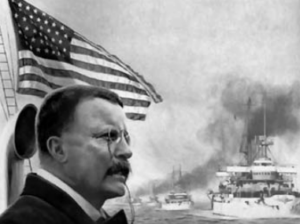
Image source: http://warandgame.wordpress.
com/2008/03/06/
great-white-fleet/.
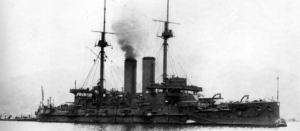
For Mahan, sea power was founded on three “pillars”—trade, merchant and naval fleets, and overseas bases to refuel and repair steam-propelled vessels. Maritime meant far more than naval, then, despite the martial tenor of his writings.
Roosevelt believed that Japanese leaders would think twice about aggression if they thought the US Navy would thwart their ambitions, but the Great White Fleet’s exploits could not prevent eventual war, and the US and Japanese navies planned against each other throughout the 1920s and 1930s. In effect, Tokyo wanted to fence off the East Asian commons for itself. Japanese strategists intended to enclose a “Greater East Asia Co-Prosperity Sphere” within the “second island chain,” which runs from the Japanese home islands southward through New Guinea. Consolidating this island-chain defense perimeter would mean driving the United States from the Philippines.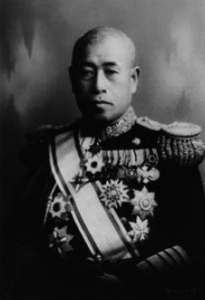
Image source: http://en.wikipedia.org/
wiki/File:Isoroku_Yamamoto.jpg.
Championed by diplomat George F. Kennan in the late 1940s, containment envisioned keeping Soviet expansion in check until the ideologically driven communist regime mellowed or collapsed under its own weight.
And on the evening of December 7, 1941—with the Pacific Fleet battle line still ablaze—Admiral Harold Stark, the chief of naval operations, ordered US submariners to wage unrestricted submarine warfare, sinking everything that flew a Japanese flag. The undersea campaign exacted a frightful toll on Japanese merchant shipping, starving the island nation of irreplaceable natural resources and war materiel. No less a figure than wartime Prime Minister General Tōjō Hideki credited the remorseless submarine offensive as one primary cause of Imperial Japan’s downfall. Another was the US Navy’s ability to remain at sea indefinitely. Mariners finally overcame the tyranny of distance in the Pacific by developing techniques for refueling, rearming, and reprovisioning while at sea. America upheld its vision of a unified Pacific commons, preventing Japan from making these waters a military and commercial bastion.THE COLD WAR AT SEA
Victory left the United States atop the Asian maritime order, where it remains six decades hence. Asia was a backwater in the Cold War, in large part because everyone expected the main conflict to take place in Europe. Deprived of an antagonist comparable in stature to the IJN, the US Navy fought no fleet actions after Leyte Gulf in 1944. Instead, it performed dual functions in Asia, executing Washington’s “containment” strategy vis-à-vis the communist world while guarding against lesser threats like piracy and weapons trafficking. It discharged both functions with invaluable help from Asian seafarers, while forward bases anchored the United States’ position in the region. Without allies, in short, Washington had few options in Asia. Much of Asia remained passive at sea. South Korea and the Philippines granted the United States basing rights throughout the Cold War but never developed powerful fleets of their own. Seoul and Manila had higher priorities, namely rebuilding nations debilitated by imperialism and war. While Indians openly coveted a blue-water fleet, Great Britain’s partition of the Royal Indian Navy between newly independent India and Pakistan left New Delhi with the barest rudiments of a navy. Japan, as we shall see, was another matter.
http://commons.wikimedia.
org/wiki/File:
George_F._Kennan_1947.jpg.
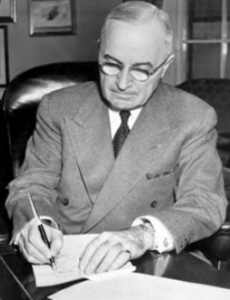
began uS involvement in Korea. Image
source: http://en.wikipedia.org/wiki/File:
Truman_initiating_Korean_involvement.jpg
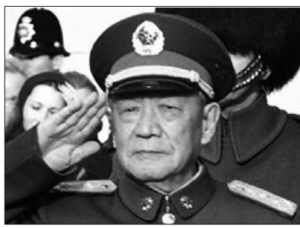
Image source: http://www.asiaobserver.com/images/fbfiles/images/
Liu_huaqing.jpg.
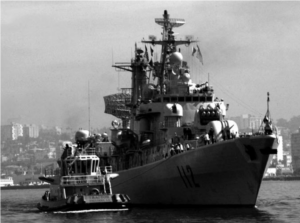
by the People's Republic of China navy ships. Photo by Petty Officer 2nd Class Felix Garza, U.S. navy.
Image source: United States Department of Defense news Web site at http://www.defenselink.mil/photos/newsphoto.aspx?newsphotoid=578
In China, Mao’s death allowed for new thinking about naval power. . . . Admiral Liu Huaqing, commander of the People’s Liberation Army Navy (PLA Navy), felt free to lay the intellectual groundwork for Chinese sea power.
THE COMMONS AFTER THE COLD WAR
Clearly, political and military history played an outsized part in Asian maritime history for most of the twentieth century. Such factors have subsided in the era of globalization but have not disappeared entirely—and they could resume their former prominence. A look at the aquatic commons today reveals a mélange of old issues, new issues, and old issues that have taken on new urgency. Perhaps the most significant factor influencing the Asian order is the diplomatic, economic, and military rise of China. As noted above, China’s maritime rise had its origins during the reform and opening era of the 1970s and 1980s, when economic openness impressed on Chinese leaders the value of the sea as a medium for importing natural resources and transporting finished goods to buyers overseas. Building a modern fleet seemed an obvious corollary to economic development. This was especially true after the Soviet Union’s collapse discredited communism, prompting the Chinese Communist leadership to look elsewhere for legitimacy. Improving living standards for the Chinese populace took its place at the center of national policy. Interruptions to seagoing traffic could endanger economic development—imperiling the regime’s chances for survival. At the same time, events exposed China’s naval weakness, even in its immediate environs. The Clinton administration ordered two aircraft-carrier battle groups to Taiwan’s vicinity in 1995–1996, after the PLA conducted “missile tests” to discourage formal Taiwanese independence. The PLA was unable to counter the US deployment; indeed, it was unable to track or even detect the American task forces. Chinese strategists vowed never again to suffer such a debacle, or to see vital Chinese interests held hostage in times of crisis. By century’s end, accordingly, Chinese defense budgets were beginning to favor the navy over the army and air force—a striking turnabout for a nation historically obsessed with continental defense. Accustomed to ruling the Asian seas, US mariners long mocked China’s naval capacity, joking that the PLA Navy could retake Taiwan only through a “million-man swim” across the Strait. But Beijing defied Western expectations, negotiating purchases of frontline Russian surface warships, diesel submarines, and combat aircraft. It aggressively built up its domestic defense industry, manufacturing its own hardware. And it promoted naval officers to influential posts, bestowing newfound prestige on the PLA Navy and helping the service advance its bureaucratic interests vis-à-vis the army and air force. Many Westerners now acknowledge, if grudgingly, the success of Chinese naval development. Japan also rethought its place in Asian politics after the Cold War, edging away from the strictly pacifist foreign policy mandated by its constitution. Threats emanating from nearby seas and skies applied a catalyst. In 1998, a North Korean missile launch through Japanese airspace aggravated Tokyo’s sense of threat (as have the North’s recent nuclear and missile tests). To ward off missile attack, the JMSDF procured destroyers equipped with the Aegis combat system—the latest in American air-defense wizardry—and joined the US Navy’s ballistic-missile-defense program. The growth of Chinese political and naval power, meanwhile, prompted Tokyo to bind itself even more tightly to the United States under the US-Japan Security Treaty. A growing sense of international responsibility also informs Japanese thinking. Roundly criticized for failing to deploy forces for the 1990–1991 Gulf War, Japanese leaders dispatched JMSDF minesweepers after the ceasefire. Mine clearance marked Japan’s first overseas naval deployment since 1945. Since the events of September 11, JMSDF vessels have helped patrol the Indian Ocean for terrorists fleeing Afghanistan, rendered aid following the 2004 tsunami, and battled pirates off Somalia. “International peace support operations,” to use the Japanese phrase, are now a core function of the sea services. India embarked on economic reforms of its own in the early 1990s. Like Beijing, New Delhi is mindful that the shipping lanes crisscrossing the Indian Ocean constitute a highway for natural resources and finished wares. Indian naval development trails that of China. A generally friendly US Navy dominated regional waters after the Cold War, in effect allowing New Delhi to free-ride on US-supplied maritime security. India has used the resulting strategic holiday to experiment with a blue-water fleet without siphoning off resources needed for economic development, the nation’s top priority.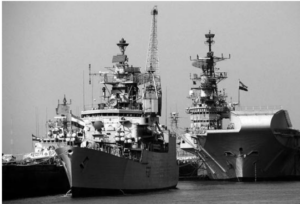
File:Indian_navy_ships.jpg