
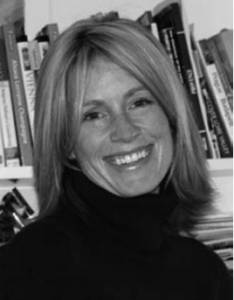
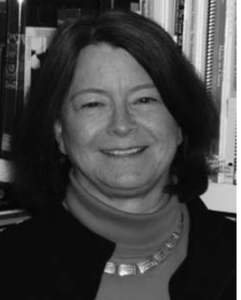
Lucien: Congratulations to both of you for winning the Buchanan Prize. Meredith, Lynn is a national leader in East Asian studies education, and many of our readers are familiar with her Teaching East Asia (TEA) programs at the University of Colorado at Boul- der. Could you tell us a bit about your background and about how you became interested in Asia?Meredith Changeux: Thanks, Lucien. I grew up in Boston and relocated to Denver in 1996 to earn my Master’s Degree in Education from the University of Colorado at Boulder (CU). I have been teaching social studies to high school students for ten years. I became interested in Asia after spending a summer in China with a high school group in 1988, and returned to this interest in the spring of 2002 when I completed a thirty-hour seminar through the National Consortium for Teaching About Asia (NCTA) in Boulder. I’ve traveled to Japan three times with the Program for Teaching East Asia at CU, first as a teacher participant on an NCTA study tour, then as a teacher with three students on a high school program, and finally, as a master teacher on TEA’s 2008 NCTA study tour. With this material, and the inspiration from workshops, seminars, and institutes through TEA at the University of Colorado at Boulder, I have created courses and curriculum units on Tokugawa Japan, Prejudices in the Pacific War, China in the Headlines, and Japanese History through the Arts.
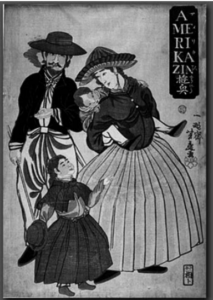
Lucien: Lynn, why do you think it is important for high school and university-level history students to take an in-depth look at Yokohama during this part of the nineteenth century?Lynn Parisi: Yokohama is a useful case study in world history for a number of reasons. I think treaty ports are fascinating and important studies as cultural frontiers and meeting places. Students can examine the Yokohama treaty port as a Western outpost at the edge of Japan. With Yokohama, they can analyze the processes of cultural transmission and adaptation, as well as specifics of these processes as they unfolded at this moment and place. Because the Japanese popular art of this period and place—primarily woodblock prints—is so extensive and readily available as an historical resource, Yokohama offers the opportunity to explore the dynamics of the treaty ports and of cultural exchange in new ways. Through artwork of this period, students literally see how, and under what circumstances, knowledge and attitudes about other cultures and nations developed. Additionally, the Yokohama treaty port period is a crucial chapter in Japan’s modernization story. In turn, Japan’s modernization is a critical piece that can help students consider the relationship between modernization and Westernization. In Yokohama, students see the many national faces of Western influence and Westernization and appreciate that Japanese in Yokohama differentiated among Americans, British, French, Russians, and Germans rather than seeing a monolithic “West.” Through study of Yokohama, students may better understand Japan’s modernization as a complex process that drew from multiple examples offered by the Western nations that preceded Japan in that process.
Lucien: Meredith and Lynn, this is an impressive array of lessons you developed for the curriculum. Please share any feedback you have received from teachers regarding one or two of the lessons you created.Lynn Parisi: When John Dower first introduced me to the huge collections of artwork that would form the basis for Yokohama Boomtown and other units in the Visualizing Cultures (VC) project, he described his own process of research as “history in a shoebox”—the equivalent of discovering boxes full of raw, unsorted, unstudied material and, as an historian, trying to make sense of what the material says about a period or event. This was a great image, and I have used it frequently when talking to teachers about the pedagogical value of the VC site. We and our fellow curriculum author Kathy Krauth, who worked on other units in the MIT program, wanted to capture this idea of “history in a shoebox”—that is, to design lessons that asked students to replicate Dower’s process of constructing narratives from primary visual sources. We ask students to grapple with fairly large, undifferentiated collections of images. Two examples of lessons that use this exercise are the Yokohama Boomtown lesson “What Did It Mean to Be Western?” and the “Old China, New Japan” lesson in Throwing Off Asia. Some teachers reported that working with numerous images was somewhat overwhelming for students, but that they were pleasantly surprised at the products students created. We appreciate the challenges of the material. At the same time, we think that the wealth of images is an important part of what this Web site offers to scholars of all ages and abilities—the opportunity to work with primary sources that have not been extensively studied.
. . . the woodblocks in Yokohama Boomtown focus on life in the city of Yokohama, presenting a vibrant picture of cultures engaging each other with amusement and respect.
Nations at http://ocw.mit.edu/ans7870/
21f/21f.027/
yokohama/yb_visnav02.html.
Lucien: Visual learning utilizing technology presents both new opportunities and new challenges for educators. I know that recently, both of you were responsible for a National Endowment for the Humanities teacher workshop where you used Visualizing Cultures. What useful information did you learn from teachers about the process of using technology in the classroom?Lynn Parisi: In July, we conducted a one-week National Endowment for the Humanities (NEH) program. We worked with twenty-eight teachers from around the country to explore the Visualizing Cultures project, the existing curriculum, and ideas for new lessons. About half the teachers who attended the program already were familiar with the project and had used it in their instruction; for others, it was completely new. The teachers at the workshop noted that the MIT Web site could be daunting because there is so much there—essays, special features, mini-narratives, an enormous database of visual material for each of the twenty units. Meredith Changeux: The time we took to walk the teachers through the Web site, its interface, and its layout truly paid off. It seems to be somewhat generational, but some of the teachers, even those familiar with the site, were intimidated by using it in the classroom. Lynn Parisi: We found that younger teachers at the workshop tended to be more comfortable with uses of online technology in the classroom, possibly because they may have worked with it more outside the classroom. At the same time, veteran teachers often had a bigger “aha” factor when they saw the resources and strategies that technology makes available to them. Meredith Changeux: A perennial issue also seems to be access. For materials such as the Visualizing Cultures units, classrooms often don’t have access to the equipment necessary to do lessons as we created them online. For example, the units depend on access to the digital images and an environment in which students can study and manipulate the full color images. Using sources delivered through online technology tends to take significant advance preparation and planning and different ways of thinking about pedagogy and student learning. Lynn Parisi: It seems clear that online curricula and resources are becoming integral to instruction. Just in the area of Asian studies, a resource like Visualizing Cultures is in the company of so many great resources, including About Japan: A Teacher’s Resource on the Japan Society of New York Web site at http://aboutjapan.japansociety.org/and Columbia University’s Web site, Asia for Educators, online at http://afe.easia.columbia.edu/, just to name a couple. Meredith Changeux and Lynn Parisi: Lucien, thank you for this opportunity to speak with EAA readers about the curriculum.
Lucien: Thanks for the interview!