

The international population of overseas Vietnamese—the Việt Kieu—have contributed growing amounts of funds, business contacts, and advanced skills to the increasingly sophisticated modern segments of the economy.

american-congressperson-visits-vietnam.html © Look At Vietnam.
A SOCIALIST MARKET ECONOMY
Việt Nam is rare among transitional states because it has retained a communist government and socialist elements in its economy, while moving to a predominantly market-based economic system. The states that emerged from the breakup of the former Soviet Union and the old Soviet Bloc quickly instituted capitalist market systems, privatized state firms and assets, and endured several years of economic chaos and recession. Việt Nam, like its giant neighbor China, followed a gradual path of market reform that began with a return to family-based farming in the early 1980s. Việt Nam then introduced the broader Đổi mới policies that liberalized commerce and ownership in the middle to late 1980s, and only moved to a predominantly market system in the early 1990s, after losing its main socialist foreign trade partners with the collapse of the Soviet Bloc countries. Like China, it has not experienced negative economic growth since the reforms began. Today the Vietnamese economy operates in most respects as a true market economy, its firms interacting with each other and with global markets on the principles of profit and loss. Several major elements, however, remain under state control. State-owned enterprises have adapted surprisingly well to the market environment.2 The share of total industrial output value produced by state-owned enterprises (SOEs) has fallen from fifty percent in the mid-1990s to just over twenty-five percent in 2008, but the absolute value of SOE output has continued to grow, while the state sector still employs around nine percent of the labor force.3 The banking system is still dominated by state-owned banks, and the energy sector—electricity generation and oil and natural gas production—is mainly state owned. The state also retains the major responsibility for education and health care, although public funding for both was drastically cut under Đổi mới. What it means to be a socialist state, and how a Vietnamese socialist economy should be structured, has been debated within the party and the government throughout the reform period, including disputes over the extent of privatization and the role of foreign trade. There is general agreement that the main objective of economic policy should be to improve living standards, but there is also a widespread belief that the socialist goals of sharing the benefits of development and providing basic services for all cannot be abandoned.SUCCESSES
OVERALL GROWTH
Since the early 1990s, Việt Nam’s GDP has grown at one of the fastest rates in the world, averaging over seven percent a year.4 Although the pace of growth has differed greatly by region, most income groups have seen major improvements in their standard of living. The largest share of new economic activity has occurred in industry and commerce. Real industrial output value (adjusted for inflation) has grown at an average rate of over fifteen percent per year since 1995 and by 2008 accounted for about forty percent of GDP. Foreign trade and investment have been spurred by new international agreements. In 2001, a bilateral trade agreement with the United States came into effect, and in 2007, Việt Nam joined the World Trade Organization. Foreign trade, in US dollar terms, has increased by over ten times between 1995 and 2008, with average annual growth near twenty percent. Foreign investment has played a significant role, introducing advanced technology and international standards. A good recent example is a one billion dollar semiconductor factory built by Intel near Hồ Chí Minh City. By 2007, firms funded entirely or partially by foreign investment accounted for eighteen percent of GDP.5
By the mid-1990s, Việt Nam’s natural advantage in rice production, complemented by market incentives for farmers, made it one of the three leading world exporters of rice, along with the United States and Thailand.
AGRICULTURE
With its subtropical location and plentiful rainfall, much of Việt Nam can grow three crops of rice per year. The rich alluvial soil and natural waterways of the Mekong Delta make it one of the world’s most productive rice growing regions, followed by the Red River Delta around Hanoi in the north. Hilly areas and the broad plateau of the Central Highlands support tree crops, including rubber, bananas, and most importantly, coffee. The long coastline and numerous rivers and ponds have long generated plentiful supplies of fish, shrimp, and other aquatic products. Agriculture struggled through much of the twentieth century, however, and there were even occasional periods of famine, most recently in 1980 following the 1979 border war with China and the termination of Chinese food aid.6 The first effective reform measure, begun in the early 1980s, was to allow farmers to make their own production decisions.7 Farmers were subsequently allowed to bring produce into the cities and sell it on the streets or in markets, rather than requiring food sales to be handled by state agencies. By the early 1990s, street markets had appeared throughout the country’s cities and towns, increasing the amount and variety of food available, reducing the time required for shopping, and raising the incomes of farmers. In the following years, produce marketing was gradually moved off the streets and into market structures, while food transportation and retailing flourished. By the mid-1990s, Việt Nam’s natural advantage in rice production, complemented by market incentives for farmers, made it one of the three leading world exporters of rice, along with the United States and Thailand.8 A more surprising agricultural success is coffee. Coffee was introduced to Việt Nam by French colonialists in the nineteenth century and is popular among urban Vietnamese. The strong Robusta variety, tolerant of lower temperatures than the milder Arabica, was grown in plantations in the Central Highlands, but Vietnamese coffee was little known internationally before it was introduced to the world market in the 1990s. Coffee production in Việt Nam tripled in the second half of the 1990s, and by 2006 it was the world’s second largest producer after Brazil.9 In 2009, after increasingly sophisticated international marketing efforts and tremendous growth in cultivation, the coffee growing industry employed two million workers and generated three percent of GDP.10
Photography by Mel Schenck. You can see more of Mel‘s Việt nam photos on his blog at http://layered.typepad.com/.
Many parts of Hanoi, Hồ Chí Minh City, and other urban centers have changed beyond recognition. Dilapidated buildings have been replaced by new construction . . .
HOUSING
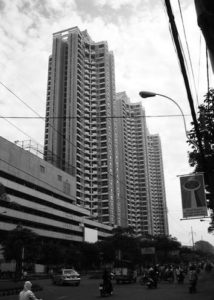
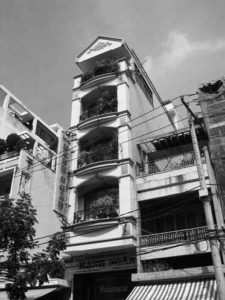 An important characteristic of Việt Nam’s development under Đổi mới is that it has been driven largely by the growth of dynamic domestic markets, especially housing. From the time incomes began to rise in the early 1990s, there has been a continuous boom in private housing construction. Many parts of Hanoi, Hồ Chí Minh City, and other urban centers have changed beyond recognition. Dilapidated buildings have been replaced by new construction, and then replaced again with larger, more modern structures. Large areas of former farmland have become bustling, modern residential and commercial districts. A lively market in land rights has emerged, and in Hồ Chí Minh City much of the new construction is done by vigorous private real estate development firms.11 The housing boom has generated jobs for thousands of construction workers and for additional thousands who work in the factories and small workshops producing the cement, reinforcing bars, bricks, metal work, doors, windows, plumbing supplies, electric fixtures, and all the other construction materials and products that go into the construction and maintenance of a home. Real estate analysts believe that the supply of housing is still insufficient for the increasingly affluent segments of the population and prices have increased sharply, particularly in Hanoi and Hồ Chí Minh City, raising concerns about a possible bubble in the market.12
Paralleling the rise in housing construction has been rapid growth in construction of new buildings for businesses and hotels. Here too, the increased jobs for construction workers have been accompanied by expansion in the numerous industries linked to construction, followed by additional jobs in maintenance, landscaping, and the positions created by the new businesses. Between 2000 and 2007, investment in both residential and commercial real estate more than quadrupled in constant price terms and grew as a share of total national investment from 2.7 percent to 4.6 percent.13
An important characteristic of Việt Nam’s development under Đổi mới is that it has been driven largely by the growth of dynamic domestic markets, especially housing. From the time incomes began to rise in the early 1990s, there has been a continuous boom in private housing construction. Many parts of Hanoi, Hồ Chí Minh City, and other urban centers have changed beyond recognition. Dilapidated buildings have been replaced by new construction, and then replaced again with larger, more modern structures. Large areas of former farmland have become bustling, modern residential and commercial districts. A lively market in land rights has emerged, and in Hồ Chí Minh City much of the new construction is done by vigorous private real estate development firms.11 The housing boom has generated jobs for thousands of construction workers and for additional thousands who work in the factories and small workshops producing the cement, reinforcing bars, bricks, metal work, doors, windows, plumbing supplies, electric fixtures, and all the other construction materials and products that go into the construction and maintenance of a home. Real estate analysts believe that the supply of housing is still insufficient for the increasingly affluent segments of the population and prices have increased sharply, particularly in Hanoi and Hồ Chí Minh City, raising concerns about a possible bubble in the market.12
Paralleling the rise in housing construction has been rapid growth in construction of new buildings for businesses and hotels. Here too, the increased jobs for construction workers have been accompanied by expansion in the numerous industries linked to construction, followed by additional jobs in maintenance, landscaping, and the positions created by the new businesses. Between 2000 and 2007, investment in both residential and commercial real estate more than quadrupled in constant price terms and grew as a share of total national investment from 2.7 percent to 4.6 percent.13
POPULATION AND THE LABOR FORCE
VIÊT KIEU CONTRIBUTIONS
In 1975, when Việt Nam was reunited at the end of the civil war, tens of thousands of families fled the south, most to the United States. Additional tens of thousands left in the following years, enduring harrowing ocean voyages in small boats and Southeast Asian relocation camps before reaching new homes in the United States, Australia, and other countries. Once established, the Việt Kieu found jobs, enrolled their children in school, and sent growing streams of remittance payments to family members in Việt Nam, especially at Tet, the Vietnamese lunar New Year holiday. With the growing success of Đổi mới, increasing numbers of Việt Kieu have returned, not only to visit family, but in many cases to pursue business or professional opportunities, and even to purchase homes.17 Official figures estimated a global Việt Kieu population of some four million in 2009, and remittances of around $7.4 billion (US) in 2008.18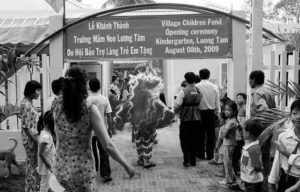
SOCIAL SERVICES
A GLASS HALF FULL
One of the strengths of the centrally planned system was that it provided basic health care and education to most of the population. Substantial aid was given by the Soviet Bloc countries in the form of equipment, supplies, and most importantly, training of professionals. When Đổi mới began, Việt Nam had more trained doctors, nurses, teachers, and professors than most countries at its very low-income level. Access to health services and education, however, varied widely. Much of the rural population was served only by minimal medical services and rudimentary primary schools.19 Nonetheless, in the late 1980s, Vietnamese people had much higher rates of literacy—around eight-five percent, and life expectancy around sixty years—than the populations of most poor countries. The elimination of the collective system and central planning at the end of the 1980s removed the organizational basis and funding for both education and health care, particularly at the local level.EDUCATION
At the end of the 1980s, private educational institutions were legalized, and much of the funding for public schools was shifted to tuition fees. Enrollments initially fell sharply, especially in upper secondary schools that saw a decline of over forty percent from 1988 to 1992.20 By the mid-1990s, however, the government doubled public funding for education, while still relying on families to cover nearly half of all educational expenses. Following traditions that emerged under early centuries of Chinese imperial domination, Vietnamese families typically will make great sacrifices to educate their children. In the pre-modern era, literacy in Chinese was the route to enter the government bureaucracy through an exam system. Today, education is again the route to success in a high-income, modern career, bringing affluence to the family as well as the individual. Despite rising private costs, enrollments at all levels have risen remarkably since the mid-1990s. Between 1994 and 2007, lower secondary school enrollment nearly doubled, rising from 3.7 million to 6.8 million, while upper secondary numbers more than quadrupled, rising from 727,000 to over 3 million.21 By 2008, the primary school completion rate was nearly ninety-four percent and sixteen percent of young adults attended higher education, up from only two percent in 1991. Access to education is still distinctly uneven between regions, with the lowest enrollment rates and years of schooling in the hill areas among minority peoples. Higher education suffers from insufficient capacity. In 2005, 1.5 million students took university entrance exams, but total admissions came to only 230,500. Numbers of trained teachers have lagged significantly behind the growth of universities and colleges, with only around eighteen percent of faculty members holding doctorates in 2006, while nearly forty-one percent held only bachelor’s degrees. On the other hand, the country benefits from a healthy mix of public and private institutions, with the majority of students in the 2005-2006 academic year served by the eighty-five public universities, two publicly funded open universities and ninety-nine public junior colleges, while almost 140,000 students studied at private universities and junior colleges.22HEALTH CARE
http://www.downtheroad.org/Asia/Photo/4Vietnam_Pictures/7Vietnam_Highland_villiage.htm.
LONG-TERM CHALLENGES
REGIONAL POVERTY
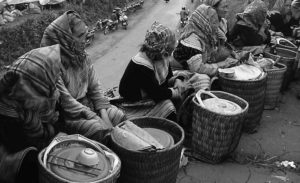
The poverty rate for Việt Nam as a whole has fallen from thirty-seven percent in 1998 to sixteen percent in 2006, but rural poverty, at twenty percent, is five times as high as the urban rate of just under four percent. The most affluent regions of the country are the two great river deltas, each with its bustling metropolis—the Mekong Delta and Hồ Chí Minh City and the Red River Delta and Hanoi. These two cities have been the focus of most investment and the majority of new business. In 2006, poverty was lowest in the region of Hồ Chí Minh City at 3.8 percent, followed by the Red River Delta at 8.9 percent, and the Mekong River Delta at 10.3 percent. The most impoverished areas are in the rugged limestone mountains that rim the Red River Delta and border on China and Laos. Here the poverty rate was nearly sixty-five percent in 1998 and still stood at thirty-two percent in 2006. Similarly, the broad plateau of the Central Highlands, isolated by poor transportation from the coast and from major urban centers, registered nearly twenty-nine percent of the population below the official poverty line in 2006, while the North Central mountains and the Central coastal area reported a poverty rate of twenty-two percent.29 Transportation difficulties severely limit the development of industry and commerce in these regions. For the most part, they are poorly suited to agriculture, except for coffee production in the Central Highlands. The highlands and mountains have historically been inhabited primarily by minority peoples, whose education and health care levels lag behind the rest of the population. For many of these groups, income improvement requires cultural adaptation, as well as education and access to modern job opportunities, all of which are difficult to provide outside the orbits of the major cities.CORRUPTION
The transition from central planning to the market led to waves of corruption in all the transitional economies due to undefined property rights and undeveloped legal codes. Việt Nam is no exception, and the incentives to use official positions to elicit bribes—often referred to as “rent-seeking”—expanded further with the economy’s rapid growth under Đổi mới. In many cases, bribery can be seen as a fee for expedited service and has little negative economic impact. In other situations, however, corruption prevents productive projects from going forward or diverts investment funds to inefficient uses. In all cases, it undermines the authority of the government and weakens Việt Nam’s attractiveness to foreign business. The government has been praised by the international community for undertaking serious anti-corruption measures, but in a speech on January 14, 2010, Prime Minister Nguyen Tan Dung acknowledged the issue’s persistence, saying, “corruption is a growingly serious and complicated problem arising from land management, taxation, customs, urban housing development, and economic projects.”30 In 2009, Transparency International ranked Việt Nam at 120 out of 180 countries for perceived corruption.31ENVIRONMENTAL DEGRADATION
Between 1979 and 2009, Việt Nam’s population grew from fifty-two million to eighty-seven million, making it one of the most densely populated countries in the world.32 Thousands of acres of forest have been cleared for farmland, and thousands of acres of farmland have been turned into housing and commercial districts. In the late 1960s, as much as fifty-five percent of Việt Nam’s land area may have been forested; by 1990 that figure had fallen to between a third and a tenth of the total area. Throughout the country, large areas have been rendered barren by deforestation, inappropriate cultivation practices, and loss of soil nutrients.33 The expansion of industry has been accompanied by the emission of polluted smoke, wastewater, and chemical waste. Small-scale industry, which has provided many of the new jobs that raise income levels, is particularly polluting, due to its characteristically low level of technology and lack of information about pollutants.34BANKING
Under the centrally planned economy, the state-owned banking system served only to hold deposits and to disburse funds according to plan. In the 1980s, it was converted into a commercial banking system, the core of which now consists of a central bank—the State Bank of Việt Nam—five large state-owned commercial banks, each with dozens of branches, and the state-owned Bank for Social Policies.35 In addition to the state banks, there are thirty-eight joint stock banks, each with only a few branches, thirty-three branches of foreign banks, and five joint-venture banks. In 2007, the state banks accounted for fifty-seven percent of all formal sector loans and deposits; joint stock banks, non-bank credit institutions, and credit funds made thirty-four percent of loans, and foreign and joint-venture banks provided the remaining nine percent of loans.36 Banking in Việt Nam has a troubled history. In 1990, a broad network of private credit cooperatives went bankrupt due to unwise practices and pyramid schemes, wiping out the life savings of depositors and ruining thousands of small private businesses. The scandal destroyed the public reputation of the banking system, which was further tarnished by several years of high inflation that reached an annual rate of 500 percent in 1986.37 By the early 1990s, inflation declined to around eight percent, and at the turn of the century, it briefly went negative, due to the Asian Financial Crisis. By 2005, however, it returned to eight percent and during the international commodities boom of 2008 it reached twenty-three percent.38 Although the system has achieved some success in restraining inflation, the banks are still widely distrusted and the great majority of the population is “unbanked.” A Ministry of Finance article in 2007 commented that fewer than six percent of Vietnamese held bank accounts and that some eight billion US dollars worth of gold and currency were believed to be held by families in their homes.39 The banks have shown little interest in providing loans to individuals and small businesses, and reportedly lend out far less than the funds available to them. Small-scale credit is available, usually from friends or family members, or at high nominal interest rates from informal private lenders. Even developers of large projects report that they rarely seek bank loans, turning instead to private investors.40The highlands and mountains have historically been inhabited primarily by minority peoples, whose education and health care levels lag behind the rest of the population.
The banking system is expected to improve markedly as the terms of Việt Nam’s 2007 accession to the WTO come into effect and as foreign banks gain greater access to Việt Nam’s financial markets.41THE ROAD AHEADViệt Nam’s economy will undoubtedly continue to grow rapidly for the foreseeable future. It is located in one of the most vibrant regions of the global marketplace, bordering on China, with good sea links to Taiwan, Japan, South Korea, Singapore, Thailand, Indonesia, Australia, and the United States. It will be attractive to investors while its average income levels remain low and its labor inexpensive. This will be the case as long as a major portion of the labor force is engaged in low productivity jobs in agriculture, which currently provides half of all employment, a huge reservoir to supply the urban job market. Less clear is how the country will deal with the side effects of development. The incomes of farmers will rise as family members move to the cities and send home money and as new farm technology is adopted. But the experiences of other countries indicate that income disparities will continue to widen; urban incomes almost always rise more rapidly than rural incomes. Environmental degradation is also bound to increase as the country’s natural resources are pressured to provide for the growing needs of a rising and more affluent population. Higher incomes and new technology will eventually allow for cleaner air and water, but these conditions are probably decades in the future. Solutions to the country’s problems require resources, and Việt Nam is still a very poor country. Growth has been impressive, but when Đổi mới began in the late 1980s, Việt Nam was among the poorest countries in the world. Away from the modern hotels and the computer chip factories, seventy percent of the population still lives in the countryside where the average income is less than 400 US dollars per year. Officials will continue to be faced with the difficult task of deciding how to divide the government’s very limited funds between providing roads, electricity, better schools, and improved health care to the chronically disadvantaged, while also creating the improved urban infrastructure and institutions of higher education that support modern industry and lead to greater prosperity for the country as a whole.