

The person who knows only one religion understands none.
—Max Müller

Image source: http://en.wikipedia.org/wiki/File:Barack_Obama_receives_a_red_shawl_from_Sri_Narayanachar_Digalakote,_a_Hindu_priest_.jpg.
Asia and the History of World Religions
Contextualize Asian religions within a world historical framework. This means covering the traditions of shamans, the Abrahamic prophets, and the Asian sages. Humanity’s first religion, shamanism, is still practiced with many variations by indigenous people worldwide. Shamans are spirit mediums who utilize the universal human capacity of achieving trance states of consciousness, either to enable spirits to speak through them, to free their souls to leave their bodies, to recover lost souls, heal, or to communicate with ancestral spirits in the afterlife. Shamanism is ubiquitous among indigenous people today across Asia, and spirit mediums coexist alongside all the major world religions.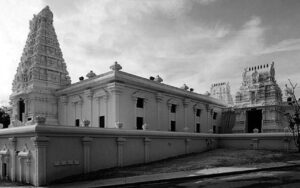
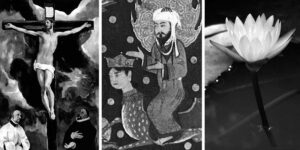
Image source: http://faculty.saintleo.edu/reynolds/
HON250-F03/projects/culture/Tintoretto/Christ%
20on%20Cross%201590.jpg. (middle) Detail of Mohammed riding his magical steed, Buraq. From a miniature in the illuminated manuscript called The Apocalypse of Muhammad (now in the Bibliotheque Nationale, Paris). Image source: http://zombietime.com/mohammed_
image_archive/islamic_mo_full/. (right) The Lotus flower. Image source: http://bp1.blogger.com/_cRw9_SMr3sM/
RyMAGnASVAI/AAAAAAAAAe8/rxxbE6ykedM/
s1600-h/Lotus+2.jpg.
The quintessential symbol of the sage is the water lotus sprouting in the muddy water (of this world). The flower, like the sage, rises above it to bloom magnificently and transcendently.
Sage traditions differ profoundly from the Abrahamic monotheistic traditions. In these traditions, revelation comes from within the experience of the individual, who as an intense spiritual seeker is most often a forest or mountain recluse. The sages’ paths to revelation formed the great Asian traditions that would guide others. Here we find the Rishis of the Upanishads, the Buddha, the Daoist, and Confucian sages and a host of later figures such as Nanak, founder of Sikhism. The quintessential symbol of the sage is the water lotus sprouting in the muddy water (of this world). The flower, like the sage, rises above it to bloom magnificently and transcendently."ASIA," "THE EAST," OR "THE ORIENT" ARE NOT USEFUL ANALYTICAL TERMS
Given Asia’s great diversity, grouping China, India, Japan, and Thailand together under “Asian Religions” as a unit of understanding invites students to lump together religious traditions that should be studied separately. Even presenting “Hinduism,” “Daoism,” or “Buddhism” as singular traditions is just as problematic as it is to treat Judaism, Christianity, or Islam as singular traditions. Consider “Hinduism.” What actually exists throughout India are hundreds of separate traditions that famously contain the full global spectrum of alternative religious practices, ethical norms, and doctrines. In the case of theology, there are various forms of monism, monotheism, polytheism, and incarnation theology, as well as vibrant traditions of skepticism. Or, take the case of ethical reckoning of violence and non-violence. What would justify an assumption of a singular “Hinduism” in the following examples?In a Calcutta suburb, devotees lead a goat toward a temple priest, who then slits the animal’s throat, severs the head, and pours the spurting blood on an icon of goddess Kali. But in a desert oasis town in western India, a sadhu who has renounced all family ties, vows to practice complete nonviolence. Despite the apparent contradiction, no one would dispute that both animal sacrificers to Kali and the absolutely nonviolent ascetic are following ancient South Asian traditions.These two examples of seeming contradictions in “Hindu” belief and practice constitute only a few of many. While it is a fruitful question to explore what, if anything, constitutes the unity in this diversity beyond geography, the starting point for students learning about traditional India should certainly not be an implied assumption of unity.2 The same problem can appear in Daoism or Buddhism. Regarding the former: the fundamental understanding of the ultimate goal of “Philosophical Daoism” (as articulated by the Daodejing and the Zhuang Zi) is to realize the harmony of complete re-absorption into the natural world, especially when facing death. In complete contrast, the goal of “Religious Daoism” is to achieve immortality through meditation and the ingestion of alchemical elixirs. In Buddhism, differences between South Asian and East Asian traditions have caused the authors of a leading introductory textbook to re-title the most recent edition to a plural: The Buddhist Religions. The key insight is that teachers should recognize the undeniable diversities between and within the great sage traditions and become aware of the limitations of using the term “Asian Religions.”
The key insight is that teachers should recognize the undeniable diversities between and within the great sage traditions, and become aware of the limitations of using the term “Asian Religions.”
A "TIMELESS ORIENTAL WORLD" DOES NOT EXIST
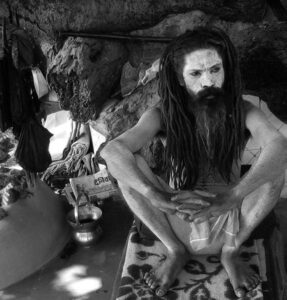
THE BELL CURVE IS A TOOL FOR UNDERSTANDING RELIGIOUS TRADITIONS
Development of student historical and sociological imagination is also important. Asian religions are not monolithic. They were not, and are not now, vague abstractions, but vibrant forces in real societies. Religious traditions have always adapted to, and have themselves shaped, the communities they entered. It is only by exploring the diversity of beliefs among followers that students can scale the importance of central beliefs and come to understand the “typical believer.” The template of the bell curve is useful to display the typical range of beliefs in a given religious community. Although impossible to graph with exactitude, the effort to understand how religion exists for the elite, the average believer, and the hardly observant is a valuable exercise. The vertical axis plots the percentage of believers, the horizontal axis is a measure of belief vitality and ritual attendance.
On the left side are the virtuosi, an elite who have complete commitment and lifestyle to the highest religious ideals. Examples include the Tibetan Buddhist nun doing a three-year cave meditation retreat or the Hindu renunciant or Daoist monk who has turned the remainder of life into a religious pilgrimage. On the far right are those who are indifferent to doctrine or who disbelieve. In teaching about world religions, disaggregation of these groups assists student understanding of how world religions captured the imagination and elicited the loyalty of the majority in every society. Plotting a bell curve of belief and practice demonstrates that elite perspectives are not representative of the entire society of adherents.
The template of the bell curve is useful to display the typical range of beliefs in a given religious community. Although impossible to graph with exactitude, the effort to understand how religion exists for the elite, the average believer, and the hardly observant is a valuable exercise. The vertical axis plots the percentage of believers, the horizontal axis is a measure of belief vitality and ritual attendance.
On the left side are the virtuosi, an elite who have complete commitment and lifestyle to the highest religious ideals. Examples include the Tibetan Buddhist nun doing a three-year cave meditation retreat or the Hindu renunciant or Daoist monk who has turned the remainder of life into a religious pilgrimage. On the far right are those who are indifferent to doctrine or who disbelieve. In teaching about world religions, disaggregation of these groups assists student understanding of how world religions captured the imagination and elicited the loyalty of the majority in every society. Plotting a bell curve of belief and practice demonstrates that elite perspectives are not representative of the entire society of adherents.
Plotting a bell curve of belief and practice demonstrates that elite perspectives are not representative of the entire society of adherents.
Accounts of sages and saints, doctrinal discussions, and theories of salvation dominate both sacred texts and even some school textbooks, so teachers and students are naturally drawn to these ideas and the exemplars. They should be as thoroughly explored in Asia as elsewhere, because the elite inspired whole civilizations. In comparative perspective, the soaring accomplishments of Asian elites demonstrate that there were “world class” holy men, philosophers, poets, and artists who justly stand alongside counterparts elsewhere. But the study of history does not stop with the virtuosi. While the elite are important, they are also not representative of all devotees or even typical adherents. Very few Buddhists are focused on nirvana-attainment; most Muslims do not approve of violence, or support terrorism; a very, very small percentage of Daoists concoct and quaff elixirs to attain immortality. Keeping this bell curve in mind directs all of us not to stop at the ultra elite or overly apply their experiences or outlook on life to all believers. It also conveys the important cross-cultural idea that religious communities everywhere, and the people who comprise them, have their saints and sinners, with most in between. What is a good way to teach about this majority in the middle? A viable pedagogical method is to utilize materials that the same age cohort reads in Asia.3 In all Asian religions, story traditions exist that parents and teachers have used for centuries to teach children about the founders, basic teachings, important sacred texts, and the lives of saints. Popular Asian narratives in English translation have been growing in number and quality. Indian stories in the Hitopadesa, the Buddhist jatakas, or exemplary Confucian virtue stories are essential resources for understanding those in the middle of the bell curve.EXORCISING "EAST" AND "WEST" FROM THE HISTORICAL IMAGINATION
The existence of a continuous “on the ground” singular Eurasian land mass extending from the Pacific Ocean west to the North Atlantic Ocean has been fully and finally ascertained in human awareness in the last five centuries. As Europeans came to dominate southern and eastern Eurasia, they projected their imagined view that the peoples of the western Mediterranean and especially Christian Europe occupied a zone wholly separate from the great land mass further east. Thus, the early modern dualistic separation of “West” from “East” was born.Making clear to students that each Asian tradition maintained coherence over the centuries despite lacking a singular institutional center of doctrinal authority, is a basic tenet upon which to build.
Motivated by reasons ranging from Christian triumphalism to racist theories, Europeans came to view “West” and “East” as real entities. To this day, many feel that when they drive east and cross a bridge over the Bosporus River in Istanbul, they have passed into Asia.4 Separating Asia from Europe with a line only perpetuates misconception. To teach students uncritically Kipling’s couplet,East is East, and West is West And never the Twain shall meet 5is to perpetuate a historical falsehood and distort student historical imagination. Let us recount a few of the reasons why:
- The spread of the Indo-European languages from central Asia across a geographical expanse that includes India, Iran, the Middle East, and Europe
- Trade goods from the Indus Valley traveled west to be traded in Egypt and the eastern Mediterranean before 1500 BCE
- The silk/horse routes linked east and central Asia to the Mediterranean and connected the regions as early as 800 BCE onwards—Romans wore clothes made of Chinese silk; Roman coins have been found in Chinese tombs
- Outposts of Greek civilization were widely established in Northwest India in the aftermath of the third century BCE invasion of Alexander the Great; some Greeks who settled in South Asia converted to Buddhism and may have made the earliest Buddha images
WHEN THINKING ABOUT ASIAN RELIGIONS, DON'T USE CHRISTIANITY
To imagine the social organization of Asian religions, one needs to examine each one on its own terms. It is probably best to ask students not to consider Asian religions based upon their understanding of many organized Christian sects. Unlike several Christian denominations, most notably Roman Catholicism, Asian religions did not have a central figure of authority who imposed rules regarding ritual practice, places of worship, monastic institutions, or doctrinal orthodoxy in any way that resembled that of the popes or the Vatican in Western Christianity. There never was a “Buddhist church,” a pan-Daoist ecclesial authority, or central arbiter of Hindu doctrinal norms. Roman Catholicism stands by itself as the most centrally organized religious tradition in world history; it is an anomaly, not a model for any other world religion. Making clear to students that each Asian tradition maintained coherence over the centuries, despite lacking a singular institutional center of doctrinal authority, is a basic tenet upon which to build.SITUATING KARMA DOCTRINE: FREE WILL, FATALISM, DESTINY
The sage traditions of South Asia, beginning with the Upanishads and endorsed by the Buddha, hold that individual beings move from lifetime to lifetime, their destiny, and especially rebirth, determined by a natural mechanism of moral cause and effect called the karma-ripening (karmavikalpa), a natural mechanism of moral cause and effect. Although diverse interpretations exist of how it works, fundamentally, it is karma from a previous lifetime or lifetimes that “fates” one to be born as a life form with certain qualities. But since new and ongoing actions (moral acts, rituals, and most powerfully, meditation) increase the accumulation of karma, most adherents are inspired to continue these practices. The difficulty for many students lies in understanding how karma relates to nirvana or salvation, and how to “scale” it. Through spiritual perfection the saint has ended all karma creation, so at death no more “seeds” will ripen and lead to future rebirth. On the second issue, the basic question is often: Does karma determine everything that happens to a person? The answer is no. The Indic traditions recognized cause and effect relations in a variety of spheres of human life besides karma. Natural laws were formulated regarding medical practice, theories on how seasonal changes influence human life were followed, and effects from astrological time and deities were carefully charted and consulted. In early Buddhism, one text that makes this clear is The Questions of King Milinda. The King questions how the Buddha could have suffered in old age if he had been a perfected saint and thus was free of any bad karma. The enlightened monk Nagasena makes a clarifying reply:It is not all suffering that has its root in karma. There are eight causes by which sufferings arise . . . [1] superabundance of wind, bile, and phlegm, the union of these humours; variations in temperature; the avoiding of dissimilarities; [2] external agency; and [3] karma . . . So what arises as the fruit of karma is much less than that which arises from other causes . . . No one without a Buddha’s insight (prajna) can fix the extent of the action of karma.6Number [1] includes medical categories of ancient India applied to individuals and how these humours interact with seasonal change and foods eaten; number [2] is the provision of random events; and [3] is karma. Note how the Buddhist sage demarcates karma’s role in relative terms, and how problematic it is for a householder, or anyone less than a Buddha, to know exactly the state of one's own karma.
CLEARING UP MISCONCEPTIONS ABOUT BUDDHISM
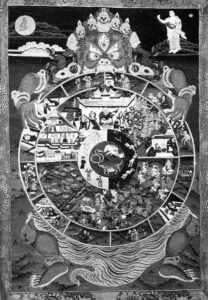

For Buddhist laity, wealth is valued as a sign of good karma in past lives, and it is desired because it provides the means to make more merit as a patron of the Buddhist community.
“A Good Buddhist is a Poor Buddhist.” This common misconception results from an inaccurate generalization about householders from monks or nuns who must personally own little. For Buddhist laity, wealth is valued as a sign of good karma in past lives, and it is desired because it provides the means to make more merit as a patron of the Buddhist community. Consider the following two passages from the Pāli Canon in which the Buddha instructs a householder to seek “The Four Ideals”:Housefather, there are these four conditions which are desirable, dear, delightful, hard to win in the world. Which four . . . [1] Wealth being gotten by lawful means . . . [2] Good reputation gotten by me along with my kinsmen and teacher [3] Long life and attain a great age—[4] When the body breaks up, on the other side of death may I attain happy birth in a heaven! 8The text proceeds to specify how moral and wealthy Buddhist householders should then work hard to do “The Four Good Deeds:”
1. [He] makes himself happy . . . he makes happy his mother and father, children and wife, servants and workmen, friends and comrades . . . 2. He takes steps for his defense and makes himself secure against all misfortunes . . . 3. Then he makes ritual offerings (bali) to relatives, guests, departed hungry ghosts, the king, and the gods (devata) . . . 4. Then he offers gifts to all worthy monastics and Brahmins . . . resulting in happiness and leading to heaven.9This canonical text is as important for understanding of Buddhist history as the “Four Noble Truths.” A careful reading shows that Buddhism fosters family ties, encourages “energetic striving” for economic success, promotes worship of hungry ghosts and local gods, justifies rightful seeking after worldly happiness and security, applauds religious virtues of faith and heaven-seeking, and underlines the virtue of being a donor and patron.10 This defines life in the middle of the Buddhist Bell Curve that is still alive today in Asia.
THE BELL CURVE IN BUDDHISM
The historical imagination of Buddhism that follows from reading only the texts written by or for the monastics and philosophers will inevitably be skewed toward this elite. Taking only this small portion of the bell curve as representing the whole tradition is an enduring problem in the West. As we have seen, the tradition itself acknowledges inherent diversity within a Buddhist society. A treatise by the Buddhist scholar Buddhaghosha, a seventh century CE Sri Lankan monk, usefully divided into three stages the ideals set forth in the Eightfold Path. As depicted in the following chart, Buddhist life begins with the development of moral character. Along with ritual participation, moral living defines being a Buddhist for most adherents. A few individuals move on to the next stage, meditation. To the extent that meditation is successful, prajna develops.11 When prajna is complete and perfected one experiences nirvana. It is easy for educators covering Buddhism to scale these central ideals and point out important conclusions: ninety-five percent of Buddhists are living solely in the morality domain. Until recently, only a few monks and nuns were regular practitioners of meditation. Among them, few reached high spiritual states (the cultivation of prajna), and attainment of enlightenment/nirvana was rare. The finer points of Buddhist philosophy have always challenged the best human minds, in Asia and elsewhere. But if the other great stream of Buddhist tradition is in focus, it is also true that understanding the great majority of Buddhists is not difficult at all. Householders from the origin of the faith have focused primarily on moral living (avoiding bad karma), making good karma (ritual offerings, supporting the monastics), and occasionally engaging in spiritual practices.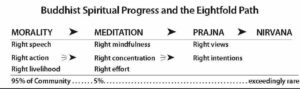
How can one see as the "same thing" the Abrahamic faiths' belief in the life as a "one time around" reality, alongside the Sage traditions doctrine of reincarnation? How much more different can two worldviews be?
ARE ALL RELIGIONS "SAYING THE SAME THING?"
This is a popular pronouncement commonly expressed in contemporary Euro-American societies and is an attractive viewpoint friendly to the much-needed promotion of inter-religious tolerance. But is it plausible? How can one see as the “same thing” the Abrahamic faiths’ belief in life as a “one time around” reality, alongside the Sage traditions doctrine of reincarnation? How much more different can two worldviews be? Can the theological conceptions of Yahweh and Allah, the Christian Trinitarian God, and those regarding Shiva, Krishna, and Rama be “the same thing?” The historian of religion asserts there are strong reasons why these traditions have remained separate over many centuries: they are irreducible to one, and these differences do matter.