

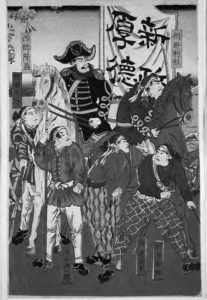
gazo film no. 4649. With permission of the Japanese National Diet Library.
Reality Is Better than Fiction: Saigidō Takamori vs. Tom Cruise
Many students have seen the 2003 Hollywood film The Last Samurai starring Tom Cruise and Ken Watanabe. The film draws loosely upon historical events—there was a revolt—the Satsuma Rebellion, in 1877 that was fought by samurai opposed to the policies of the Meiji government. It was led by Saigō Takamori, the real figure who was the inspiration for Watanabe’s character, Katsumoto. Katsumoto stands out as a powerful man of conviction who resisted Westernization and commanded tremendous respect. Students can discover for themselves by examining primary sources that the real Saigō Takamori did not oppose all things Western and was even more revered than his fictional movie counterpart. Japanese woodblock prints are one way to encourage critical thinking and to help students question the film. These colorful prints functioned like newspapers, and in the late 1870s Saigō and the Satsuma Rebellion were popular topics. Today you can find many of them online. Upon examination, students find that most prints depict Saigō wearing a Western-style military uniform and that some of his followers have guns. The statue commemorating Saigō in his hometown of Kagoshima also shows him in uniform. This is quite different from the film character Katsumoto, who only wore kimono and refused to use Western weapons. In fact, the real Saigō did not oppose Japan’s modernization. He met with British representatives to help secure guns for his Satsuma troops in the final days of the Tokugawa shogunate. Later, as a member of the new Meiji government, he helped modernize its army. In 1877, Saigō and his rebel followers initially set out with Western weapons. In the end, only their lack of munitions forced them to use traditional weapons.2 If Saigō did not oppose Westernization, students may ask, why did he rebel? Saigō had several issues with the government, but the most significant was Japan’s relationship with Korea. Traditionally, East Asian states carried out diplomacy in the Chinese tribute-system framework. In that system, there was only one emperor—the Chinese emperor. All other rulers had lesser titles such as “king.” But following the 1868 Meiji Restoration, Japan’s new government was centered on its emperor. When Meiji representatives traveled to Korea in the name of their emperor, the Koreans insulted them and refused to engage in diplomacy. Saigō felt this necessitated a military response; others, such as Okubo Toshimichi, argued that it was not time to go to war. Okubo prevailed, and Saigō quit the government. He retired to southern Kyushu and tried to remain out of politics, but when his students began rioting to protest government policies that eliminated samurai privileges, Saigō was drawn into leading the rebellion. When students examine woodblock prints of the rebellion, they are sure to notice that Saigō is often shown with a distinctive flag bearing a four-character inscription: shinsei kōtoku (a new government, full of virtue). In fact, Saigō had no such flag, but the Japanese press added one to give his rebellion a cause. Saigō was widely heralded as an honorable man, and the flag confirmed what many in the general population believed anyway—that Saigō was fighting to replace evil Tokyo bureaucrats with more virtuous administrators. He was so revered that even when the Satsuma Rebellion was crushed, many refused to believe that Saigō died, claiming that he escaped to another country (or planet!). Some woodblock prints show Saigō returning to earth in a comet, surrounded by ordinary people listing various complaints for him to rectify. As these and other images make clear, the real Saigō was even more highly regarded than his fictional counterpart. Key to the success of the lesson, of course, is letting students examine the materials and come to these conclusions on their own.Establishing the Myth: Bushidō and Samurai Champloo
Students have preconceived ideas about Japan, but many are misinformed. Studying samurai provides an excellent opportunity to show students the importance of questioning their sources of information. You might start a lesson by asking students individually or in small groups to answer two questions. First, what were samurai like? Second, how do you know? Their answers to the first question will likely include “brave, loyal, honorable, used swords,” etc., and their answers to the second might include movies or manga. Alternatively, open class with a clip from the animated television program Samurai Champloo. The show centers on three main characters— Jin, Mugen, and Fu—who live in an alternate Tokugawa age. Jin is the only samurai, so I ask students to watch his story. In the first episode, he comes to the aid of a commoner about to be killed for not paying a bribe to the local magistrate. Though outnumbered, Jin is cool, collected, and lets his sword do the talking as he quickly dispatches the magistrate’s tough bodyguards. He fights for justice and questions the honor of the samurai bodyguards because they work for a corrupt man. The cartoon confirms students’ preconceived ideas of samurai. But were samurai really like that? Where do such ideas come from? One source might be Inazo Nitobe’s Bushidō: The Soul of Japan. This classic 1904 text presents one man’s recollections of the samurai he knew from his youth and argues that Japanese society is pervaded by samurai values. The style of writing is dated, but students can read it quickly and seem to enjoy it. Even if you cannot assign the text, show your students the table of contents (available online). It reveals many characteristics that probably appeared on the students’ lists of samurai qualities: honor, loyalty, courage, self-control, justice, and the sword as “the soul of the samurai.” The text also includes an eyewitness account of a samurai committing ritual suicide, something that further appeals to our modern students’ notion of the samurai as exotic. Bushidō has been influential in shaping modern Western ideas about samurai. But is it a reliable source? Although the author had first-hand knowledge of the society he described, careful students will detect important clues that lead us to question the text. First, the author wrote almost thirty years after samurai status was abolished. Second, he wrote to defend his people from European criticisms that Japanese did not teach religious education. Caught up in the Meiji nation-building experience, he was more concerned with finding sources of contemporary Japanese culture. In short, Nitobe might have painted an overly favorable picture of the samurai and their adherence to the moral code known as bushidō. Having come to doubt these twentieth-century images of the samurai, one can now introduce primary sources from medieval Japan (1180–1600), the age during which samurai came to power and actually fought on the battlefield. One such source is The Tale of Heike, the most famous medieval Japanese war tale. This epic work recounts stories of the Genpei War, fought between the Taira and Minamoto warrior clans from 1180 to 1185. The victorious Minamoto went on to create Japan’s first warrior government, and the tale has often been held as a model of exemplary samurai behavior. Reading a few of the battle scenes from chapter nine will reveal to students that samurai rarely used swords in battle. Instead, their primary weapon was the bow and arrow. In addition, there are many examples of betrayal, such as the account of Kaneyasu (who murders the men who spared his life) or the final Battle of Dan-no-ura, which the Taira lose because most of their allies switch sides. Another such source is the Mongol Invasion Picture Scroll of Takezaki Suenaga, the record of a Japanese warrior who fought against the Mongols when they invaded in 1274 and 1281.3 It suggests that warriors disregarded orders and followed no established code. In Suenaga’s account, he prevaricates in order to be the first into battle and is primarily concerned with getting rewards. The scroll’s images reveal that soldiers on both sides used bows and arrows, pikes, and halberds, but rarely swords. These are readily understandable points that force students to reconsider what they thought they knew and weigh the reliability of different sources—in other words, think critically about knowledge and where it comes from.The Nature of Medieval Warfare
Another effective way to use the Heike is by letting students replicate the errors of historians who took the tale to be a wholly accurate representation of late twelfth-century warfare. This assignment involves a small degree of risk, for unless set up in just the right way, students may feel that they have been misled into writing bad papers. Nonetheless, I feel the pedagogical value outweighs the potential risks. To begin, have a general discussion with your students (perhaps in conjunction with lesson two above) about the questions that they should ask of any source. There are many good books that discuss these questions (see my teaching resources), but I find it easiest to keep things simple. I advise students to ask the following four questions of anything they read:“Who wrote it?” “When was it created?” “Why was it created?” “How has it come to us?”These should become familiar enough to your students that they know the questions, have seen you apply them to a source, and know that you expect them to ask these questions. Yet despite your best efforts at teaching students to interrogate sources, most will not think to do it on their own. Having emphasized this kind of questioning with your students, ask them to read select chapters of The Tale of the Heike and write papers on what the tale can teach us about late twelfth-century warfare. Students tend to notice the same exotic aspects of warfare that many early scholars did: warriors called out their names and lineages to find worthy opponents, wore brightly–colored armor, and individual feats of bravery were the order of the day. Only the most careful students—those who ask the four questions and carefully consider the answers—will come to realize that the tale is rather unreliable as a source of information about twelfth-century warfare. In order to give the students many opportunities to think critically about the text, I use the McCullough translation and include her introduction that tells students that the version they are reading was composed by the Buddhist chanter Kakuichi in 1371. I also assign some of the early and later passages (in addition to the battle scenes), including section 1.1, which conveys the Buddhist message of impermanence; section 1.6, a story clearly intended to show the evil nature of the Taira leader Kiyomori; and part of the Initiates’ chapter, which illustrates the fleeting nature of riches and glory. You might choose other sections, but your selections should allow students to pose the questions that you taught them to ask of any source and come up with answers that question the tale’s reliability. After all, (1) it was written almost 200 years after the events it describes, (2) it was supposed to convey Buddhist messages of impermanence rather than accurately describe the war, and (3) its completely negative portrayal of Kiyomori suggests that the writers wanted to appeal to the winning side. Many students will notice at least one of these points, and hopefully, some will reach the (correct) conclusion that the depiction of warfare in The Tale of Heike should be handled with extreme caution. After students turn in their papers, I have them read Butler’s article “The Heike Monogatari and the Japanese Warrior Ethic” and/or Friday’s chapter “The Culture of War.”4 These two pieces effectively dispel any illusions about the tale as an accurate depiction of the Genpei War. Butler uses textual analysis to demonstrate that notable parts of the tale’s descriptions—the colorful armor, the acts of individual bravery, etc.—were details added in later versions, well after the lifetime of anyone who had lived through the events. Friday reaches similar conclusions arguing from a practical standpoint, noting that, for example, no one in the opposing army would have been able to hear a warrior calling out his lineage amidst all of the other battlefield noises. Reading these two pieces will shatter students’ assumptions about what The Tale of the Heike can reveal about twelfth-century war. As noted earlier, it is very important to carry out this exercise with caution, for you do not want students to feel that they were “set up” or that they read something of no real benefit. We can learn many important things from The Tale of Heike, though it teaches us more about fourteenth-century values than those of the twelfth. I have done this exercise twice now, and both times the students responded quite well, recognizing that they had not adequately considered the very questions that we agreed to ask of any source. Some even thanked me for the relatively lenient marks I gave their papers, suggesting that they believed that I should have been harsher in grading their work. The point, of course, is not to give bad grades but to help students realize an important lesson about the sources of information they use.