Farmers along the Watarase River sixty miles northwest of Tokyo had never worried much about the spring and summer floods, even the occasional big ones, because the waters brought rich top soil from the north and with it, better harvests. The floods of 1890 were different, however. New seeds refused to sprout once the waters evaporated; fish in the river died; silkworms ate mulberry leaves along the shore and shriveled up; sores broke out on field workers’ feet. And when even bigger floods came six years later, the devastation was massive: nearly 84,000 acres of land ruined, more than 7,000 fishermen without jobs, 16,470 homes laid waste.
The source of the new grimness was clear to anyone who gave thecene an honest look: wastes and smoke from the huge mines around Ashio, the city at the river’s source, which were producing nearly a third of Japan’s copper by the mid-1890s.1 Heavy deforestation to build mines and workers’ homes had denuded the surrounding mountainsides, transforming lush vistas into moonscapes and allowing mountainside soil to gush downstream when the rains came—soil saturated with a “chemistry textbook table of nasty elements and compounds, ranging from arsenic to zinc.”2 Once the 1896 floods had worked their evil, Ashio and its famous mine owner, Fukukawa Ichibei, became national bywords for pollution and industrial greed.
Viewed through the disinterested lenses of history, the Ashio struggles were typical as modern pollution episodes go. Ongoing environmental degradation produced spasmodic fits of public attention, which led to reluctant and inconsistent responses by officials and industrialists, resulting in continuing profits for the businesses that polluted the environment but only modest improvements in pollution control. In certain ways, however, the Watarase disaster stands alone in the annals of Japan’s environmental development. Not only did it trigger the country’s first major environmental protest movement, but it also clarified with unprecedented force the often typical struggles in the move toward modernity, struggles between the needs of the industrial/military state and those of some people who live in that state. It is the unfolding of this struggle that this essay will narrate.
The Ashio region’s copper, discovered in the mid-1500s, was a key element in Japan’s thriving seventeenth century foreign trade, providing employment for thousands of men who worked in dirty, dark, dangerous conditions and usually died young, even as they enjoyed relatively high social status and good wages. By the early 1800s, however, the mines had become largely inactive, with some historians attributing their near shutdown to a depletion of the known copper veins, others to the Tokugawa shogunate’s environmentally sensitive response when peasants complained that river pollution was damaging their crops and killing their fish.3
Modernity brought the mine—which consisted of a “beehive” of individual holes bored into the mountainsides—back to life after it was purchased by Furukawa in 1877. The son of a village headman who had made money in Yokohama silk sales, Furukawa poured massive resources into the creation of an up-to-date mine complex—ferreting out new veins of ore, improving drainage and lighting, replacing human carriers with trams, then in the early 1890s installing Japan’s first hydroelectric plant and its first electric railroad. He brought in air drills, fans, and electric lights, and by the 1890s he had turned Ashio into one of the world’s largest copper mines, and himself into a financial tycoon.
The most visible impact on Ashio itself was to turn a sleepy village into Tochigi prefecture’s second largest city, populated in the early 1900s by 11,500 full-time miners and more than 20,000 others, nearly all of whom had connections to the mines.4 In the telling of the Meiji-era novelist Natsume Sōseki, an arriving visitor would rub his eyes, shocked by the boomtown energy:
Everything was brand new—new banks, new post office, new restaurants, even new women with makeup on their faces . . . . The only thing old and peeling was the mountain itself.5
Tanaka coined the word kōgai (literally, “public harm”) to connote not pollution (its standard translation today) but government transgression against the people, arguing repeatedly that farmers were the emperor’s children.
First, the Ashio struggles highlighted the conflicting interests of two groups of commoners who inhabited the same space and ideally should have been working together—the miners and the farmers. Observers often assumed that everyone in Ashio except the mine owners opposed pollution, but they were mistaken. In actuality, most miners avoided—often even despised—the protest movement, partly because their own employment structure mitigated against opposition, but primarily because pollution controls threatened their livelihood. Long hours and the lodge system of hiring, paying, and controlling workers made protest difficult even for those who wanted change. And money spent on pollution-control measures meant less available for salaries. Indeed, wages, which had been quite good into the 1890s, stopped rising after the government forced Furukawa to get serious about curbing contaminants. Miners worried particularly about demands that the mines be shut down altogether if pollution were not curbed. As a result, they were largely absent in the pollution fight.
Farmers, by contrast, overwhelmingly supported it because they felt the impact of pollution most directly. While some accepted paltry financial inducements to remain quiet, most took part in the protests or backed activist friends. As one old village woman told a group of investigators:
We used to be quite comfortable, as farming folk go, but since the poison came we’ve had no harvest, no money coming in. . . . Ever since the bad floods started, ten years back, eye-sickness has spread in these parts, till now there’s hardly a soul in the village has the proper use of his eyes.14
That was why she and her fellow farmers supported the marches and presentations to the Diet, and why they refused to accept Furukawa’s glib promises of change. One of the episode’s most poignant tragedies was the fact that miners and farmers—natural allies who belonged together in what historian F. G. Notehelfer calls “the mass of unsung men and women who paid dearly for national greatness with the forced sacrifice of their personal well-being”15—were pitted against each other by Ashio’s complexities.
A second tension lay in the conflict between industry and the environment. Japan’s rulers had not been bent on national wealth nor committed to modernity or industrialization in the late 1700s when, in the traditional narrative, pollution led to a cutback in mining. During the Furukawa years, by contrast, the ruling elites needed copper wires to transmit thousands of miles of electricity; they demanded ore to make ammunition for wars with China and Russia; they coveted copper (Japan’s second largest export at the turn of the century) to improve the foreign trade balance.16 Recognizing all of this, Furukawa fostered close ties to Japan’s political and business elites, going so far as to have his daughter marry a son of Agriculture and Commerce Minister Mutsu Munemitsu, then adopting that son-in-law as his own child. Moreover, the authorities showed their preference for industrial progress over environmental purity when they repeatedly explained away, or just ignored, 30,000 acres of denuded mountainsides and thousands of acres of poisonous farmland in the early 1890s.
Kinoshita had these conflicting demands in mind when he raged that the long-awaited golden age had indeed come, but that it had turned out to be “an age of almighty gold in which the peaceful wars of industry and trade would replace the wars of aggression characteristic of the barbaric age.”17 The activists were mistaken when they suggested that the Ashio struggle was a portrait in simple black and white, pitting evil industrialists against good farmers. The picture was more complex, for industrialization brought a great deal of good, making Japan a major player in world trade and politics, and raising living standards for large numbers. However, the activists were right about the incompatibility of industrial and environmental interests. They were right, too, in pointing out that the natural world usually lost in this struggle.
Kinoshita’s complaint also highlighted a third tension inherent in the Ashio struggle: the question of whose priorities take precedence in a modern society—the people’s or the state’s. Like the environment, the people most often placed second, but not without a struggle and not without forcing officials to take into account a public will that they would have preferred to ignore. Indeed, few of Ashio’s lessons were more heartening to many commoners than the evidence that the march to modernity in Meiji Japan always would entail debates and compromises between those who claimed power and the people they purported to serve, debates that revealed a genuine balance, even if the preponderance of power lay with the establishment.
Undergirding the people-state debate was the time-honored Confucian orthodoxy that made rulers responsible for the well-being of those over whom they ruled. The shogunal advisor Ogyū Sorai had asserted in the eighteenth century that society performed well only when rulers acted as “father and mother of the people” and “each class performs its own duties, each assists the others,” adding that “if any one class were lacking, the country would be the worse for it.”18 That idea was applied by farmers and officials alike in their debates over Ashio pollution. Tanaka coined the word kōgai (literally, “public harm”) to connote not pollution (its standard translation today) but government transgression against the people, arguing repeatedly that farmers were the emperor’s children. “To kill the people is to kill the nation,” he said in the Diet in 1898; “to despise the law is to despise the nation. This is the end of the nation.”19 Government leaders used similar rhetoric, describing Japan as a family where the emperor and officials cared for the people, a place governed by a Confucian agreement that people would be loyal and rulers would provide a decent life for everyone.
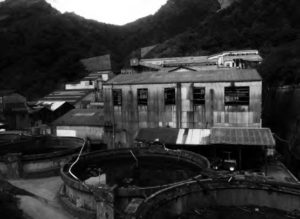
The ruins of the copper concentrating plant and sludge thickeners, ashio Copper Mine. Photograph by Saitomo at http://www.panoramio.com/photo/14374631.
The effort to actualize that contract became more complex in the post-Tokugawa world, as both the power-holders and the “people” gained new levers for exercising power and influence. On the one side stood the state, where officials and capitalists committed themselves to a massive program of national progress (i.e., industrialization and militarization). There was no question where their priorities lay. Economic prosperity and military muscle underlay the drive toward world power status; the commoner’s welfare was secondary. If some people—like those farmers along the Watarase—had to suffer for the national project—that was unfortunate, but unavoidable. As a Tokyo Nichi Nichi Shimbun writer put it in 1892, “the public benefits that accrue to the country from the Ashio mine far outweigh any losses suffered in the affected areas;” people hurt by mine pollution could be “taken care of by compensation.”20 On the other side stood those Watarase farmers to whom modernity had brought a host of fresh tools for fighting popular battles—commoner-oriented newspapers, a legislature, and new labor and student organizations. The impact of these populist institutions was inescapable. While the state officials and the industrialists might not be induced to change their preference for “progress” over “people,” neither could they any longer act monolithically. A preponderance of power certainly remained with the state; the Furukawas continued to hold more influence than the Tanakas. Nevertheless, when the popular voices grew loud in this modern era, as they did at Ashio, officials simply could not ignore them.
Ashio today reveals the region’s troubled experiences only to those who look carefully. Getting there by rail takes time, as one rides a one-car train slowly upward, winding along the rock-filled Watarase and through endless tunnels, one of which takes a full nine minutes to traverse. In the town itself, where the depleted mine finally shut down in 1972, two years before area farmers won a $7 million settlement from Japan’s Environmental Disputes Coordination Commission, the main street is sleepy—almost empty. Most mountainsides are green again; the mine is remembered by a small library and a museum that takes one down where supposedly happy miners dug out the ore; monkeys frolic on the hillsides and in backyards. One of the few reminders of Ashio’s complex and bustling past is the iron bridge in the center of town, where a sign proudly proclaims that it was Japan’s first such structure. Another is a faded roadside map, diagramming the location of a cluster of lodges. All that remains here are the crumbled concrete residue of a communal bath and the shattered timbers of what may have been an office. Looking at the ruins, one recalls the old fighter Tanaka’s lament:
No men love mountains and rivers now. When trees are planted on the hillsides, it is not done from love, but from greed, for what the timber will fetch. Even when trees are planted where they should be, where rivers rise, if it is not done with love, it is not the Way of forestry.21
Industry has vanished today and with it pollution. Unfortunately, so have most of the people—both the thousands who slaved in the mines and the other thousands downstream whose livelihoods were destroyed by the mining toxins.
Harvard-Style Citation
L. Huffman,
J.
(2010) 'Nation Versus People: Ashio and Japan's First Evironmental Crisis',
Education About Asia.
15(3)
doi: 10.65959/eaa.981

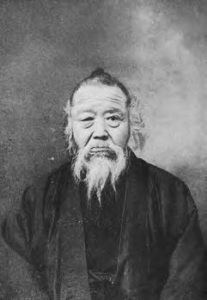 At the center of the environmental campaign all along was the acerbic, often eccentric village headman’s son, Tanaka Shōzō. Known for his rough tactics and crumpled look, he was equally at ease in the homes of officials, farmers, and Tokyo students—with whom he loved to drink and sing. Diet member Ozaki Yukio said that when Tanaka stayed with prominent friends, “he left a trail of lice behind him,” and Tanaka retorted when criticized, “Don’t you know lice are the decoration of a man with a cause?”11 A Diet member himself, he was relentless across the 1890s in haranguing fellow legislators and cabinet ministers about the pollution problems.
Three episodes in the early 1900s encapsulated Tanaka’s style and illustrated the complexity of the environmental struggle even as they ended the Ashio campaign. In the first, on March 23, 1901, he was thrown out of the Diet chambers for calling officials “traitors”; they deserved the label, he said, for their willingness to “decorate Furukawa while allowing him to ravage the fields that gave the nation its very life.”12 In the second, he attempted to present an anti-pollution petition directly to the Meiji Emperor as his majesty was making his way from the Diet on December 10, 1901. Though he was arrested for harassing the emperor, he was released without charge the next day as newsboys hawked screaming headlines about his “direct appeal.” In the third, in 1904, he took up residence in Yanaka village when officials announced that they were going to destroy the small community in order to create a flood-prevention basin. The old crusader was no more able to prevent Yanaka’s demise than the officials were able to stop the floods, but his act of solidarity inspired villagers to continue resisting even when police came to tear down their homes in the summer of 1907. “Old age will not make me retire,” he declared. “I must go forward till I drop, or until age simply withers me away.”13 A reported 30,000 people attended his funeral in 1913.
While environmental problems continued to plague those living along the Watarase River, Ashio largely disappeared from the national conversation after the mid-1900s, as Japan became increasingly preoccupied with war with Russia (1904–05), and then with expansion onto the Asian continent. New events occasionally piqued the journalists’ memories of the environmental crusades—the destruction of Yanaka, violent labor strikes at the Ashio Mine in 1907, and Tanaka’s death in 1913. However, pollution became yesterday’s issue. Historians never lost interest in Ashio though— partly because of its role as a trigger for the country’s first environmental crusade and partly because it dramatized so vividly fundamental tensions that confront every modern (and modernizing) society. Three of those issues call for discussion here.
At the center of the environmental campaign all along was the acerbic, often eccentric village headman’s son, Tanaka Shōzō. Known for his rough tactics and crumpled look, he was equally at ease in the homes of officials, farmers, and Tokyo students—with whom he loved to drink and sing. Diet member Ozaki Yukio said that when Tanaka stayed with prominent friends, “he left a trail of lice behind him,” and Tanaka retorted when criticized, “Don’t you know lice are the decoration of a man with a cause?”11 A Diet member himself, he was relentless across the 1890s in haranguing fellow legislators and cabinet ministers about the pollution problems.
Three episodes in the early 1900s encapsulated Tanaka’s style and illustrated the complexity of the environmental struggle even as they ended the Ashio campaign. In the first, on March 23, 1901, he was thrown out of the Diet chambers for calling officials “traitors”; they deserved the label, he said, for their willingness to “decorate Furukawa while allowing him to ravage the fields that gave the nation its very life.”12 In the second, he attempted to present an anti-pollution petition directly to the Meiji Emperor as his majesty was making his way from the Diet on December 10, 1901. Though he was arrested for harassing the emperor, he was released without charge the next day as newsboys hawked screaming headlines about his “direct appeal.” In the third, in 1904, he took up residence in Yanaka village when officials announced that they were going to destroy the small community in order to create a flood-prevention basin. The old crusader was no more able to prevent Yanaka’s demise than the officials were able to stop the floods, but his act of solidarity inspired villagers to continue resisting even when police came to tear down their homes in the summer of 1907. “Old age will not make me retire,” he declared. “I must go forward till I drop, or until age simply withers me away.”13 A reported 30,000 people attended his funeral in 1913.
While environmental problems continued to plague those living along the Watarase River, Ashio largely disappeared from the national conversation after the mid-1900s, as Japan became increasingly preoccupied with war with Russia (1904–05), and then with expansion onto the Asian continent. New events occasionally piqued the journalists’ memories of the environmental crusades—the destruction of Yanaka, violent labor strikes at the Ashio Mine in 1907, and Tanaka’s death in 1913. However, pollution became yesterday’s issue. Historians never lost interest in Ashio though— partly because of its role as a trigger for the country’s first environmental crusade and partly because it dramatized so vividly fundamental tensions that confront every modern (and modernizing) society. Three of those issues call for discussion here.