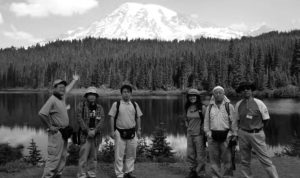
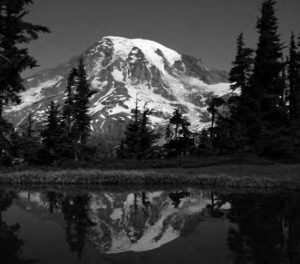
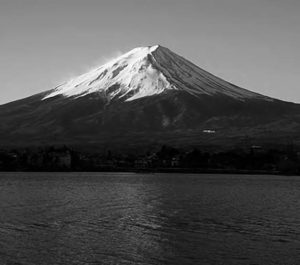
The United States–Japan Foundation, The Mountain Institute, and the National Park Service collaborated to create the Sister Mountain Curriculum Project. The Mountain Institute’s Alton Byers is project director and works with Lee Taylor of the National Park Service. The Sister Mountain Curriculum Project teaches middle and high school students in the US and Japan about two iconic mountains, Mount Fuji and Mount Rainier. These famous peaks serve as a lens to focus student awareness of the physical processes of mountains, their ecology, and human culture. Students gain insight into the value of mountains and the importance of environmental stewardship. By highlighting similarities and differences between these two volcanoes and their people, the project also enhances international understanding. In August 2010, six Japanese teachers visited Mount Rainier to meet with American teachers and review the lesson plans they had developed. In 2011, the Japanese teachers will host a workshop in Japan for the US teachers. The Sister Mountain Curriculum will be completed in 2011 and available to students and teachers on the web.
Park Service.
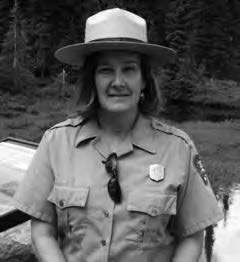
In what follows, Lee Taylor interviews Peter Conrick and Setsuro Kobayashi; the American and Japanese Teacher Ranger Teachers who participated in the Sister Mountain Curriculum Project. Lee Taylor is the Chief of Interpretation and Education at Mount Rainier National Park. She has worked for the National Park Service for twenty-six years in ten different national parks.
Lee Taylor: Why do you think young people should learn about Mount Fuji and Mount Rainier?Peter Conrick: Overall, the importance of making a connection to the natural world is critical for young people. Mountains have always inspired people, and these two mountains are both icons in their own right. Both mountains have compelling scientific connections, but they also have intriguing human stories. By studying Rainier and Fuji, our students will come to a clearer understanding of environmental, social, and political issues across national boundaries. They will begin to understand that beautiful places need protection, wherever they are on earth. Moreover, they will come to see themselves not just as Americans or Japanese, but as joint custodians of those treasured places. Setsuro Kobayashi: Symbolic places like Mount Fuji and Mount Rainier can provide a huge impression and attraction to students and will increase their desire to learn. Both mountains are symbolic to their countries/states and have a strong impact because of their beauty and the richness of their natural world. These mountains also have an economic impact as well as cultural impact. Teachers need a variety of field materials and information in order to teach their students science, geology, history, culture, tradition, and environmental protection. This workshop provided these. School systems need professionals who have knowledge and experience in these fields. Both mountains have rich resources of material and provide professionals with field experience. One of our main purposes of the workshop for the Sister Mountain Project was to build relationships and provide for interactions between the two countries. Developing lesson plans, sharing ideas, and exchanging lesson plans was an ideal way to interact with each other and for the two mountains to assist in connecting teachers in each country more easily. I found many differences between the two countries/mountains, such as our educational systems, how we teach “protect and preserve” concepts, and the differences in our schools. To compare these differences among the students or make them aware of these differences will be a very interesting topic in my class and will broaden the student’s knowledge and understanding.Thus, I strongly believe it is very important to study about Mount Fuji and Mount Rainier.
The Sister Mountain Project has been a wonderful experience, because it has allowed me to bring together so many professional and personal interests: love of the outdoors and especially mountains, hiking, climbing, and a long time interest in teaching about Japanese history and society. — Peter Conrick
Lee Taylor: What are some of the benefits of studying the ecosystems of these mountains from a comparative perspective?
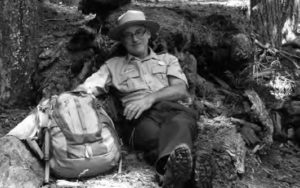
Lee Taylor: Do you think the study of these two great mountains will have applicability for several academic disciplines? If so, why?Peter Conrick: Absolutely. The most rewarding and effective method of studying these two mountains is to take an interdisciplinary cross-curriculum approach. Recent brain research on how we learn best points to the importance of making connections between different disciplines. Students can learn so much from thinking and creating in a variety of disciplines. The best way to study these mountains is by offering a variety of scientific, literary, historical, and artistic activities.
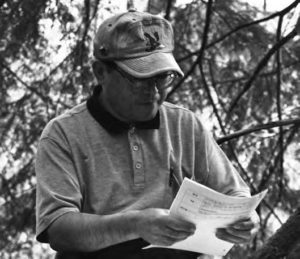
Lee Taylor: How have you grown as a professional educator from participating in this project?Peter Conrick: The Sister Mountain Project has been a wonderful experience, because it has allowed me to bring together so many professional and personal interests: love of the outdoors and especially mountains, hiking, climbing, and a long time interest in teaching about Japanese history and society. The Sister Mountain Project has enabled me to combine these passions and bring them to my students. I am excited about the opportunity for my students to make contact with the Japanese students and share common projects. This will allow them to connect in the same way that I’ve been able to connect with my Japanese colleagues.
As a teacher who is very close to students and who is able to pass this message on to students, I would like to continue our mission to educate students about the importance of protecting and preserving these sacred places for future generations. — Setsuro Kobayashi