
Stories from the Revolution in Mao’s China: Teaching Students to Think about Socialism and Communism
by Aminda Smith
Editor's Note: Supplemental lesson plans from NCTA teachers—to help guide students in exploring the logics of Chinese communist experiments, how the state tried to convince people of those logics, and whether that process worked—are available to download at the end of Dr Smith’s article.
Download the PDF version of this article for classroom use
Aminda Smith is Associate Professor at Michigan State University and the Co-Director of the scholarly organization The PRC History Group. She is a historian of modern China, with a particular interest in Chinese Communism and the grassroots histories of political thought and activism. She writes about the ways ordinary people have engaged with Maoism in China and around the world during the twentieth century. Her recent publications have examined topics including Mao Zedong Thought, brainwashing/thought reform, and Maoist logics such as the mass line.
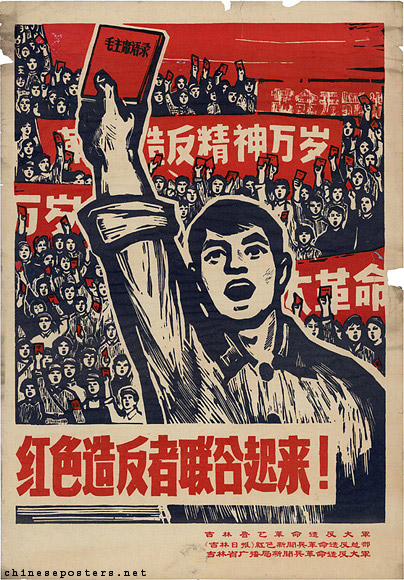
“Red Rebels unite!.” Poster designed by Jilin Lu Yi, Great Revolutionary Rebel Army (1967). Chineseposters.net. Private Collection.
I am honest with my students. I admit I have sympathy for the ideals of freedom and justice that fueled revolutionary experiments in China. I am also deeply sobered when I consider the failures of those experiments and the role of Mao Zedong and his government in disaster, repression, and suffering. Yet, as a historian, I have found that most Chinese communists joined that movement because they wanted to make the world a better place.
Many people argue that the “crimes of communism” belie its ideals. Professor Perry Link put it poignantly: “In the late 1960s, I admired Mao because I felt strongly about things like peace, freedom, justice, truth, and a fair chance for the little guy. Today I detest Mao and his legacy. Why? Because I am drawn to things like peace, freedom, justice, truth, and a fair chance for the little guy.”1
I explain Link’s views to my students. I also share my perspective: There are powerful lessons—positive and negative—to learn from the history of Maoism. We should not ignore the utopian intentions or the tragedies. The Chinese Communist Party (CCP) has had important and long-term successes. They have also made serious mistakes. People who study Chinese history offer widely divergent assessments because Mao launched a radical experiment in revolutionary change. The history of that experiment was fraught with complex motivations, challenges, and contradictions.
Understanding that history is more important than ever. The Cold War seems to have reemerged or never ended. Students on social media see images of Mao Zedong that link him to contemporary political issues both in positive and negative ways. Propagandists of various stripes are vying for young people’s attention. Stories about China’s past and present are frequently at the center of the discussion.
I never ask students to accept one position over another. But I ask they take seriously the logics of revolution and its historical realities. The most important thing I want students to learn is that oversimplified histories do not help us understand. They do not even help us promote one political view over another. We are all better at evaluating political movements—today and in the past—if we attempt to explain why socialism and communism are genuinely appealing to many people, while others find them abhorrent. Reasonable, intelligent, well-informed people can disagree.
The lesson plans that accompany my article were created by teachers to guide students in exploring the logics of Chinese communist experiments, how the state tried to convince people of those logics, and whether that process worked. In many places, students are asked to consider these questions as they investigate the rise of authoritarianism in the twentieth century.
Suggested sources include propaganda posters, revolutionary films, and excerpts from Mao. Students and teachers can watch these three 3-minute videos from PBS for Teachers: https://ny.pbslearningmedia.org/resource/fln43cusrxj-soc-mao/mao-and-the-cultural-revolution/
These engaging videos provide a brief introduction to the history of Maoism. They present different views. Some are more positive, while one speaker portrays the early years of the People’s Republic of China (PRC) as a series of atrocities. Viewers also learn that current leader, Xi Jinping, suffered during the Mao Years but maintained his commitment to the CCP. Students can weigh these different perspectives as they evaluate Mao’s ideas and the global history of socialism and communism. The lesson plans provide excellent resources and overviews, tested by educators. I will avoid reiterating those rich materials. Instead, this brief introductory essay draws on conversations I have with high school teachers as we think about how to approach these topics in the classroom. I highlight several key ideas that I use in my own classes.
Socialism and Communism (and Capitalism)
Students often use socialism and communism interchangeably. They are similar, as broad terms for economic philosophies that favor collective ownership over private property. Within those general categories, however, there are many variations. In socialism, the government often manages production and distribution, but the governing philosophy might be democratic, authoritarian, or something else. In most forms of communism, the government ideally disappears, but other elements of the system vary. Mao’s communism was only one example, in the same way capitalism in the U.S. is not identical to capitalism in other places or other times.
Mao’s China and Communist Party were also very different from China and the Chinese Communist party today. For example, Mao celebrated struggle and encouraged young people that “it’s right to rebel.” In the 21st century, Xi Jinping prizes social stability and forbids rebellion. Mao would probably say that China today is closer to a capitalist country than a communist one. Some experts agree. Other experts agree with Xi, who claims China is still pursuing a socialist path.
Maoism cannot stand for socialism or communism but studying it can help us understand those ideologies. In the twentieth century, Maoism became a global phenomenon. Many people were frustrated by economic inequality and wondered if capitalism could live up to its promises. U.S.-led wars in Korea and Vietnam further heightened dissatisfaction, not just with capitalism but with liberal democracy. Some people were hopeful about alternatives in the Soviet Union and China.
Maoism and leftist ideas had as many detractors as supporters. The Cold War was not purely an ideological conflict, but its contestations over economic and political theories were fiercely real. Governments, organizations, and individuals devoted maximum resources to celebrating one ideology while demonizing the other. In the U.S., anti-communist views continue to shape our understanding of China. Many popular histories suggest that Maoism was nonsensical, even diabolical, and that the very idea of communism is responsible for authoritarian repression and catastrophe. It is true that Mao and his allies enacted policies that led to disaster. It is also true that they never fully realized their revolutionary aims. But there is little evidence that communist politicians were uniquely evil among world leaders or that communism has created more suffering than capitalism.
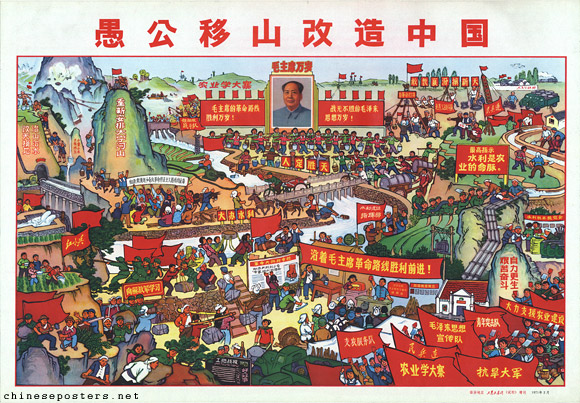
“The Foolish Old Man who moves mountains changes China.” Poster designed by Wang Linkun (June, 1987). Chineseposters.net. Courtesy of the Landsberger Collection.
Mao’s Stories
Mao is a controversial figure, but he is viewed more negatively in the U.S. than in China. In China, he is often appraised as an important leader who helped launch the country out of poverty and colonialism, but one who also made many disastrous mistakes along the way. Mao insisted that all ideas come from practice. His own thinking grew out of his practical experiences as a revolutionary, and some of his ideas are useful in understanding revolution while others require reevaluation.
Mao was called the “great teacher.”2 Like many great teachers, he told great stories. Students will encounter these stories in the propaganda posters, plays, and quotations from the lesson plans presented here. Mao’s stories imparted quick and accessible lessons. But each can also be unpacked to reveal deeper layers of guidance. Take Mao’s retelling of an ancient Chinese fable, “The Foolish old Man Who Removed the Mountains.” Long ago, an old man was frustrated by two massive mountains, which blocked both sunlight and the road. He and his sons began digging them up, filling buckets with dirt and dumping them into the sea. Another man, identified as “the wise old man,” ridiculed the foolish old man, saying his task was physically impossible. The foolish old man pointed out that the mountains would not grow taller. If he and his descendants continued their work, wouldn’t they eventually succeed? Impressed by this unwavering persistence, the gods stepped in and carried the mountains away.
Mao claimed the ancient tale was relevant for the revolution. He argued that China had three oppressive institutions which were responsible for suffering and lack of progress. The institutions—imperialism, capitalism, and feudalism—were “big mountains” lying “like a dead weight on the Chinese people.”3 In Mao’s story, the gods were replaced by the masses, who would work collectively to create revolutionary change.
Mao’s foolish old man became world-famous in the 1960s and 1970s.4 He appeared in each of the one billion (or more) copies of the Little Red Book.5 The story also featured in millions of other publications.6 It was retold by everyone from teachers in China to civil rights advocates in the U.S. In Wild Swans, a memoir widely used in classrooms today, Jung Chang recalls how her father took a nom de guerre when he joined the communists. His chosen revolutionary name included the character for “foolish.” He kept that reference to revolutionary foolishness throughout his life.7
In can be tempting to see communist believers as actual fools and Cold-War communist propaganda as doublespeak or dangerous lies. Sometimes, propaganda contained those things. Yet it could also impart ideas that many of us might still teach. The story of the foolish old man highlighted a powerful truth and made it seem simple: when people work together and think big, they can achieve things that seem impossible.
The foolish old man is an example of utopian ideas in Maoism. But the story was important because it had both utopian and evidence-based elements. Few people in China believed that an old man could really move mountains, bucket by bucket. Yet they believed in the story because it reinforced something historically true: humans have created unimaginable changes in the world, often against all odds. Most modern thinkers, from Vladamir Lenin to Woodrow Wilson, believed that human history was the story of progress. In the modern world, moving mountains is hardly the most miraculous thing humans have done.
Nonetheless, not everyone found Mao’s story convincing. With propaganda, messages were purposely styled to make them appealing and compelling. The CCP won people over. Others, they coerced. Still others went along for more cynical reasons. Some people resisted official tales and told their own. But the stories mattered. They often set the terms of the conversation.
I ask my students to look at propaganda with that in mind. What were the terms of the conversation? What lessons, assumptions, and viewpoints were people considering? Can students find other examples from Chinese Communist propaganda in which simple statements or images point to more profound ideas? Can they identify similar reference points in their own lives: a few words that remind them of a meaningful lesson, or a photograph that stands for a powerful message? I provide examples of bumper stickers and refrigerator magnets. They share memes.
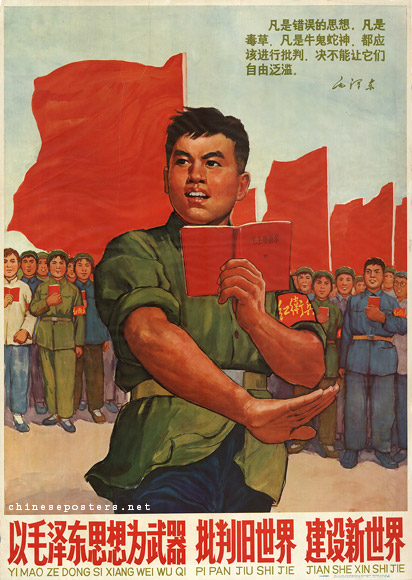
“Criticize the old world and build a new world with Mao Zedong Thought as a weapon.” Poster designed by the Shanghai People’s Fine Arts Publishing House Propaganda Poster Group (September, 1966). Chineseposters.net. Courtesy of the Landsberger Collection.
Violence and Democratic Dictatorship
Critics often suggest that communist propaganda was mere window dressing for a darker reality. But students will find Mao spoke very explicitly about the violent and authoritarian aspects of his policy and ideology. He argued that violent struggle would be necessary. History had shown that powerful people rarely relinquish their positions voluntarily. The Litte Red Book famously proclaims, “A revolution is not a dinner party, or writing an essay, or painting a picture, or doing embroidery . . . A revolution is an insurrection, an act of violence by which one class overthrows another.”8
Mao praised violence from his earliest years as a revolutionary. He lauded peasants who attacked landlords, seizing their property, beating and even killing them. In 1926, he returned to his home region to investigate a peasant movement. He reported that “local tyrants, evil gentry and lawless landlords have themselves driven the peasants to this. For ages they have used their power to tyrannize the peasants and trample them underfoot; that is why the peasants have reacted so strongly.”9
Scholars have contested Mao’s claims. China is a vast and diverse country. In some places, elite power was oppressive and violent. In other places it was less so. Some peasants seized the opportunity to overthrow their landlords. In other cases, activists had to cajole and coerce people into action. But Mao’s message was powerful: violent exploitation would be met with violent justice. Much like the story of the foolish old man, Mao’s tales of peasant revolution did not have to be true to be logical and convincing.
After 1949, Mao continued to argue that authoritarian rule was necessary and justified. He announced a “democratic dictatorship.” The “people”—which included workers, peasants, and their allies—would enjoy democracy. But their “enemies”—including landlords, capitalists, and imperialists—would be subject to a dictatorship. When critics accused the CCP of being “dictatorial,” Mao did not disagree. “My dear sirs,” he replied, “you are right, that is just what we are.”10
Mao and other Marxists justified dictatorship, which was intended to be temporary, by arguing that older oppressive systems are very difficult to abolish. “Enemies” benefit under the old institutions and fight bitterly to preserve them. Maoists claimed that socialism and communism could not succeed unless its opponents were prevented from resisting until new systems were fully established.
Controlling Culture
Dictatorial governance also included tight control over culture. The accompanying lesson plans feature Mao’s Talks at the Yan’an Forum. In those talks, Mao insisted that art and literature must serve the masses. His message is sometimes interpreted narrowly to mean that artists and writers can only work on state-approved topics. This interpretation isn’t wrong, but it misses the deeper claim. Most of us would agree that culture has a heavy influence on what we believe to be true about the world. As George Orwell wrote in 1940, “All art is propaganda.”
I ask my students for examples of culture that shaped their worldview in positive and negative ways. They cite things like scriptures and history books. They also name fairy tales, songs, TV shows, and movies. My students disagree about which stories have positive impacts and which have negative ones. But they tend to be universally in favor of writing new stories that better reflect what they see as good values or life lessons. We tie this back to the question of authoritarianism and state control. Is it ever appropriate to ban books? Should we try to ensure that people learn the right lessons from their culture, and not the wrong ones? Should the government play a role in deciding what writers write and what readers read? Are there some ideas so dangerous that people shouldn’t be exposed to them? We also talk about the relationship between the government, corporations, and culture. Should tech companies be allowed to decide what we know? If not, who should stop them and how? Most of my students argue that a small number of ideas are dangerous enough to necessitate intervention. Many also think someone should intervene to stop corporate or government media monopolies. Students disagree over what those interventions should be.
My students laugh when I point out that they agree with Mao. They don’t generally support his methods. But most of them do think, as he thought, that culture is important enough to warrant government oversight. “If it makes you feel better,” I tell them, “the U.S. government agrees too.” During the Cold War, the CIA established writing programs at universities and set up literary magazines in other countries. One goal was to encourage literature that portrayed capitalism positively and communism negatively.11 More recently, in August 2025, the U.S. president signed an executive order to increase scrutiny of federal grants and ensure they are not used to promote “Marxism, class warfare propaganda, and other anti-American ideologies.”12 Nearly all governments control culture. Mao used to joke that China was less hypocritical than the U.S. because at least the CCP was honest about the limitations they placed on free speech.
Disaster and Tragedy
Mao said explicitly that “enemies” would be treated with violence and coercion. However, as the recommended video overviews make clear, many ordinary people also suffered during the Mao Years. The CCP sometimes failed to live up to its core mission: to serve the people.
That said, it is not clear that the cause of mass suffering was the ideology of communism itself. I welcome my students to make that argument if they choose, but not to simply assert it. First, I remind them that capitalism and socialism are economic systems while democracy and authoritarianism are political systems. Regimes have combined these in different ways. Second, democratic, capitalist governments also engage in political killings and mass incarcerations of non-violent people. Very readable histories of the United States detail how governments here have enacted policies that deliberately increase social disruption and lead to suffering, including starvation.13 Just to give a single example, millions of deaths have resulted from blockades and wars to keep the world safe from communism. Some are still ongoing.
Both communist and capitalist ideologues sometimes see human life as an acceptable sacrifice for their cause.
As they evaluate socialism and communism, I also want my students to understand that Maoist experiments were sometimes truly revolutionary. But other times, CCP logics were similar to capitalist ones. To illustrate this point, I discuss the case of the Great Leap Forward. In the late 1950s, Mao launched one of his most radical campaigns. He argued that Chinese people could propel a developmental leap. For a few years, they would labor as hard as possible, using their ingenuity and resources to increase production and technological development. Then China could surpass England, catch up with the United States, and leap into socialism and communism. The plan was utopian, but not entirely so. The Soviet Union had demonstrated that socialism could produce development. In 1957 the Soviets launched Sputnik, the first artificial satellite in the world and proof that communist countries could progress ahead of capitalist ones. In factories and communes across China, people vowed to “launch satellites” in everything from farming to engineering to child development.
The Great Leap project centered heavily on agricultural production. Farmers would collectivize, utilize every inch of land, and innovate technologies to raise outputs to the max. The surpluses would be so high that they would fund industrial development and provide socialist plenty for all. Some people were enthusiastic. Everyone was under pressure to appear enthusiastic. Some began overreporting their yields, out of excitement, fear, or because superiors simply demanded higher surpluses than farmers could produce. The government took a portion of the grain, based on those exaggerated figures. People in rural areas were left with nothing to eat. The experiment ended in one of the worst famines of the century.
The Great Leap is associated with the lies and exaggerations that fueled the tragedy. Maoist authoritarianism discouraged many people from exposing inaccurate reports. Others risked their lives to tell the truth. Many dedicated communists opposed Mao and his allies. Some were purged, punished, and possibly assassinated for their resistance to more extreme policies. Many of them remained steadfast in their commitment to socialism and communism, but they disagreed over which versions best suited China at different times.
More accessible histories unfortunately portray the Great Leap Forward as utterly illogical. In fact, it had hyperbolic elements, but it also had a logic. Many of its policies were initially evidence-based. In the 1940s and 50s, people tried many tactics to increase their yields. They made mistakes, learned lessons, and achieved successes. Many Great Leap methods had demonstrated positive results. Rural economists have shown that collectivization, for example, led to early successes in many places. The same was true for techniques later decried as unscientific. “Deep plowing” and “close planting” appear in many histories as examples of agricultural practices that led to disaster. And they were indeed disastrous when taken to extremes during the Leap. But in moderation in the right conditions, they are still used effectively in many parts of the world.
The basic logic of the Great Leap was not even that radical. Most people in the 20th century believed that the scale and pace of scientific and technological change was only increasing and that hard work and ingenuity could power rapid and almost unimaginable development. My students can generate many examples. My favorite: humans had existed for millions of years when the Savery steam engine was invented in 1698, but it was only fourteen more years before someone invented a superior version. As the anthropologist Steven Harrell put it, “Great Leap thinking was in one way too logical, the ultimate triumph of rationalist logic.”14 When the Leap lost touch with empirical reality, it was because some officials pushed the globally popular logics of progress and development to their extreme.
Of course, there are substantial differences between capitalism and socialism. There were also many other factors in the Great Leap disaster. These included elite power struggles, authoritarian whims, and the challenges of governing through an enormous bureaucracy. But popular explanations of the Leap famine often reduce it to a problem with communism. I want my students to interrogate that claim. If they argue that communism is flawed, I hope they’ll also be able to identify problems with unfettered capitalism. I hope they can see the differences between ideologies as well as where they converge. As theories, communism, socialism, and capitalism were all born of the same historical context. Their histories tell us as much about the conditions of our modern world as they do about the limitations of any particular idea.
Conclusion
I often propose a thesis to my students: socialist experiments were not utopian enough. We talk about whether this weakness was foreshadowed in the story of the foolish old man. In 2008, artist Chang Jin critiqued that story in a caricature called “The New Foolish Old Man Who Moved Mountains.” In the drawing, two mountains are labeled “natural resources,” the commodities that people all over the world deplete to chase rapid economic development and endless progress.15 The story of the foolish old man might reinforce the idea that the earth is little more than a resource to fulfill human desires.16 This attitude often dominated socialist and capitalist ideology alike. And people everywhere have paid a shared price.
A more utopian project imagines a revolution that doesn’t necessitate authoritarian control over nature or society.
I am glad my students are still engaged in heated arguments about socialism and communism. As a historian, I want my students to put themselves in the shoes of the people who tried to change the world. I want them to learn from the mistakes and the tragedies. I want them to hold people accountable, especially leaders. I also want them to know that many Chinese communists were ordinary people trying to make their way and maybe make a difference. Many of them are still proud of those efforts. Many also admit mistakes and regret them.
I want my students to learn from the past. But I don’t want them to be pessimistic about their ability to make change. Too often, people cite socialist experiments as proof that the world is the way it is, that there is no alternative, that when we aim for better, what we get is worse. That cannot be the lesson.
Notes
1 Perry Link, “Dawn in China,” ChinaFile (February 9, 2011) https://www.chinafile.com/dawn-china
2 A propaganda poster from 1967 lists his four appellations: “Great teacher, great leader, great commander, great helmsman” https://chineseposters.net/posters/pc-1967-018
3 Mao retold the Foolish Old Man’s story in 1945. The 1945 text was reprinted in Chapter 21, “Self-Reliance and Arduous Struggle,” of Quotations from Mao Zedong [The Little Red Book] https://www.marxists.org/reference/archive/mao/works/red-book/ch21.htm
4 For a rich discussion of the creation, dissemination, and reception of the foolish old man as propaganda, see Barbara Mittler, A Continuous Revolution: Making Sense of Cultural Revolution Culture (Harvard University Press, 2012), 189–256.
5 Alexander Cook, Mao’s Little Red Book: A Global History (Cambridge, 2014) xiii.
6 “Maxims for Revolutionaries: The ‘Three Constantly Read Articles,” Peking Review 10, no. 2 (6 January 1967): 7–8. Excerpts from these articles are available here: “Commonly Read Speeches and Writings of Mao Zedong (1927–1945) Asia for Educators, Columbia University. Online: https://afe.easia.columbia.edu/
7 Jung Chang, Wild Swans: Three Daughters of China (Simon &Schuster, 2008), 144.
8 https://www.marxists.org/reference/archive/mao/works/red-book/mao-red-book-1966.pdf
9 Mao Zedong, “Report on an investigation of the Peasant Movement in Hunan,” https://www.marxists.org/reference/archive/mao/selected-works/volume-1/mswv1_2.htm
10 https://www.marxists.org/reference/archive/mao/selected-works/volume-4/mswv4_65.htm
11 “Six Books You Didn’t Know Were Propaganda,” The Economist 3 Nov 2023, https://www.economist.com/the-economist-reads/2023/11/03/six-books-you-didnt-know-were-propaganda
12 Executive Office of the President, “Executive Order 14332: Improving Oversight of Federal Grantmaking,” August 7, 2025:
13 Greg Grandin, America, América: A New History of the New World (Penguin Press, 2025); Daniel Immerwahr,
How to Hide and Empire: A Short History of the Greater United States (Vintage, 2020).
14 Steven Harrell, An Ecological History of Modern China (University of Washing Press, 2023), 137.
15 Mittler, A Continuous Revolution, 239.
16 Anna Lora-Wainwright, “Yi shan dao hai Removing Mountains and Draining Seas,” in Afterlives of Chinese Communism: Political Concepts from Mao to Xi, ed. Christian Sorace, Ivan Franceschini, and Nicholas Loubere (Australian National University Press, 2019), 221.
Supplemental Lesson Plans
The following supplemental lesson plans from NCTA teachers are available to help guide students in exploring the logics of Chinese communist experiments, how the state tried to convince people of those logics, and whether that process worked.
The Relationship between Ideology, Propaganda, and State Power in Communist China under Mao by Sean Fitzgerald (Sumner Academy of Arts & Science, Kansas City).
This lesson is designed for the International Baccalaureate (IB) History curriculum, specifically the Authoritarian States (20th Century) topic, and examines the emergence, consolidation, and maintenance of power in Communist China under Mao. Through inquiry and analysis of excerpts from Mao’s Talks at the Yan’an Forum on Literature and Art (1942) and a selection of Chinese Communist propaganda posters, students investigate the relationship between ideology, propaganda, and state power.
Propaganda, Power, and Persuasion: Visual Messaging in Nazi Germany, the United States, the Soviet Union, and Communist China by Randy Snyder (Huntington High School, WV).
This three-day lesson encourages students to examine how governments and political movements have used visual media to persuade, mobilize, and shape public opinion. Using propaganda posters from Nazi Germany, the United States and the USSR during World War II and the Soviet Union, and Communist China, students will analyze how governments use color, imagery, composition, symbolism, and rhetoric to communicate political messages—motivation, beliefs, legitimacy, and unity.
The Trial of Mao by Paula Frohman (Retired Director of Technology/Teacher at Evanston High School) is intended for students in grades 10–12. Working as a member of the Prosecution or Defense team, you will try and prove or disprove that Mao Zedong is guilty of the crimes as charged. Charges include The specific charges include: demolishing Chinese traditions and culture; eliminating traditional (Confucianism, Daoism) and foreign religious thought; destroying traditional family structure; imposing political tyranny; eliminating free expression; harming the health and livelihood of the Chinese people; and diminishing China’s stature in the world.
Mao Propaganda: Promotion or Publicity? by Angela Peck (co-coordinator of the International Baccalaureate program at Ingraham High school in Seattle, WA) is intended for students in grades 10–12.
Learning About Propaganda Techniques through Chinese Propaganda Posters by Natalie Roy (Deer Park High School, Deer Park, WA) is intended for high school students. Posters in this lesson were selected as examples for multiple uses of propaganda, in which discussions are held as a class about which techniques were used, why some techniques were omitted all together, and, more broadly, how students have seen these techniques used today, both politically and commercially. The lesson also introduces twelve techniques as designated by the U.S.-based Institute for Propaganda Analysis as a tool for critically analyzing political propaganda from both China and the United States. In addition, the PowerPoint slides provide students with increased familiarity with the ideals of communism, Chinese culture under Mao, and the history of China.