

Editor’s Note: We thank the University of Hawai`i Press for providing permission to publish this essay, adapted from Laurel Kendall’s book, Shamans, Nostalgias, and the IMF: South Korean Popular Religion in Motion (Honolulu: University of Hawai`i Press, 2009).
Shamans are religious specialists who are perceived as having the capacity to deal directly with spirits on behalf of the community, either by sending their own soul on a journey to other realms or by calling them into the here and now and manifesting them in their own bodies. Shamans bear witness to their encounters with spirits through their own bodies, either ina journey undertaken in a trance state or by manifesting the spirits’ presence through their ownvoice, gestures, dances, and mimes. Because shamans were first described in Siberia among hunters and herders, their work is sometimes described as an “ancient” or “primitive” religion, but shamans have had long and expansive histories in the sophisticated kingdoms and then nation states of East and Southeast Asia. As the following account illustrates, a living shamanic practice must effectively engage the contemporary world around it.In the 1970s, as a young anthropologist and novice fieldworker, I spent nearly two years in the company of South Korean shamans, called mudang or mansin, observing their rituals and divination sessions and accompanying them to kut, their most elaborate ritual. In kut, the shaman puts on the costumes of the gods, dances to rapid drum beats, and when the music stops, speaks and mimes in the god’s persona, sometimes angry and demanding, sometimes comic, usually offering promises of good fortune before departing to another flourishing of drum beats and dancing. And then another shaman dresses to manifest another deity until all of the appropriate gods and ancestors of a client family have made their appearance, and all manner of inauspicious influences have been cast away.
GOING TO A KUTTANG
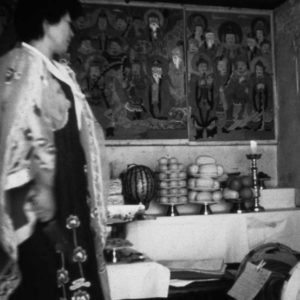
On this May morning in 1992, filmmaker Diana Lee and I have made a dawn journey along the north/south axis of the Seoul subway system to Ansan to join the senior shaman Yongsu’s Mother (as Korean matrons are addressed) and her promising apprentice, Babe. Okkyŏng’s Mother, who was a bumbling apprentice at the time of my first fieldwork, but has now become a deep-voiced and confident shaman, joins us at Babe’s house. We wait for a telephone call from the client who, the shamans rightly assume, cannot leave for the kut until her husband is out of the house. Why is she holding a kut? Is someone ill? Yes, it’s a kut for affliction. The wife is ill. They should have had a kut three years ago. The husband was in construction, building houses and selling them, but he lost everything and now he just stays home. The wife goes out to clean and cook for other people while the couple wallows in debt. The call comes through, and we collect Mrs. Yi from a pink apartment complex, not a luxurious facility, there is no landscaping, but a fresh new construction. Mrs. Yi, a tall, thin woman in her early thirties, wears jeans, a striped knit top, and a cardigan. She is carefully groomed with permed hair, bright and carefully applied make-up, gold earrings, and a thin gold chain necklace. This is probably how she leaves the house to go to work, disguised to resemble any young housewife going shopping or meeting friends. Long red artificial fingernails complete the image, belying hands that do other women’s housework. She comes out to the van hauling a large carton of fruit for the offerings. After exchanging greetings with Babe and nodding to the rest of us, she sits silently all the way to the shrine. Like a paper flower that unfolds in a glass of water, she will open up slowly over the course of her kut.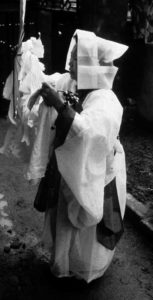
BABE: SIGHTING A DIVINE ANCESTRESS
Immediately after lunch, Babe dresses to invoke the Mountain God, joking that it will be hard to work on such a full stomach. The mansin laugh, but Mrs. Yi’s face is blank. The Mountain God (Babe) describes anxiety over wealth going out of the family. The god speaks of a grandmother who prayed on mountains in the past and an ancestor who was a high official. These sightings indicate a family with powerful gods, a family that should honor them with frequent kut. All of the gods who appear in this sequence describe wealth going out of the family. With gestures toward the offering tables, they repeat, over and over, that if the family had done a kut earlier, all would have been well, a logic already familiar to me from many other kut both past and present. When, as the Mountain God’s Special Messenger, Babe tries to balance the pig’s head on a trident, a sign that the kut offering is accepted, she cannot get the trident to balance. Okkyŏng’s Mother, with a sharp hand gesture, sets Mrs. Yi to bowing in front of the offering tray where Babe struggles with the trident. When it finally stands, Babe relates a vision of the ancestral grandmother who honored the Seven Stars, a confirmation of the divination she has already given. Babe manages a complicated dance, trailing the long sleeves of the white robe, then addresses Mrs. Yi, who is rubbing her hands in a gesture of intense supplication, “I am the Seven Stars who has helped this family from long ago. In the past, the women of the family honored me. As for you, no good will has come to you (from the neglected Seven Stars).” Gesturing to her forehead, she adds, “Your head aches all the time.” Mrs. Yi tries to flick away the tears that pool in the corners of her eyes. Another deity, the Birth Grandmother, tosses chestnuts and dates from the upturned surface of Babe’s cymbals into Mrs. Yi’s lap telling her, “If you can just surmount the current crisis, all will be well. I will help you.” The pock-marked Princess (Hogu), her red skirt thrown over her head, makes a brief appearance and extracts a fee for make-up to cover her scars, the fee that enables her to remove the red skirt. Babe manages to convey all of this to Mrs. Yi with gestures, pointing to her cheeks to indicate the marks. Next, attired in a traditional military robe and hat, Babe dances with a bundle of colored flags and manifests a Spirit Warrior:You left your native place. You have a difficult fate. There was a Spirit Warrior in this house from long ago (a god helpful to commerce). I have waited for a long time. If your luck changes quickly, it will be in the 8th or 9th month; if it comes more slowly, then next year things will improve. I will help you get a house of your own.
OKKYONG'S MOTHER: COMMISERATING ANCESTORS
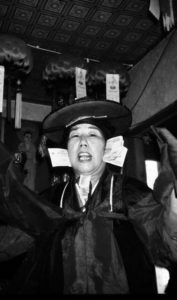
During a brief break, Mrs. Yi bends into the conversation and asks the mansin to clarify one of the points made in the divinations. Okkyŏng’s Mother, who will manifest the ancestors, takes this opportunity to ask her about the grandmothers and grandfathers in her family and the manner of their deaths, then puts on a yellow robe and manifests Great Spirit Grandmother who leads the ancestors to kut.[In a weepy voice.] There are afflictions in this family, multiple afflictions. You can never go back home [both parents are dead]. Things did not work out for you. You are sore all over. Is there any place on your body that isn’t in pain?Okkyŏng’s Mother manifests the ancestors, beginning with distant generations, conjuring a grandmother who speaks of “descendants’ mistakes,” again alluding to the broken tradition of honoring the Seven Stars, offering commiseration. Mrs. Yi’s own father, who hung himself, appears weeping, “Why did Father die? There wasn’t any property. There wasn’t any money. It tears you up inside. It’s so pathetic.” Her dead mother follows, continuing the lament for the hardships that led to the father’s suicide. After Okkyŏng’s Mother tears the strips of cloth that signify each ancestor’s release from hell, she rubs Mrs. Yi’s hair and shoulders, half embracing her. Mrs. Yi sobs without restraint, as she is meant to do. An uncle complains that he died as a bachelor. A sister-in-law who died as a child demands candy and cash then promises to look after her nephew. Okkyŏng’s Mother rubs Mrs. Yi’s back, a locus of pain. Departing ancestors express gratitude for their offerings and tell her not to worry, that her situation will improve. Once the ancestors’ segment is complete, Okkyŏng’s Mother describes how, when she manifested Mrs. Yi’s father, she could not stop coughing, her own throat constricted because he died by hanging.
YONGSU'S MOTHER: A ROMP WITH ROWDY GODS
CONCLUDING ACTS
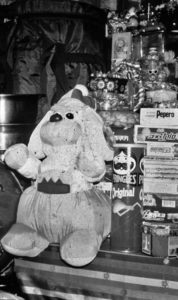
Babe very quickly invokes other deities, the House Lord and the Mountebank, affirming that next year things will be much better. The shamans disassemble the offering food and pack their equipment. Babe gives Mrs. Yi final instructions. She must take some of the white rice cake home and place it in the inner room for the grandmother who honored the Seven Stars:Bow three times saying “You are the grandmother who helped us from long ago.” Tell her you are giving her an offering . . . . and say to the twelve Officials, “Twelve Officials, make us rich.” Then take a sip of wine from each cup and toss some of the wine outside.Mrs. Yi takes notes. Babe gives her other leftover offering food to take home and suggests how she might use it, filling plastic bags with fish, meat, and rice cake. Mrs. Yi looks overwhelmed, perhaps wondering how to deal with this sudden excess and whether it will arouse her husband’s suspicions. Yongsu’s Mother takes care of the gods outside the house and the final send-off of wandering ghosts and noxious influences. She seats Mrs. Yi on the edge of the narrow veranda and exorcises her, pelting her with scraps of food, taking the bundle of clothing offered to the ancestors and wafting it around Mrs. Yi before tossing it away, tearing strips of cloth to release the hold of the dead, brandishing her knife until she is satisfied that Mrs. Yi is clean. As a blind ghost, Yongsu’s Mother rolls back her eyes, takes a frog-like leap, and squats on the ground, tapping with her hand until she finds the basin of water that she must sprinkle on her eyes in order to open them again. For the ghost of a woman who has died in childbirth, she takes a bowl of post-partum soup and bites a huge wad of kelp so that it dangles from her teeth like a long ghostly green tongue. Within minutes, the mansin are in everyday wear, the van packed, and we are on our way home. I ask Mrs. Yi if she feels relieved. She tells me that she does not know what she feels. During the kut, she says, she felt heavy-hearted about all of the things that had gone wrong in her life, but the ancestors understood her feelings and had given her encouragement.
CONCLUSION: MAKING A MYTHIC WORLD
The next day, I asked Yongsu’s Mother about the kut. Was it because the family should have held a kut in the past? Is this why the wife became ill and the husband’s business failed?Yes, more or less. They should have had a kut. The husband’s business failed. He hasn’t worked for three years. They’re just living on debt. Living that way makes a person anxious, they use their nerves, and then, of course they get sick. It’s that way with everyone, isn’t it? You don’t have money and then you fret about it until it makes you ill.Mrs. Yi’s immediate domestic crisis was enmeshed in the gyrations of the South Korean economy in the early 1990s, bad years for precarious small businesses. In the mansin’s terms, Mrs. Yi’s afflictions were, simultaneously, a product of anxiety and frustration and a consequence of her having neglected household gods and ancestors with appropriate rituals and offerings. In the kut, Mrs. Yi experienced the compassion of family ancestors and was encouraged to regard an ancestral grandmother as a long-neglected but potentially helpful household god. Through gods’ play and the tears of ancestors, the kut offered a reason to hope, but conjuring hope for Mrs. Yi was no easy task. Mrs. Yi lacked the accompanying mother, sister, sister-in-law, husband, or neighbor one sometimes sees at shrine kut, much less the knowledgeable village women who might have coached and supported her in decades past. It was the shamans themselves who gradually acculturated Mrs. Yi to the world of kut. She had no prior experience and initially, she had seemed confused and awkward, present only because she was desperate enough to accept a shaman’s advice. The mansin had to construct a mythic world for her, foundation up, and they did this with a mingling of inspiration, skill, and improvisation. They found her an ancestral grandmother as a potentially helpful deity (“You saw a woman in white in a dream. That’s who it was”), a link between household gods and family fortune whose presence they underscored throughout the kut and perpetuated in the household ritual Babe enjoined Mrs. Yi to perform at home. The ancestors articulated the tragedy of her father’s suicide. The Official’s antics gave presence to demanding gods who would also be honored at home. By degrees, the mansin brought Mrs. Yi to the point of weeping, laughing, and talking back to the gods. In this work, the apprentice Babe displayed competence and a developing comic flare, an ability to provoke moist eyes and giggles, but it was the two more experienced shamans, Yongsu’s Mother and Okkyŏng’s Mother, who caused Mrs. Yi to weep and laugh with abandon. Yongsu’s Mother’s comic manifestation of the Official elicited not only belly laughs from her erstwhile bashful client, but drew spectators to the doorway. Perhaps the reader might appreciate, as I learned to do, the skill and resourcefulness with which mansin like Yongsu’s Mother and Okkyŏng’s Mother and their gods continue to work their enchantment for anxious city women like Mrs. Yi in places like the anonymous kuttang.